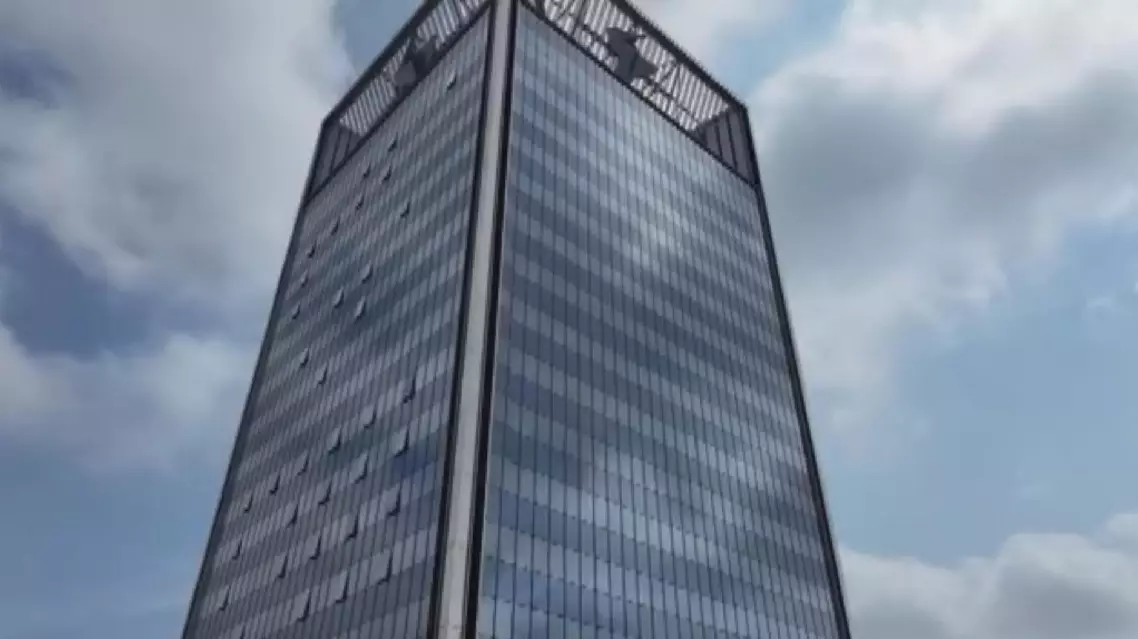
The world's first ultra zero-carbon building was inaugurated on Sunday in Qingdao City, east China's Shandong Province, marking a significant progress in the country's zero-carbon construction push.
With the daily electricity consumption of 6,000 kilowatt-hours, this 117-meter-tall office building is equipped with cutting-edge high-tech solutions to achieve 100 percent green energy substitution.
Unlike conventional buildings with rooftop solar panels, this structure features building-integrated photovoltaic glass curtain walls on its east, south, and west facades.
This directly provides DC electricity, reducing energy loss and supplying 25 percent of the building's energy needs. The carbon emission savings can reach 500 tons annually.
Furthermore, the building utilizes retired EV batteries for energy storage. Fourteen used EV batteries store surplus energy generated by the photovoltaic glass curtain walls and absorb surplus clean energy from the grid during off-peak hours at a low cost of 0.22 yuan per kilowatt-hour.
The stored energy will then be used during peak demand or periods of low sunlight to balance the building's power load.
Inside the building, nearly 24,000 micro-sensors, replacing switches, enable automated operation of lighting, air conditioners, and elevators.
"By consuming green electricity, we can save about 2,500 tons of carbon emissions annually. Digitalization has reduced our investment cost of the building by 20 percent to 30 percent, increased operational efficiency by 30 percent, and lowered energy consumption by about 30 percent," said Yu Dexiang, chairman of TELD New Energy, one of China's largest EV charging pile network operators.
The building also features the world's first fully automated high-speed vertical parking system.
Equipped with a high-precision track system and gear-driven control technology, the innovative system enables swift and precise vehicle movement, with each vehicle being parked to designated area within 35 seconds.
This parking system also incorporates a groundbreaking vehicle-to-grid technology, with parked EVs connecting to the building's power system.
At present, 300 vehicles, each providing 10 kilowatt-hours of electricity daily, can meet nearly half of the building's energy demand.
World's 1st ultra zero-carbon building inaugurated in east China's Shandong