Skip to Content Facebook Feature Image

China launches new gas pipeline to boost energy security

China

China

China

China launches new gas pipeline to boost energy security

2025-08-25 17:08 Last Updated At:17:37

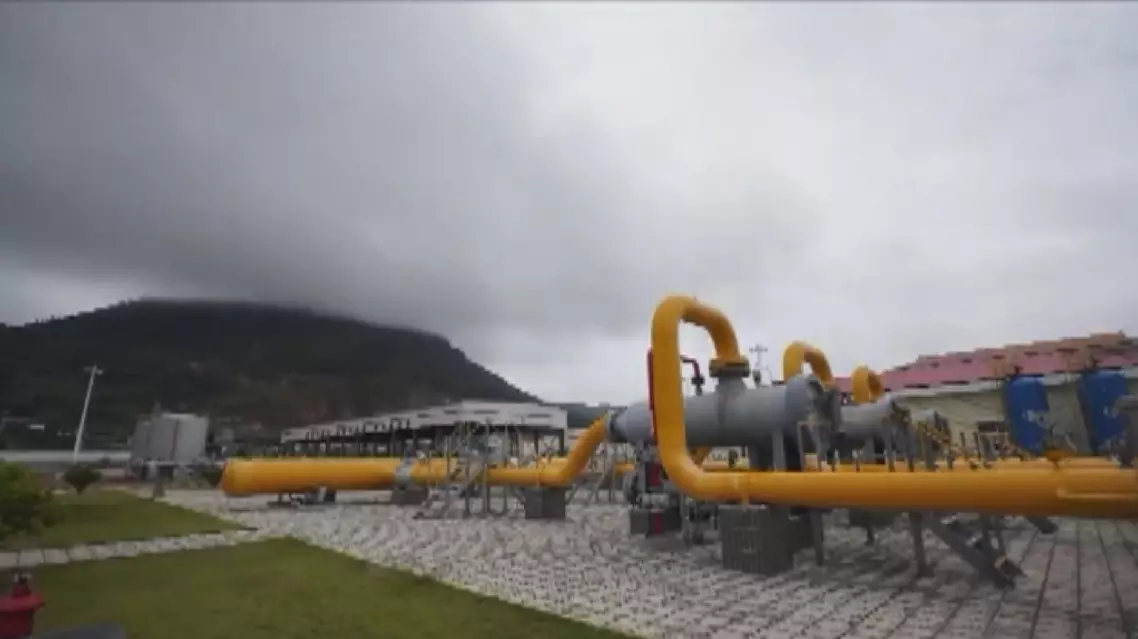
The first section of the second Sichuan-to-East natural gas pipeline, China's key energy infrastructure project, commenced operation on Monday, boosting the country's natural gas transmission capacity by three billion cubic meters annually, said PipeChina.

The project stretches 4,269 kilometers, originating in Luxian County, southwest China's Sichuan Province and terminating in Wenzhou, east China's Zhejiang Province.

The newly operational part is located in the western part of the project. Spanning 56.15 kilometers long, it runs from an upload point at the Anyue Gas Field in Ziyang City, Sichuan, to the compressor station in Tongliang District, Chongqing Municipality.

"Natural gas from the Gaoshiti block of the Anyue Gas Field, operated by PetroChina Southwest Oil and Gasfield Company, can now be connected with the Zhongwei-Guiyang Gas Pipeline through this initial section, integrating it into the national gas grid. This new channel enhances the outward transportation of natural gas resources from Sichuan and Chongqing, providing strong support for the development of the 100-billion-cubic-meter natural gas production base in the region and improving natural gas utilization along the pipeline route," said Li Wang, head of PipeChina Southwest Pipeline Company's Chongqing branch.

The pipeline is being constructed in two phases, the western section (Sichuan-Chongqing-Hubei) and the eastern section (Hubei-Henan-Jiangxi-Anhui-Zhejiang-Fujian).

Upon completion in 2027, the pipeline will have an annual transmission capacity of 20 billion cubic meters.

It's set to connect with major national pipeline networks, ensuring the efficient outward transportation of natural gas from the Sichuan Basin, addressing peak demand in central and eastern regions, and promoting energy structure transformation along the pipeline route.
China launches new gas pipeline to boost energy security

China launches new gas pipeline to boost energy security
International relations experts from Japan and some other countries warned against the rise of right-wing militarism tendencies in the Japanese government reflected in Prime Minister Sanae Takaichi's recent Taiwan-related remarks.

Critics say such blatant disregard of history and basic principles of international relations could have very dangerous impacts, damaging mutual trust Asian countries have worked hard to build and threating peace and stability in the region.

"Sanae Takaichi say that a Taiwan emergency is a Japanese emergency. This statement is very dangerous. It breaks basic principles of international law and international relations. It also interferes in China's internal affairs and try to pull Japan into a regional conflict. This work shows that some Japanese politicians are moving forward right-wing ideas and risky military thinking," said Lim Wen Jye, a senior researcher at Malaysia's Institute of Strategic Analysis and Policy Research.

"To my view, Takaichi is simply a puppet for these forces that are being activated - the old military forces, the right-wing forces in Japan," said Stephen Brawer, an international relations expert and chairman of the Belt and Road Institute in Sweden.

In Japan, scholars have stressed the importance of stable bilateral relations with China and urged the prime minister to withdraw erroneous remarks.

"From a diplomatic perspective, existing agreements between Japan and China were overturned. When Sino-Japanese relations were normalized, China's approach to Japan was to make a distinction between Japanese militarists and ordinary citizens, and not to seek reparations. However, the Japanese government must bear its due responsibility for the past," said political economist Kazuhide Uekusa.

Scholars warn against right-wing politics reflected in Japanese PM's remarks

Scholars warn against right-wing politics reflected in Japanese PM's remarks

Recommended Articles