
Skip to Content Facebook Feature Image

York Space Systems Completes Delivery of 21 Satellites for Tranche 1 Launch

News

York Space Systems Completes Delivery of 21 Satellites for Tranche 1 Launch
News

News

York Space Systems Completes Delivery of 21 Satellites for Tranche 1 Launch

2025-08-26 23:23 Last Updated At:23:50

DENVER--(BUSINESS WIRE)--Aug 26, 2025--

York Space Systems (York), a defense technology company transforming how the United States builds and operates space-based capabilities, today announced the completion and shipment of its final spacecraft to the launch site for the upcoming Tranche 1 Transport Layer launch. A total of 21 York-built satellites—comprising the full payload of the launch vehicle—will lift off by the end of this summer, marking the on-orbit debut of the first generation of the Space Development Agency’s (SDA) Proliferated Warfighter Space Architecture (PWSA) directly supporting warfighters in the field.

This press release features multimedia. View the full release here: https://www.businesswire.com/news/home/20250825644634/en/

All 21 spacecraft were manufactured and delivered at scale from York’s production facilities, underscoring the company’s ability to produce highly capable national security satellites with speed, precision, and consistency. This milestone demonstrates the transition from bespoke legacy architectures to a scalable industrial model designed to meet modern threats head-on.

“This launch marks the operational beginning of a new era in national security space, one defined by responsiveness, capacity, and real-world performance,” said Melanie Preisser, VP and GM of York. “York is proud to be the first to deliver and launch spacecraft for Tranche 1, helping bring SDA’s vision to life with highly capable systems built at unmatched production rates. This is how the future of military space gets fielded.”

The Tranche 1 mission represents a historic pivot from experimentation to enduring capability. SDA’s low-Earth orbit constellation is designed to provide secure, resilient communications and data transport for U.S. and allied warfighters, at a fraction of the cost and time of traditional defense prime contractors.

“Our satellites are built, delivered, and ready for launch, now all that’s left is integration with the rocket,” added Preisser. “Once deployed, these systems will provide on-orbit Link 16 connectivity to the warfighter.”

This launch builds on a year of rapid and measurable progress for York. In the past few months alone, the company successfully launched its Dragoon mission and then followed just weeks later with the BARD mission, demonstrating next-generation communications capabilities for NASA. With Tranche 1, York continues to accelerate the timeline from customer request to delivery on orbit, demonstrating what can be accomplished when speed and capability are demanded by the government customer and built into the very foundation of the performing prime.

York’s proven ability to deliver highly capable spacecraft at scale and on compressed timelines positions the company as a leading contender to serve as an integrated prime provider for the U.S. Space Force’s defense programs. With a demonstrated track record in mass production, rapid deployment, and seamless integration of space and ground systems, York offers the scale, technical depth, and operational readiness needed to execute on the program’s ambitious vision for a fully integrated, resilient national security space architecture.

About York Space Systems

York Space Systems is a defense technology company transforming how the United States builds and operates space-based capabilities. As the leading provider of proliferated warfighter space solutions, York routinely delivers fully integrated, mission-ready systems, combining high-performance spacecraft, software-defined operations, and ground-based autonomy, at unmatched speed and value.

With a foundation in high-rate manufacturing and systems-level integration, York is driving the convergence of hardware, software, and mission autonomy to redefine how the U.S. executes national defense from space. By enabling real-time intelligence and resilient, scalable infrastructure, York empowers a smarter, faster, and more adaptive defense posture. Learn more at http://www.YorkSpaceSystems.com.
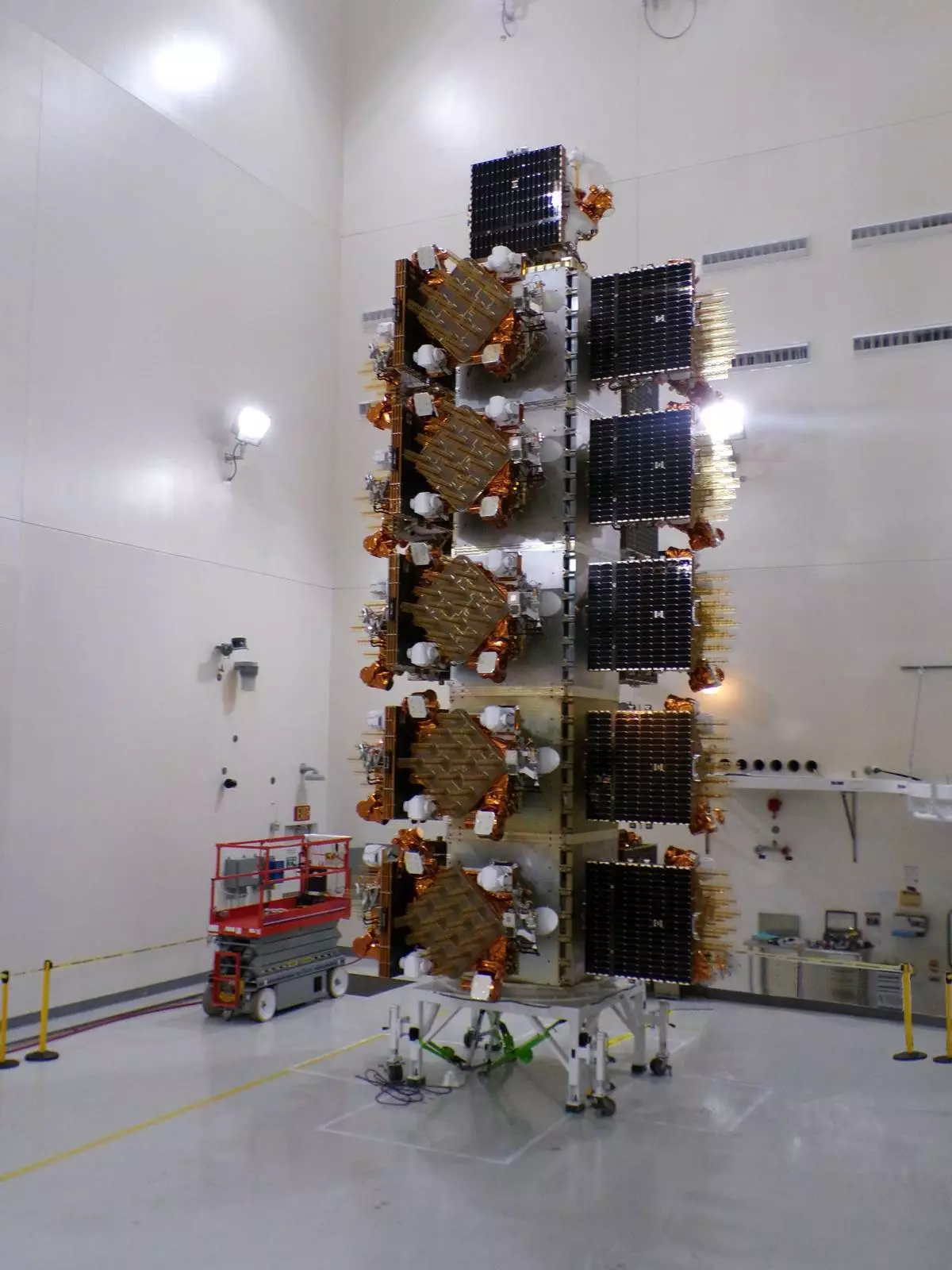
21 satellites manufactured by York Space Systems for Space Development Agency's upcoming Tranche 1 Transport Layer launch.


21 satellites manufactured by York Space Systems for Space Development Agency's upcoming Tranche 1 Transport Layer launch.

WASHINGTON (AP) — The U.S. Commission of Fine Arts on Thursday approved the design for the triumphal arch that President Donald Trump wants built at an entrance to the nation's capital, a key step in the project's process.

Commissioners, all appointed by Trump, acted despite overwhelming public opposition to the 250-foot arch, one of several projects that Trump is pursuing alongside a White House ballroom to leave his imprint on Washington.

“The building is beautiful,” the commission's chairman, Rodney Mims Cook Jr., said shortly before the vote on a design revised slightly from what was presented to the federal agency in April.

The arch would stand 250 feet tall (76 meters) from its base to a torch held aloft by a Lady Liberty-like figure on top of the structure. The statue would be flanked on top by two gilded eagles, but the four lions envisioned as guarding the base are now gone. The phrases “One Nation Under God” and “Liberty and Justice for All” would be inscribed in gold lettering atop either side of the monument.

A public observation deck on top would provide 360-degree views of the surroundings.

The commission’s vice chairman, architect James McCrery II, said in April that he preferred the arch without the figures on top, which would have reduced the arch's height by about 80 feet (24.4 meters). Critics of the project argue that the arch would dominate the skyline and disrupt views from the Lincoln Memorial to Arlington National Cemetery.

The arch would dwarf the Lincoln Memorial, which is 99 feet (30 meters) tall, and be close to half the height of the Washington Monument, an obelisk that is about 555 feet (169 meters) tall.

Commissioners were told at Thursday's meeting that Trump considered the suggestion to remove the statue “but elected not to pursue such an option.”

McCrery recommended doing away with the lions on the base and objected to plans for an underground tunnel for pedestrians to get to the arch, which would be built on a traffic circle. Both design elements have been removed.

Preliminary surveys and testing of the site began last week.

A group of veterans and a historian have sued the Trump administration in federal court to block construction on grounds that the arch would disrupt the sightline between the Lincoln Memorial and Arlington House at Arlington National Cemetery, among other reasons.

The Republican president and his interior secretary, Doug Burgum, have argued that Washington is the only major Western world capital without such an arch. Burgum's department includes the National Park Service, which manages the plot where Trump wants to put the arch.

The president has said some of his other projects, such as adding a blue coating to the interior of the Lincoln Memorial Reflecting Pool, will beautify the city in time for July 4 celebrations of America’s 250th birthday.

Trump's rehab of the Reflecting Pool is also the subject of a court challenge brought by The Cultural Landscape Foundation, which said the administration’s moves to repaint the bottom of the Reflecting Pool blue without first undergoing relevant reviews ran afoul of federal preservation laws governing historic sites.

The nonprofit group argued in a lawsuit filed last week that the changes at the Reflecting Pool are part of Trump’s broader effort to push through dramatic renovations in Washington without proper reviews and undermine the tone of the area.

A hearing in the case was scheduled for later Thursday in federal court in Washington.

Flags placed by workers are pictured in the Memorial Circle, where President Donald Trump has proposed building an arch to commemorate the United States' 250th anniversary, Friday, May 15, 2026, in Washington. (AP Photo/Jacquelyn Martin)

Flags placed by workers are pictured in the Memorial Circle, where President Donald Trump has proposed building an arch to commemorate the United States' 250th anniversary, Friday, May 15, 2026, in Washington. (AP Photo/Jacquelyn Martin)

The Memorial Circle, where President Donald Trump has proposed building an arch to commemorate the United States' 250th anniversary is seen, Tuesday, May 19, 2026, in Washington. (AP Photo/Alex Brandon)

The Memorial Circle, where President Donald Trump has proposed building an arch to commemorate the United States' 250th anniversary is seen, Tuesday, May 19, 2026, in Washington. (AP Photo/Alex Brandon)

Recommended Articles