Formula 1's newest team began its quest to expand the grid with a plan to become a true American team that featured a driver representing the red, white and blue.
Yet when Cadillac F1 finally unveiled its inaugural lineup it was Valtteri Bottas and Sergio Pérez, drivers from Finland and Mexico, respectively.
Michael Andretti started this project in 2021 with plans to put IndyCar driver Colton Herta of California in the seat: American driver, American team, American car and an American engine. But Andretti was bought out by Dan Towriss of TWG Global, and TWG Motorsports owns this team.
Towriss said in May at the Miami Grand Prix there remains a desire to get an American driver in one of the seats, but only when one is ready. Herta doesn't have the super license required to compete in F1, Towriss noted, and a new team learning a new car requires experienced and steady drivers.
Few believe Cadillac will be competitive out of the gate, so it was necessary to go with drivers willing to set their egos aside for the sake of building a program. Bottas and Pérez don't have seats this year, and both said they were willing to sacrifice wins and even points to be part of a project as monumental as what Cadillac is trying to do in expanding the F1 grid to an 11th team next year.
“The more I was talking to the Cadillac team, the more it became apparent that this is what excites me,” Pérez said. “It's not going back to the grid with a regular team to fight for wins and podiums, it's a project itself.”
Bottas was not a subtle suitor and even made a social media video two months ago captioned “Do we like this seat?” and gave a tour of a Cadillac. Shortly before the announcement dropped Tuesday, he posted an image of himself in a tuxedo, on a surfboard, waving an American flag and carrying a green can. It wasn't AI, either: behind the scenes footage showed the surfboard being towed by a small craft, Bottas once even losing his balance and falling into the water.
“We don't need to prove anything to anyone, so we get to put team first,” said Bottas. “That's what we're here for and that's probably one of the biggest reasons why we were the chosen ones. We're competitors, we're going to drive as fast as we can. We want to perform the best we can. But we have very clear priorities on this project.”
Cadillac F1 does hope to have a driver from the United States as part of its lineup, but who knows how long it could take.
Herta has been trying to earn enough points in IndyCar to secure the super license, but four seasons have passed since this began and he still doesn't have one. Now there's speculation Towriss may move him to F2, an idea Herta and Towriss both declined to address.
“Oh boy, I don’t really have any comments for any of that stuff, to be honest,” Herta told AP.
Herta, who turns 26 early next year, began the IndyCar season saying he wasn't even sure he wanted to go to F1 because he loved his IndyCar team so much. Now he won't even talk about it, so perhaps there's still a desire to eventually get him on the F1 grid.
Either way, Cadillac team principal Graeme Lowdon said the team plans to field cars in F1's feeder series' eventually, as well as a young driver program. Towriss already supports Sebastian and Oliver Wheldon, the young sons of the late Andretti driver, Dan Wheldon.
Don't rule out the possibility of Sebastian Wheldon, a Floridian who turns 17 next year and currently races internationally.
But, all parties insisted, there is no rush, only an awareness that there is hope Cadillac will some day field an American driver.
“We know from feedback from fans that fans would love to see an American driver in an American team with an American engine, as well,” Lowdon said. “These things are all things that could well happen. I see no barrier to seeing that combination in the future.”
AP auto racing: https://apnews.com/hub/auto-racing

Graeme Lowdon, the team principal of the new Formula One team Cadillac, talks to The Associated Press during an interview at the Silverstone racetrack, ahead of the British Formula One Grand Prix, in Silverstone, England, Sunday, July 6, 2025. (AP Photo/Darko Bandic)

FILE - Colton Herta prepares to drive during qualifications for the Indianapolis 500 auto race at Indianapolis Motor Speedway in Indianapolis, May 17, 2025. (AP Photo/Michael Conroy, File)
BEIJING (AP) — In China, the names of things are often either ornately poetic or jarringly direct. A new, wildly popular app among young Chinese people is definitively the latter.
It's called, simply, “Are You Dead?"
In a vast country whose young people are increasingly on the move, the new, one-button app — which has taken the country by digital storm this month — is essentially exactly what it says it is. People who live alone in far-off cities and may be at risk — or just perceived as such by friends or relatives — can push an outsized green circle on their phone screens and send proof of life over the network to a friend or loved one. The cost: 8 yuan (about $1.10).
It's simple and straightforward — essentially a 21st-century Chinese digital version of those American pendants with an alert button on them for senior citizens that gave birth to the famed TV commercial: “I've fallen, and I can't get up!”
Developed by three young people in their 20s, “Are You Dead?” became the most downloaded paid app on the Apple App Store in China last week, according to local media reports. It is also becoming a top download in places as diverse as Singapore and the Netherlands, Britain and India and the United States — in line with the developers' attitude that loneliness and safety aren't just Chinese issues.
“Every country has young people who move to big cities to chase their dreams,” Ian Lü, 29, one of the app's developers, said Thursday.
Lü, who worked and lived alone in the southern city of Shenzhen for five years, experienced such loneliness himself. He said the need for a frictionless check-in is especially strong among introverts. “It's unrealistic,” he said, “to message people every day just to tell them you're still alive.”
Against the backdrop of modern and increasingly frenetic Chinese life, the market for the app is understandable.
Traditionally, Chinese families have tended to live together or at least in close proximity across generations — something embedded deep in the nation's culture until recent years. That has changed in the last few decades with urbanization and rapid economic growth that have sent many Chinese to join what is effectively a diaspora within their own nation — and taken hundreds of millions far from parents, grandparents, aunts and uncles.
Today, the country has more than 100 million households with only one person, according to an annual report from the National Bureau of Statistics of China in 2024.
Consider Chen Xingyu, 32, who has lived on her own for years in Kunming, the capital of southern China’s Yunnan province. “It is new and funny. The name ’Are You Dead?' is very interesting,” Chen said.
Chen, a “lying flat” practitioner who has rejected the grueling, fast-paced career of many in her age group, would try the app but worries about data security. “Assuming many who want to try are women users, if information of such detail about users gets leaked, that’d be terrible,” she said.
Yuan Sangsang, a Shanghai designer, has been living on her own for a decade and describes herself as a “single cow and horse.” She's not hoping the app will save her life — only help her relatives in the event that she does, in fact, expire alone.
"I just don’t want to die with no dignity, like the body gets rotten and smelly before it is found," said Yuan, 38. “That would be unfair for the ones who have to deal with it.”
While such an app might at first seem best suited to elderly people — regardless of their smartphone literacy — all reports indicate that “Are You Dead?” is being snapped up by younger people as the wry equivalent of a social media check-in.
“Some netizens say that the 'Are you dead?' greeting feels like a carefree joke between close friends — both heartfelt and gives a sense of unguarded ease,” the business website Yicai, the Chinese Business Network, said in a commentary. ""It likely explains why so many young people unanimously like this app."
The commentary, by writer He Tao, went further in analyzing the cultural landscape. He wrote that the app's immediate success “serves as a darkly humorous social metaphor, reminding us to pay attention to the living conditions and inner world of contemporary young people. Those who downloaded it clearly need more than just a functional security measure; they crave a signal of being seen and understood.”
Death is a taboo subject in Chinese culture, and the word itself is shunned to the point where many buildings in China have no fourth floor because the word for “four” and the word for “death” sound the same — “si.” Lü acknowledged that the app's name sparked public pressure.
“Death is an issue every one of us has to face,” he said. “Only when you truly understand death do you start thinking about how long you can exist in this world, and how you want to realize the value of your life.”
A few days ago, though, the developers said on their official account on China’s Weibo social platform that they’d pivot to a new name. Their choice: the more cryptic “Demumu,” which they said they hoped could "serve more solo dwellers globally.”
Then, a twist: Late Wednesday, the app team posted on its Weibo account that workshopping the name Demumu didn’t turn out “as well as expected.” The app team is offering a reward for whoever offers a new name that will be picked this weekend. Lü said more than 10,000 people have weighed in.
The reward for the new moniker: $96 — or, in China, 666 yuan.
Fu Ting reported from Washington. AP researcher Shihuan Chen in Beijing contributed.

The app Are You Dead? is seen on a smartphone in Beijing, China, Thursday, Jan. 15, 2026. (AP Photo/Ng Han Guan)

A woman looks at her smartphone in a cafe in Beijing, China, Thursday, Jan. 15, 2026. (AP Photo/Ng Han Guan)
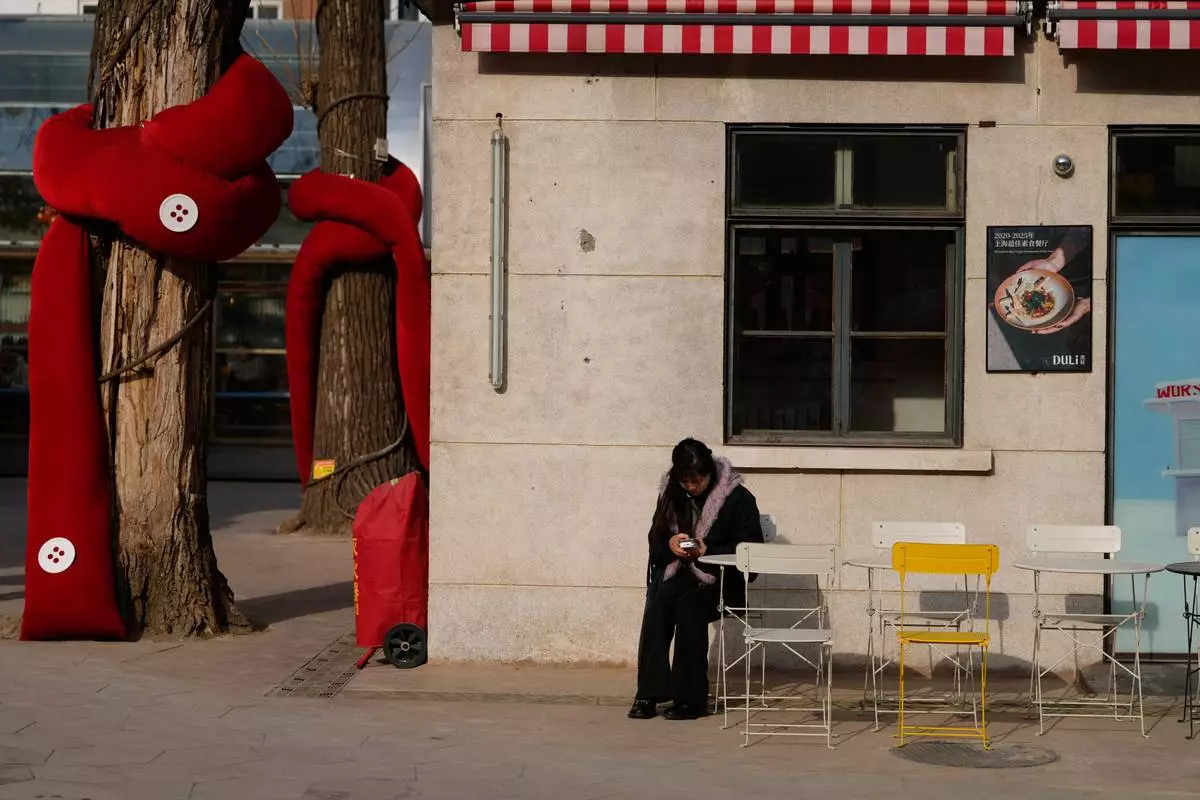
A woman looks at her smartphone outside a restaurant in Beijing, China, Thursday, Jan. 15, 2026. (AP Photo/Ng Han Guan)

A man looks down near his smartphone in Beijing, China, Thursday, Jan. 15, 2026. (AP Photo/Ng Han Guan)
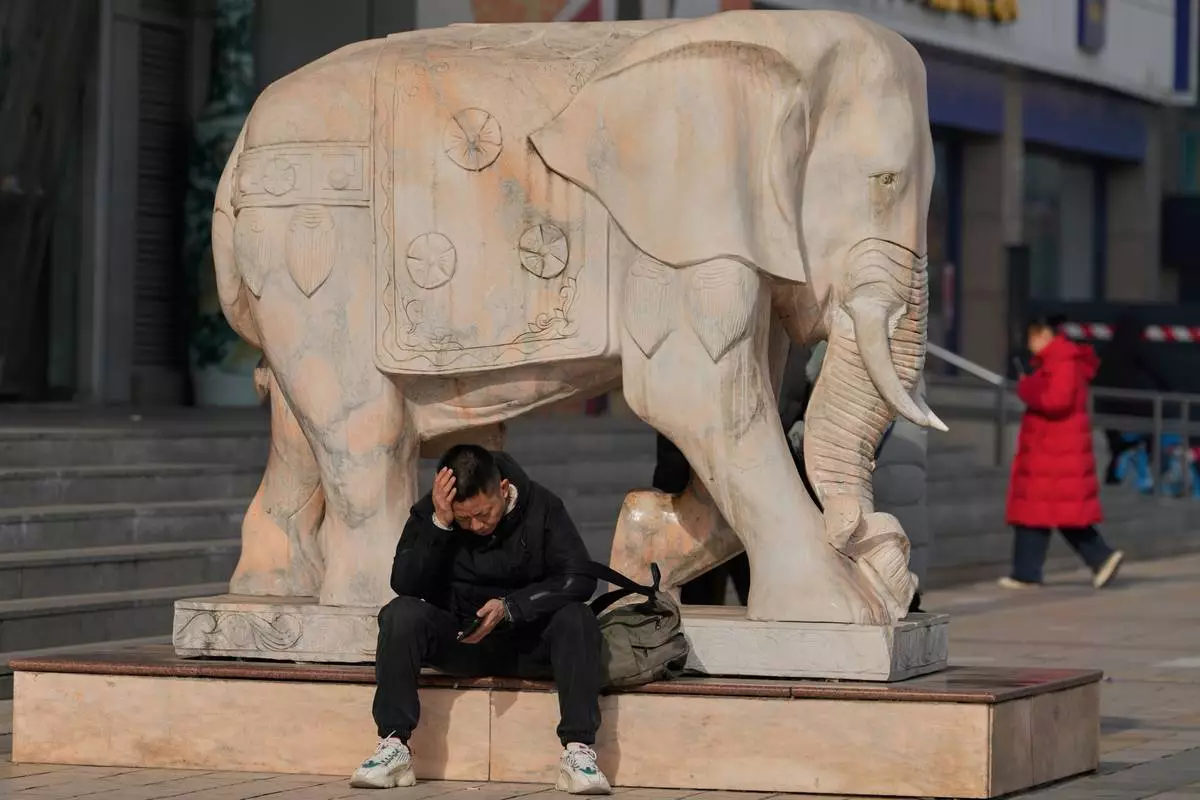
A man reacts while holding his smartphone in Beijing, China, Thursday, Jan. 15, 2026. (AP Photo/Ng Han Guan)