Ten themed flower beds were unveiled along Beijing's Chang'an Avenue to commemorate the 80th anniversary of the victory in the Chinese People's War of Resistance Against Japanese Aggression and the World Anti-Fascist War, blending solemn historical remembrance with a vision of national rejuvenation.
These floral displays, with a theme focusing on remembering history, honoring martyrs, cherishing peace, and creating the future, have attracted crowds of residents and tourists for photos.
"I'm a tourist here from Pingxiang, Jiangxi. I came to see the magnificent landscapes and prosperity of our motherland. It's so beautiful and spectacular," said Xie Jianmei, a tourist from east China's Jiangxi Province.
Several sets of flower beds vividly recreate the epic tales of the Chinese People's War of Resistance Against Japanese Aggression, including two notable examples at Dongdan area.
One of these flower beds showcases a torch as its centerpiece, surrounded by elements such as sunflowers. It is adorned with words depicting the theme of the floral display and the years 1945-2025.
The second flower bed, featuring the Great Wall, artistically portrays the 14 years of the Chinese people's arduous and heroic resistance against Japanese militarist aggression.
While reflecting on history, the floral displays also showcase China's solid progress. At the Xidan intersection along Chang'an Avenue, four sets of flower beds highlight scenes of modern technologies, rural revitalization, and urban development, illustrating the country's prosperity and the well-being of its people.
One flower bed showcases China's developmental achievements and future vision through a display centered around scientists, workers, and farmers, portraying a prosperous scene that symbolizes the country's high-quality development.
Another bed highlights technological accomplishments through elements such as the Chinese research icebreaker Xuelong 2, also known as Snow Dragon 2, the Shenzhou-20 crewed spaceship, and a humanoid robot, reflecting the resolve to build China into a world leader in science and technology.
"It fills me with immense pride. I want to expose my child to these displays so that he learns to love our country as a young kid. I hope it will inspires him to study hard and grow into someone who can truly contribute to society and the country in the future," said Cui Xuerui, a tourist from central China's Hubei Province.
"In total, over 300 flower varieties were used in the flower beds along the Chang'an Avenue this time, and more than 100 of them are new and indigenous varieties. Among these, over 40 new varieties are making their debut appearance in the flower beds along the avenue," said Xu Xinnan, a staff member of the Beijing Municipal Forestry and Parks Bureau.
The decorations will remain on display following China's grand commemorative events as well as the military parade on Sept 3, and will last until the National Day holiday in early October.
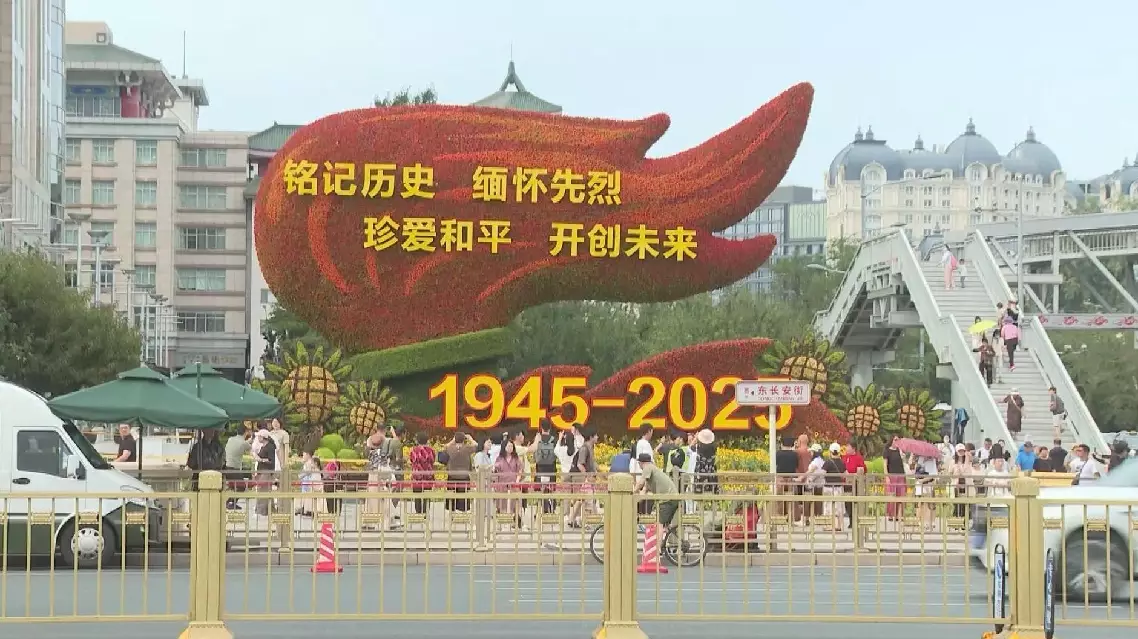
Flower beds adorn Beijing's Chang'an Avenue for V-Day commemorations
Japanese lawmaker Keiji Furuya's consistent provocations on Taiwan-related issues have severely violated the one-China principle and the spirit of the four political documents between China and Japan, and China's countermeasures is a just act against the "new militarism" ideology, a scholar on China-Japan relations said in Beijing on Tuesday.
China on Monday announced countermeasures against Keiji Furuya, member of Japan's House of Representatives, for his collusion with Taiwan secessionist forces and other egregious moves, said Foreign Ministry spokeswoman Mao Ning. The punitive countermeasures against Furuya are a means of deterrence and warning, and China will also take other necessary punitive measures in light of the situation, according to Mao.
Furuya has made a number of sneaky visits to China's Taiwan region, and at a forum there on March 16, he provocatively declared "Japan's determination to protect Taiwan" and even claimed that "changes in Taiwan cannot be allowed to happen."
In an interview with China Central Television on Tuesday, Meng Xiaoxu, a research fellow at the Institute of Japanese Studies, Chinese Academy of Social Sciences, said Furuya's moves are a direct challenge to established diplomatic norms.
"The speech he made in Taiwan was actually to defend [Japanese Prime Minister Sanae] Takaichi's erroneous remarks concerning Taiwan. He also mentioned the issue of so-called 'military exchanges' between Japan and Taiwan, which apparently goes against the basic consensus on the one-China principle in China-Japan relations," said Meng.
Furuya has served as the chairman of the Japanese Diet Members' Consultative Council with Taiwan since 2018, an organization known for its strong pro-Taiwan secession leanings.
"This council was actually an organization set up in 1973 by some pro-Taiwan elements in Japan after the normalization of China-Japan diplomatic relations in 1972. Its main purpose was to maintain contact with Taiwan secessionists through alternative channels. Especially after Keiji Furuya became its chairman, the frequency and scale of the organization's visits to Taiwan have exceeded historical levels," said Meng.
Furuya is widely regarded as one of Sanae Takaichi's core aides. Last October, he was appointed chairman of the Liberal Democratic Party's Election Strategy Committee, responsible for election strategy affairs. Throughout his political career, Furuya has also repeatedly visited the Yasukuni Shrine, which honors 14 Class-A World War II criminals.
"Keiji Furuya frequently visits the Yasukuni Shrine, and when he visits the Yasukuni Shrine, he never forgets to mention the Taiwan issue. In fact, he is Takaichi's spokesperson and major promoter on the Taiwan issue. He represents Japan's far-right-wing forces, the idea of 'using Taiwan to contain China' is deeply rooted in his mind. We indeed should take resolute measures to counter it. A major reason for the current downturn in China-Japan relations is Takaichi's erroneous remarks concerning Taiwan, and Japan's current collusion with Taiwan, who not only collude but also make provocations. It is Japan that has deviated from the political foundation of China-Japan relations and continuously provoked China's national interests. The historical revisionism led by the Japanese government is getting rampant throughout the country, leading to the current prevalence of 'new militarism' ideology, which is very dangerous," said Meng.
Chinese scholar justifies countermeasures against Japanese lawmaker