WASHINGTON (AP) — A federal appeals court ruled Friday that President Donald Trump had no legal right to impose sweeping tariffs on almost every country on earth but left in place for now his effort to build a protectionist wall around the American economy.
The ruling from the U.S. Court of Appeals for the Federal Circuit found Trump overstepped his authority under an emergency powers law, a major legal blow that largely upheld a May decision by a specialized federal trade court in New York.
“It seems unlikely that Congress intended to … grant the President unlimited authority to impose tariffs,” the judges wrote in a 7-4 ruling.
But they did not strike down the tariffs immediately, allowing his administration until mid-October to appeal to the Supreme Court.
The president vowed to do just that. “If allowed to stand, this Decision would literally destroy the United States of America,” Trump wrote on his social media platform.
White House spokesman Kush Desai said Trump had acted lawfully, and “we look forward to ultimate victory on this matter.”
An attorney for small businesses affected by the tariffs, meanwhile, said the ruling shows Trump doesn't have unlimited power to impose tariffs on his own. “This decision protects American businesses and consumers from the uncertainty and harm caused by these unlawful tariffs,” said Jeffrey Schwab, director of litigation at the Liberty Justice Center.
Still, it remains unclear whether businesses will see any effects from the decision, said National Foreign Trade Council President Jake Colvin.
“If these tariffs are ultimately struck down, it ought to serve as a wake up call for Congress to reclaim its constitutional mandate to regulate duties and bring some long-term certainty for U.S. businesses and relief for consumers,” Colvin said.
Democratic Sen. Ron Wyden of Oregon said he plans to force votes on “repealing these harmful, regressive taxes at every opportunity.”
The ruling complicates Trump’s ambitions to upend decades of American trade policy completely on his own. Trump has alternative laws for imposing import taxes, but they would limit the speed and severity with which he could act. His tariffs — and the erratic way he’s rolled them out — have shaken global markets, alienated U.S. trading partners and allies and raised fears of higher prices and slower economic growth.
But he’s also used the levies to pressure the European Union, Japan and other countries into accepting one-sided trade deals and to bring tens of billions of dollars into the federal Treasury to help pay for the massive tax cuts he signed into law July 4.
“The administration could lose a pillar of its negotiating strategy,” Ashley Akers, senior counsel at the Holland & Knight law firm and a former Justice Department trial lawyer, said before the appeals court decision.
A dissent from the judges who disagreed with Friday’s ruling clears a possible legal path for Trump, concluding that the 1977 law allowing for emergency actions “is not an unconstitutional delegation of legislative authority under the Supreme Court’s decisions,” which have allowed the legislature to grant some tariff authorities to the president.
The government has argued that if the tariffs are struck down, it might have to refund some of the import taxes that it’s collected, delivering a financial blow to the U.S. Treasury.
Revenue from tariffs now totals $159 billion, more than double what it was at the same point the year before. Indeed, the Justice Department warned in a legal filing this month that revoking the tariffs could mean “financial ruin" for the United States.
“For all the tariffs that have been collected under IEEPA, you’re going to see folks request refunds and more refunds,” said trade attorney Ryan Majerus, a partner at King & Spalding and a former White House economic adviser.
Attorney General Pam Bondi, meanwhile, accused the judges of interfering with the president's central role in foreign policy and vowed to appeal.
The ruling involves two sets of import taxes, both of which Trump justified by declaring a national emergency under the 1977 International Emergency Economic Powers Act (IEEPA):
— The sweeping tariffs he announced April 2 — “Liberation Day,” he called it — when he imposed “reciprocal” tariffs of up to 50% on countries with which the United States runs trade deficits and a “baseline” 10% tariff on just about everyone else. Those tariff rates have since been revised by Trump, in some cases after trade negotiations, and generally went into effect Aug. 7.
The national emergency underlying the tariffs, Trump said, was the long-running gap between what the U.S. sells and what it buys from the rest of the world. The president started to levy modified tariff rates in August, but goods from countries with which the U.S. runs a surplus also face the taxes.
— The “trafficking tariffs” he announced Feb. 1 on imports from Canada, China and Mexico and later refined. These were designed to get those countries to do more to stop what he declared a national emergency: the illegal flow of drugs and immigrants across their borders into the United States. The Constitution gives Congress the power to impose taxes, including tariffs. But over the decades, lawmakers have ceded authority to the president, and Trump has made the most of the power vacuum.
But Trump’s assertion that IEEPA essentially gives him unlimited power to tax imports quickly drew legal challenges — at least seven cases. No president had ever used the law to justify tariffs, though IEEPA had been used frequently to impose export restrictions and other sanctions on U.S. adversaries such as Iran and North Korea.
The plaintiffs argued that the emergency power law does not authorize the use of tariffs.
They also noted that the trade deficit hardly meets the definition of an “unusual and extraordinary” threat that would justify declaring an emergency under the law. The United States, after all, has run trade deficits — in which it buys more from foreign countries than it sells them — for 49 straight years and in good times and bad.
The Trump administration argued that courts approved President Richard Nixon’s emergency use of tariffs in a 1971 economic crisis that arose from the chaos that followed his decision to end a policy linking the U.S. dollar to the price of gold. The Nixon administration successfully cited its authority under the 1917 Trading With the Enemy Act, which preceded and supplied some of the legal language used in IEEPA.
In May, the U.S. Court of International Trade in New York rejected the argument, ruling that Trump’s Liberation Day tariffs “exceed any authority granted to the President” under the emergency powers law. In reaching its decision, the trade court combined two challenges — one by five businesses and one by 12 U.S. states — into a single case.
In the case of the drug trafficking and immigration tariffs on Canada, China and Mexico, the trade court ruled that the levies did not meet IEEPA’s requirement that they “deal with” the problem they were supposed to address.
The court challenge does not cover other Trump tariffs, including levies on foreign steel, aluminum and autos that the president imposed after Commerce Department investigations concluded that those imports were threats to U.S. national security.
Nor does it include tariffs that Trump imposed on China in his first term — and President Joe Biden kept — after a government investigation concluded that the Chinese used unfair practices to give their own technology firms an edge over rivals from the United States and other Western countries.
Trump could potentially cite alternative authorities to impose import taxes, though they are more limited. Section 122 of the Trade Act of 1974, for instance, allows the president to tax imports from countries with which the U.S. runs big trade deficits at 15% for 150 days.
Likewise, Section 301 of the same 1974 law allows the president to tax imports from countries found to have engaged in unfair trade practices after an investigation by the Office of the U.S. Trade Representative. Trump used Section 301 authority to launch his first-term trade war with China.
Associated Press writers Mark Sherman and Josh Boak contributed to this story.
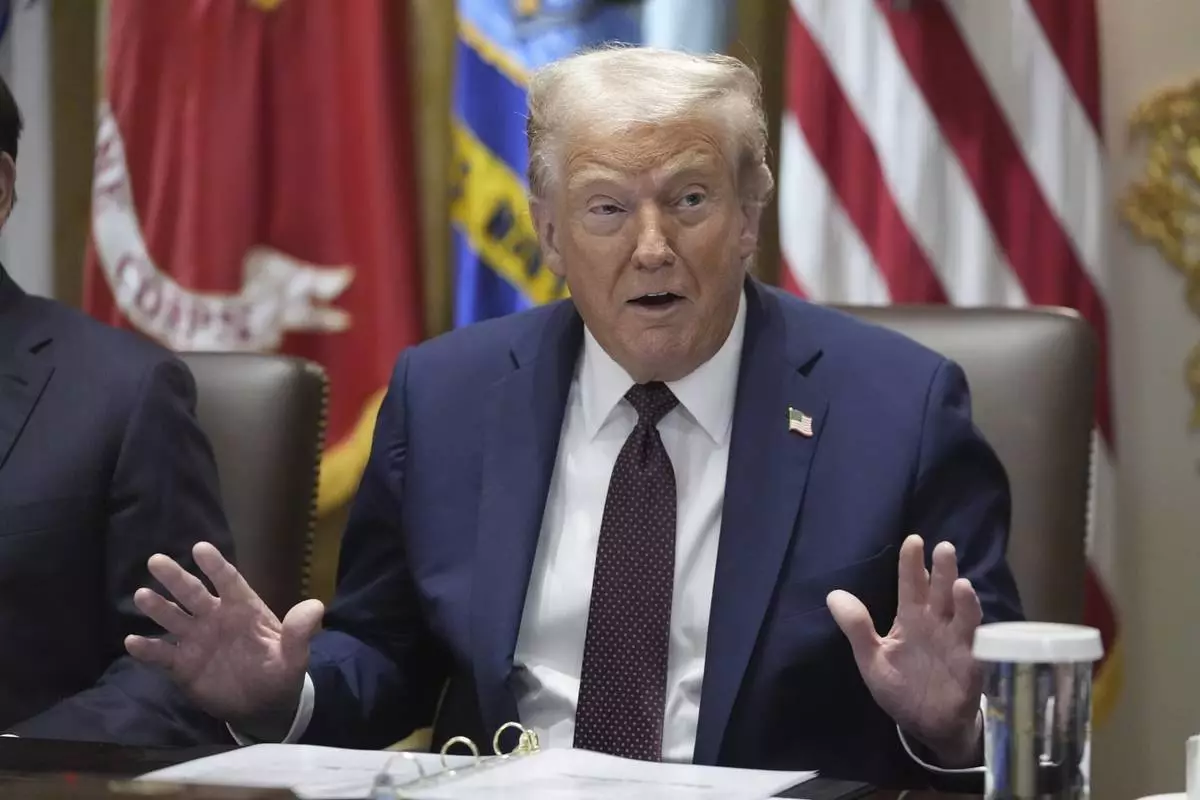
President Donald Trump speaks during a cabinet meeting, Tuesday, Aug. 26, 2025, at the White House in Washington. (AP Photo/Mark Schiefelbein)