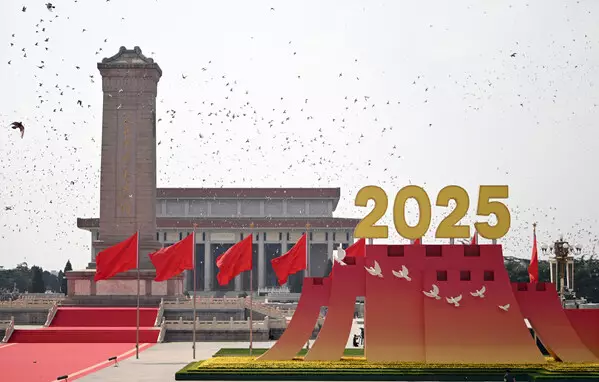
BEIJING, Sept. 3, 2025 /PRNewswire/ -- Only when nations across the world treat each other as equals, live in harmony and mutually support one another can common security be safeguarded, the root cause of war eliminated, and historical tragedies prevented from recurring, said Chinese President Xi Jinping on September 3, at a grand commemorative gathering in Beijing marking the 80th anniversary of victory in the Chinese People's War of Resistance Against Japanese Aggression and the World Anti-Fascist War.
The resistance war (1931-45) is more than a chapter in national memory, it is a cornerstone of the global victory in the World Anti-Fascist War, or World War II (WWII). As the world observes the 80th anniversary of that triumph this year, and with it the founding of the United Nations (UN), commemoration must be seen as more than ceremony. It is a call to remember that the rules, institutions and agreements forged from the ashes of catastrophe were designed with a single purpose: to ensure that such devastation never returns.
The UN was born to write a new page in global governance, and eight decades later, this page is smudged by turbulence and a crisis of confidence. History has taught us that when the international system reaches a crossroads, we must all commit ourselves to peaceful coexistence and cooperation.
China, a country that bore immense wartime suffering, emerged from the ruins with a solemn promise to uphold international order. Over the decades, it has remained true to that promise, assuming greater responsibilities in global peacekeeping, climate action, development cooperation and multilateral diplomacy.
At the Shanghai Cooperation Organization (SCO) Plus meeting in Tianjin on August 31-September 1, President Xi introduced the Global Governance Initiative (GGI), outlining the principles, methods and pathways to reform and improve global governance.
The initiative distills five guiding commitments: adhere to sovereign equality, abide by the international rule of law, practice multilateralism, advocate the people-centered approach and focus on real results.
The GGI also dovetails with earlier China-proposed frameworks such as the Global Development, Global Security and Global Civilizations initiatives, all of which are public goods intended to respond to imbalances in the international order and deficits in global governance.
The SCO meeting where Xi unveiled the GGI also underscored how China envisions the initiative's implementation: through platforms guided by the "Shanghai Spirit" of mutual trust, mutual benefit, equality, consultation, respect for civilizations and common development.
Through the SCO and other platforms, China has shown how multilateral institutions can thrive on consensus, mutual respect and shared benefits. The SCO's expansion to a 26-nation family comprising 10 member states, two observer states and 14 dialogue partners, along with its active role in regional security, economic development and connectivity, exemplifies the type of collaborative governance the GGI seeks to globalize.
Importantly, the GGI is not about replacing the existing international system but about reforming it from within to better serve the global majority, particularly the Global South.
Eighty years ago, the international community came together to end the horrors of war. Today, it must reunite, not only to address escalating regional conflicts but also to confront shared vulnerabilities and pursue collective aspirations. In leading this call, China is offering direction, rooted in its history, shaped by its development experience and aimed at building a future where global governance serves everyone, not just a select few.
Web: https://www.bjreview.com/World/202509/t20250903_800413919.html
X: https://x.com/BeijingReview/status/1963174282147799111
Facebook: https://www.facebook.com/photo.php?fbid=1077712181114139&set=a.201361052082594&type=3&ref=embed_post
** The press release content is from PR Newswire. Bastille Post is not involved in its creation. **
Beijing Review: The Global Governance Initiative for a Shared Future
ZYT's German Office Commences Operations in January, Debuting Local Recruitment for European Push
SHENZHEN, China, Jan. 16, 2026 /PRNewswire/ -- Intelligent driving solution provider ZYT launched its commercial vehicle strategy at the "ZYT Brand Gala 2025," expanding its business from passenger car ADAS into heavy-duty truck Navigation on Highway (NOA) and unmanned logistics vehicles.
ZYT has partnered with three major Chinese OEMs — XCMG, SHACMAN, and SINOTRUK — to bring the first ZYT-powered heavy trucks to mass production in the first half of 2026. Beyond highway transport, ZYT is extending its intelligent driving capabilities to broader automated scenarios. In early 2026, the company will co-develop unmanned logistics vehicles with leading industry players, targeting automated transport in ports, industrial parks, and mines.
This move marks a natural extension of ZYT's core technical pillars: its transferable architecture, platform adaptability proven through "Equal Intelligence for ICE and EV Vehicles," and a world-class engineering system.
Leveraging Transferable Architecture for Peak Performance
ZYT is porting its mature, full-stack "Perception-Decision-Control" technology from passenger cars to commercial vehicle applications. To address the unique dynamics and operational environments of heavy-duty transport, the company remains committed to its "Stay Passionate" engineering philosophy — extracting peak performance from constrained hardware resources.
The heavy-duty truck intelligent driving system features ZYT's proprietary 1L3R7V sensor suite, powered by an SA8650 domain controller delivering 100 TOPS of computing power. At its core is ZYT's self-developed End-to-End model. Optimized for heavy-truck scenarios, the system enables Navigation on Highway (NOA), driving assistance, and active safety features across a full speed range of 0–110 km/h. Supporting diverse environments — including urban roads, expressways, and highways — the architecture establishes a robust capability for rapid technical migration across different models and scenarios.
Solving Compatibility Challenges through "Equal Intelligence for ICE and EV Vehicles"
The commercial vehicle market — spanning diesel, natural gas, pure electric, and hybrid platforms — demands exceptional system compatibility and stability. Compared to the more uniform passenger car sector, commercial fleets require intelligent driving solutions with far more rigorous universality and reliability.
Building on its "Equal Intelligence for ICE and EV Vehicles" strategy pioneered in the passenger sector, ZYT has validated its multi-platform adaptability, laying the technical foundation for its expansion into commercial vehicles.
Achieving true "Equal Intelligence for ICE and EV Vehicles" is a complex technical feat. Internal Combustion Engine (ICE) powertrains are highly non-linear and present significant thermal management challenges. ZYT specializes in delivering high-level intelligent driving functions using low-power, cost-effective chips, enhancing system stability and adaptability from the ground up.
While industry resources are largely concentrated on New Energy Vehicle (NEV) intelligence, ZYT recognizes the persistent demand for ICE vehicles in markets like Europe. Through its "Equal Intelligence for ICE and EV Vehicles" capability, ZYT provides ICE users with a smart experience on par with EVs. This offers a differentiated upgrade path for legacy automakers like Volkswagen and FAW, who maintain massive global ICE fleets.
By 2025, ZYT had already facilitated the mass production of intelligent driving features in several ICE models, proving its ability to deliver standardized, high-reliability solutions for any commercial powertrain.
Meeting Global Standards to Drive European Localization
Entering the European market with intelligent driving systems requires adherence to the highest levels of functional safety and engineering process standards. Through seven years of deep collaboration with the Volkswagen Group, ZYT has established a research and development and quality management framework that complies with international standards such as A-SPICE CL2 and ISO 26262. This robust engineering foundation serves as a key enabler of ZYT's European strategy.
In August 2025, ZYT successfully passed a third-party joint audit and obtained the relevant certifications. This system is a concrete reflection of ZYT's "Users First • Clients Empowered" philosophy and acts as a critical "passport" for entering high-standard global markets like Europe.
Building on this groundwork, ZYT is steadily advancing its European localization. Following the official launch of its European strategy during the IAA Mobility show in Munich, ZYT is positioning Germany as a key hub and has begun recruiting for local roles. Looking ahead, ZYT aims to provide European OEMs with intelligent driving systems that comply with EU regulations, while simultaneously supporting Chinese automakers in their global market entry by offering solutions ranging from L2+ to L3 and L4 levels.
Moving Toward an Era of Autonomous Mobility
As its business footprint continues to grow, ZYT officially enters a new phase of "Empowering Autonomous Mobility." Moving forward, the company will prioritize its robust engineering framework and localized capabilities as key strategic levers for long-term development. With the passenger car business as its foundation and the commercial sector as a new growth engine, ZYT remains dedicated to its mission: "Safe and Effortless Mobility for ALL."
** The press release content is from PR Newswire. Bastille Post is not involved in its creation. **

Scales Intelligent Driving into Heavy-duty Trucks and Unmanned Logistics