The KJ-600 carrier-based early warning aircraft, which made its debut over a military parade in Beijing on September 3, is hailed as a "mobile airborne command post at sea" for its role in extending the vision of fighter jets and enhancing the situational awareness of China's maritime combat system.
The grand military parade was held to commemorate the 80th anniversary of victory in the Chinese People's War of Resistance against Japanese Aggression and the World Anti-Fascist War.
Developed independently by China, the birth of the carrier-based KJ-600 marks a leap forward in the country's pursuit of a modernized navy, providing essential support to carrier strike groups and greatly improving their operational efficiency and survivability.
"As a carrier-based early warning aircraft, the most distinctive feature is its foldable wings. On an aircraft carrier, this means we can station more early warning aircraft, which enhances efficiency in both takeoff and combat operations," said Li Yuan from Chinese People's Liberation Army (PLA) Naval Aviation University.
Li emphasized that while compact in size, the KJ-600 is highly advanced.
"Though small, it is fully equipped. As a carrier-based early warning aircraft, its functions are very advanced. You can see that like carrier-based fighter jets, the KJ-600 is also fitted with a tail hook, which ensures safe and stable landings on an aircraft carrier," he noted.
He further underlined the significance of the aircraft's development for China's naval system.
"The KJ-600 carrier-based early warning aircraft is an all-weather system independently developed by our country. It is indispensable for building a modern navy and for enhancing the survivability of carrier groups. As a carrier-based early warning aircraft, it enhances the overall combat effectiveness of our carrier-based formations," Li said.

China's KJ-600 early-warning aircraft boosts naval combat capabilities: military expert
Iran's Minister of Science, Research and Technology Hossein Simaei-Sarraf on Saturday condemned the United States and Israel for attacking Iranian academic institutions and research facilities, saying that more than 30 universities across the country have been directly targeted since the war started in late February.
The official made the condemnation when speaking to reporters at the site of the damaged Shahid Beheshti University in the Iranian capital Tehran.
Simaei-Sarraf said five university professors and more than 60 students had been killed in the strikes so far, describing attacks on Iranian infrastructure as "crimes against humanity."
Those killed include Saeed Shamghadri, an associate professor at the Iran University of Science and Technology. "Since the war started, five university professors, including Professor Shamghadri, and more than 60 university students have been killed. As I mentioned before, more than 30 universities in Iran have been attacked. It is unbelievable that in an era when democratic values, rights, international law, and human rights are being promoted, the most obvious of these rights are being trampled, violated, and attacked," said Simaei-Sarraf.
An U.S.-Israeli air raid hit the laser and plasma research center of the Shahid Beheshti University on Friday, destroying the interior of the entire building and shattering all the windows. The force of the strike also shattered almost all the windows on another building about 100 meters away from the explosion site.
A researcher at the university said it is incomprehensible that such a facility could become a target of attacks.
"You can see that there's neither any military personnel or military activity here. This is a place where only research was being conducted. Why did it become a target of attacks? What was the motive for this crime?" Azimi, the researcher, said in an interview with China Media Group.
Since the U.S.-Israeli strikes against Iran started, the Iranian government has repeatedly denounced the two countries for targeting the country's academic institutions and research facilities, calling such attacks serious war crimes.
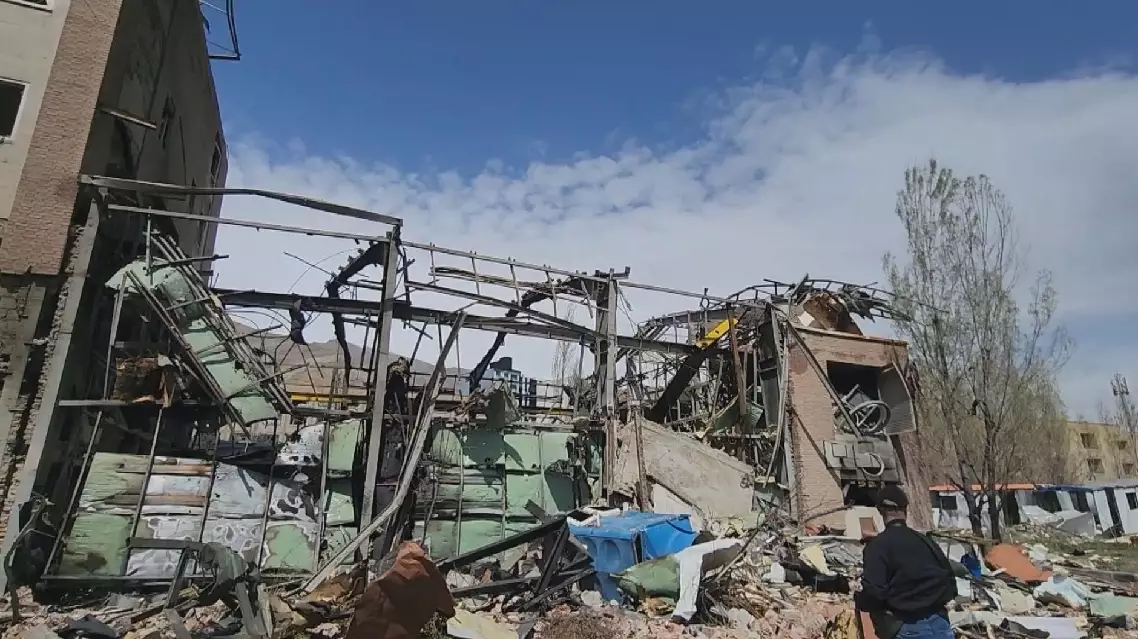
Iranian official condemns U.S.-Israeli strikes on universities