As the world's second-largest service trader, China has kept opening its services sector wider to the outside world in reform over recent years, with the upgraded "China Services" contributing significantly to both domestic and global economic growth.
Since the beginning of this year, China's service trade has demonstrated vigorous momentum and accelerated development.
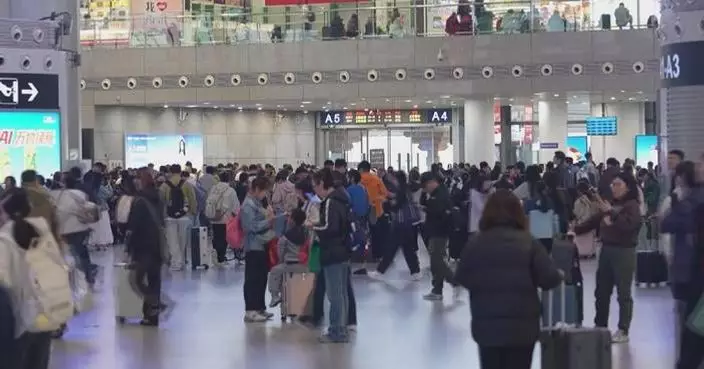
In the first half of the year, the number of border entries and exits by foreigners increased by 30.2 percent year on year.
The export of travel services continued to gain momentum in the first six months, with tourist demand expanding from major urban destinations to smaller cities and towns.
Freight services have also seen substantial improvements, with one China-Europe freight train departing every 30 minutes or less.
New integrated service models such as "rail express + cross-border e-commerce" and "rail express + bonded warehousing" have been successively introduced, enhancing the efficiency and quality of transport service exports.
In the first seven months, China's exports of services including transport and travel achieved double-digit growth. The total imports and exports of services reached 4.58 trillion yuan (around 644 billion U.S. dollars), a year-on-year increase of 8.2 percent, hitting a record high for the same period in history.
Developing service trade is key to stabilizing foreign trade and boosting domestic demand.
General Secretary Xi Jinping has repeatedly advocated further easing market access and increasing cross-border service trade openness when delivering video speeches at or sending congratulatory letters to the past editions of China International Fair for Trade in Services (CIFTIS).
In his congratulatory letter to the 2025 CIFTIS, he emphasized accelerating pilot reforms in free trade zones and national demonstration zones for innovative service trade development, as well as steadily opening service markets and promoting high-quality growth in service trade.
"General Secretary Xi Jinping, profoundly grasping the global economic landscape, has put forward a series of major measures for reform, opening up, innovation and cooperation of trade in services. These measures have charted a clear direction and pathway for the development of trade in services, contributing to the continuous expansion of China's service trade scale and the steady strengthening of its comprehensive competitiveness. Furthermore, they have played a significant role in fostering an open global economy," said Li Jun, director of the Institute of International Trade in Services under the Chinese Academy of International Trade and Economic Cooperation.
Since the beginning of this year, China has steadily taken steps to improve service trade quality, including the adoption of a negative list for cross-border service trade and broader market access. Platforms such as CIFTIS and the CIIE have strengthened support for service trade growth.
Service exports have expanded in both scale and value, with manufacturers integrating goods and service exports to increase added value.
At Peru's Chancay Port, a Chinese company applied an algorithm to create a "smart brain" for its freight system, generating an optimal stowage plan in just three minutes and enabling precise coordination between intelligent driving trucks and automated rail cranes.
"This approach can reduce the rates of container flipping on terminal ground and container overturning on vessels, leading to shorter operation times and higher overall efficiency," said He Bo, executive deputy general manager of the COSCO Shipping Ports Chancay Peru.
Leveraging advantages in AI and the digital economy, China has expanded exports in emerging sectors such as BeiDou services, self-developed operating system HarmonyOS, and computing power.
In the first seven months of this year, exports of knowledge-intensive services grew by 8.6 percent year on year, as more high-value-added, technology-driven Chinese services reached the global market.
Besides making the country's trade service exports more competitive, China has also kept increasing quality service imports.
So far this year, 155 pilot programs for opening the service sector wider to foreign investment have been launched, with the focus on telecommunication service, medical care and health preservation, and finance. At the same time, the threshold for market access to the service sector in China has kept lowering.
About 200 financial institutions have been set up in Beijing's service sector demonstration zone. Services accounted for 72 percent of actually utilized foreign investment in the country in the first seven months.
According to the latest calculations by the Chinese Academy of International Trade and Economic Cooperation, China's ranking in the service trade comprehensive development index rose from 15th last year to within the top 10 globally this year, reflecting the country's strengthened comprehensive capabilities in service trade.
"Next, we will fully implement the negative list for cross-border trade in services, proactively align with high-standard international economic and trade rules, and steadily advance the opening of the service market to create more high-level open platforms. Support will be provided for enterprises in areas such as taxation, finance, regulatory facilitation, and international market expansion," said Kong Dejun, director of the Department of Trade in Services and Commercial Services under the Ministry of Commerce.

China advances service trade innovation, opening up, driving global economic growth