MANILA, Philippines (AP) — The Philippine defense and military chiefs rejected a call for the country’s armed forces to withdraw support from President Ferdinand Marcos Jr. in response to public outrage over allegations of massive corruption in flood control projects that have implicated several congressmen and public works officials and sparked pockets of street protests.
Defense Secretary Gilberto Teodoro, Jr. and military chief of staff Gen. Romeo Brawner Jr. issued a joint statement late Friday expressing their rejection of “all attempts to patronize the Armed Forces of the Philippines by certain groups that insinuate or suggest unconstitutional, unilateral interventions.”
They did not elaborate, but underscored that the 160,000-member military was non-partisan, professional and “abides by the constitution through the chain-of-command.”
The House of Representatives, the Senate and Marcos’ administration have been investigating alleged substandard and non-existent flood control projects in separate televised inquiries. Dozens of legislators, senators, construction companies and public works engineers were identified and accused of pocketing huge kickbacks that financed lavish lifestyles and high-stakes casino gambling.
The corruption scandal has been especially sensitive in a poverty-stricken Southeast country that is prone to deadly typhoons and floodings that devastate entire towns and villages multiple times each year.
Unlike recent violent protests in Nepal and Indonesia, street rallies against alleged abuses in the Philippines have been smaller and relatively peaceful. Outrage is largely vented online, including by Catholic church leaders, business executives and retired generals.
During a recent rally, a speaker called on the military to withdraw its loyalty from Marcos and called on Filipinos to stage a non-violent “people power” revolt similar to army-backed uprisings that ousted Ferdinand Marcos, the current president’s late father and namesake, in 1986 and Joseph Estrada in 2001.
“At this critical juncture for our national security in the face of threats to our peace and regional stability, politically motivated attempts to distract the Armed Forces of the Philippines from focusing on its mission are not only futile but also irresponsible,” said Teodoro and Brawner, who backed the anti-corruption investigation led by Marcos.
“The strength of our republic rests on the rule of law and the unity of our people,” they said. “At this crucial time, we call on every Filipino to place their trust in our democratic institutions, to respect our processes."
Two high-ranking national security and defense officials told The Associated Press there was no currently monitored threat of secessionism within the military and the police forces. They spoke on condition of anonymity because of a lack of authority to discuss the delicate issue publicly.
A confidential government security assessment seen by The AP said groups opposed politically to Marcos were joining the public outrage over the flood control corruption, but added that a major “people power” uprising was highly unlikely without support from key groups led by the military.
“Drastic movements in the military and other uniformed service are very unlikely due to strong loyalty and patriotism … to constitution, the flag, and the president,” according to the intelligence assessment.
The Philippines has spent an estimated 545 billion pesos ($9.6 billion) for thousands of flood mitigation projects in the last three years. The projects were under government review to determine which ones are substandard or non-existent as Marcos said he has found during recent inspections he led in some flood-prone provinces, including in Bulacan, a densely populated province north of Manila.
Marcos formed an independent commission to investigate the massive anomalies he described as “horrible” and prompted him to withhold fundings for flood control projects at least for next year and accept the resignation of the public works secretary.

FILE - Philippine President Ferdinand Marcos Jr. center, tosses the ceremonial ball during the opening of the 2025 FIVB Volleyball Men's World Championship in Pasay, Philippines on Friday, Sept. 12, 2025. (AP Photo/Aaron Favila, File)
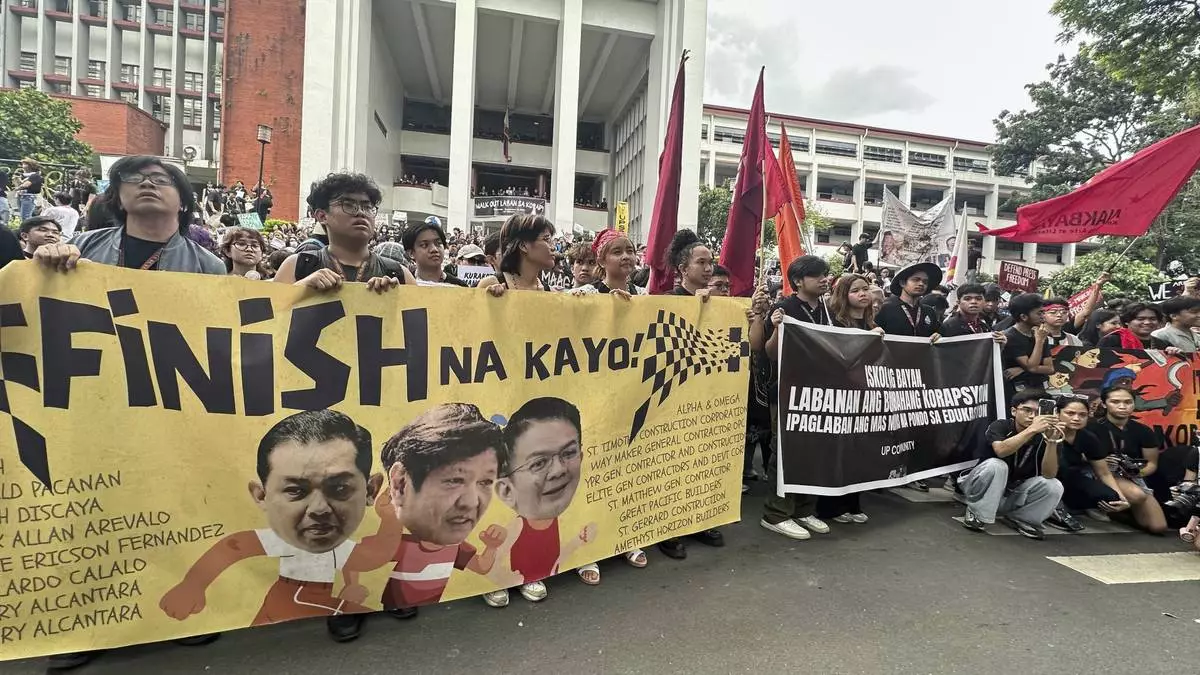
FILE - Hundreds of students at the University of the Philippines walk out of their classes and protest against corruption in government projects in Manila, Philippines, Friday, Sept.12, 2025. (AP Photo/Joeal Calupitan, File)
CAIRO (AP) — Iranians began to regain internet access on Wednesday after authorities ended a monthslong shutdown. But users said service was slow and spotty in some areas, with apps like YouTube and Instagram heavily restricted, as they were before the cutoff began during nationwide protests in January.
Authorities justified the outage as a military imperative after the United States and Israel attacked Iran on Feb. 28. Their decision to lift some restrictions this week came as negotiators appeared to be closing in on a more permanent truce. But many Iranians feared access could be cut off again at a moment's notice.
Internet tracking company Netblocks said Iran’s connectivity, which measures the ability of devices to connect to the internet, is at around 86% of capacity from before the cutoff. Internet analysis firm Kentik said internet traffic, which measures the amount of data transferred and is a good illustration of usage, was at around 40%.
Amir Rashidi, an Iranian cybersecurity analyst, said there were still widespread disruptions. “It's too early to say the shutdown is over,” he wrote on X.
Iran’s roughly 90 million people have been cut off from the internet for most of 2026, one of the world’s longest and strictest national shutdowns. Young people with online careers saw their incomes evaporate. Job losses and the closure of online businesses added to the war's steep economic costs.
The cutoff made it difficult for Iranian families to communicate through months of unrest and war. At some points, phone lines were also cut off, though they were later restored.
A woman living in Tehran said that for months she was barely able to speak to her sons living abroad. She couldn't believe authorities had restored access, saying she had assumed they would find some justification to prolong the outage.
A taxi driver said service was restored but weak. He expressed hope it would improve so he could use messaging apps with family and friends. Both spoke on condition of anonymity for security reasons.
Prices spiked during the shutdown, with residents in Tehran at times paying around $7.50 per gigabyte. Prices are back down to around $2.25 for 30 gigabytes, roughly where they were before the protests.
Even then, Iran tightly controlled access to popular social media sites, leading many to rely on virtual private networks, or VPNs. The cost of those workarounds soared during the shutdown, making them unaffordable for many as the economy was battered.
Businesses have started reappearing online, announcing their return with posts on sites like Instagram and Telegram.
A gamer and tech influencer in the central city of Isfahan said the shutdown had caused him to lose a lot of his audience on YouTube and Instagram, where he had spent years building up a large following.
“All my views and interactions are way down. I’ve been erased from the algorithm,” he said in a voice note sent by WhatsApp, adding that his internet connection was still slower than before the shutdown.
“The situation is such that many content producers have had their income reduced to zero, have moved on to other jobs, or have been forced to sell their equipment to survive,” he said. He spoke on condition of anonymity for fear of reprisal.
Iranian authorities first shut down the internet in January during mass anti-government protests that were eventually stamped out in a violent crackdown. Thousands of people were killed and tens of thousands detained.
That cutoff was just starting to ease when the government imposed a complete internet blackout after the start of the war, when U.S. and Israeli strikes killed Iran's supreme leader and other top officials.
The government faced criticism for the prolonged shutdown, which caused even more harm to an economy devastated by inflation, strikes on key industries and a U.S. blockade on Iranian ports.
The internet cutoff cost an estimated $30-40 million daily, with indirect losses likely twice that much, a member of Iran’s Chamber of Commerce, Afshin Kolahi, told a local newspaper last month. About 10 million people have jobs that depend on internet connectivity, according to Communications Minister Sattar Hashemi.
Iranians still had access to a national net, but that has a far narrower reach, and users complained of poor service and heavy censorship. Senior government officials are given SIM cards granting them access to the global internet. Under pressure, the government expanded access to the SIM cards to some professions during the shutdown.
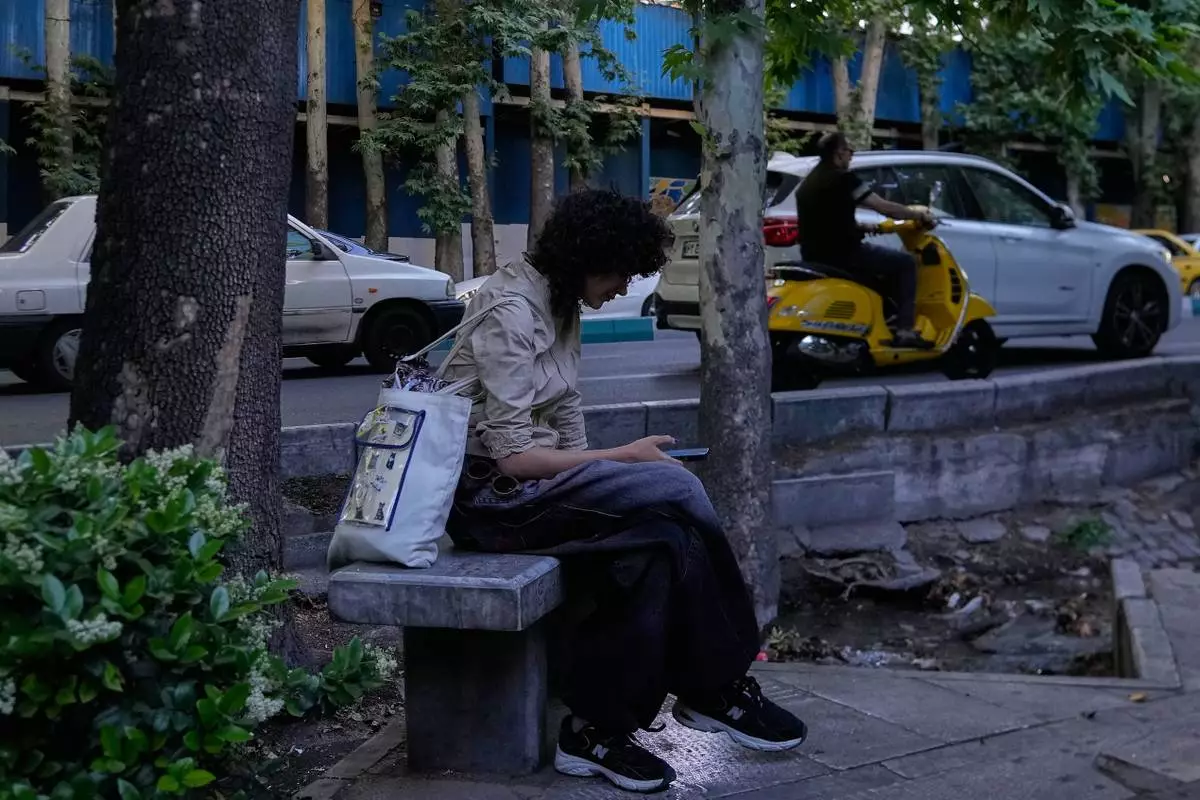
A woman checks her smartphone while sitting on a bench along a sidewalk in northern Tehran, Iran, Tuesday, May 26, 2026. (AP Photo/Vahid Salemi)