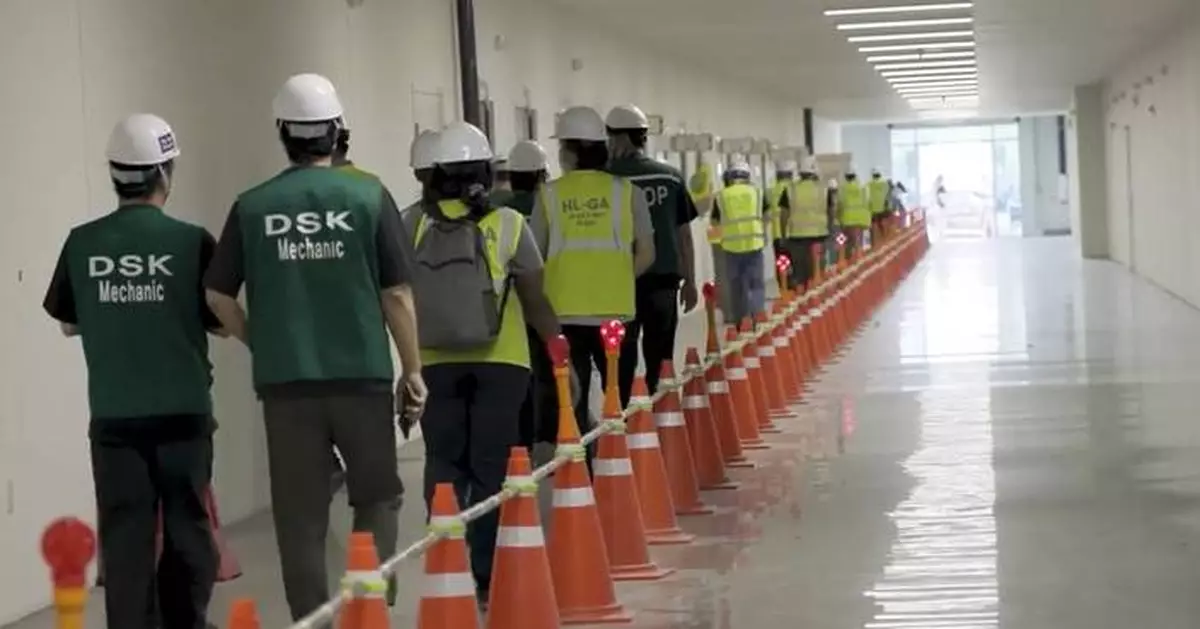
Ever since a massive immigration raid on a Hyundai manufacturing site swept up nearly 500 workers in southeast Georgia, Rosie Harrison said her organization’s phones have been ringing nonstop with panicked families in need of help.
“We have individuals returning calls every day, but the list doesn’t end,” Harrison said. She runs an apolitical non-profit called Grow Initiative that connects low-income families — immigrant and non-immigrant alike — with food, housing and educational resources.
Since the raid, Harrison said, “families are experiencing a new level of crisis.”
A majority of the 475 people who were detained in the workplace raid — which U.S. officials have called the largest in two decades — were Korean and have returned to South Korea. But lawyers and social workers say many of the non-Korean immigrants ensnared in the crackdown remain in legal limbo or are otherwise unaccounted for.
As the raid began the morning of Sept. 4, workers almost immediately started calling Migrant Equity Southeast, a local nonprofit that connects immigrants with legal and financial resources. The small organization of approximately 15 employees fielded calls regarding people from Mexico, Guatemala, Colombia, Chile, Ecuador and Venezuela, spokesperson Vanessa Contreras said.
Throughout the day, people described federal agents taking cellphones from workers and putting them in long lines, Contreras said. Some workers hid for hours to avoid capture, in air ducts or remote areas of the sprawling property. The Department of Justice said some hid in a nearby sewage pond.
People off-site called the organization frantically seeking the whereabouts of loved ones who worked at the plant and were suddenly unreachable.
Like many of the Koreans who were working at the plant, advocates and lawyers representing the non-Korean workers caught up in the raid say that some who were detained had legal authorization to work in the United States.
Neither the Department of Homeland Security nor Immigration and Customs Enforcement responded to emailed requests for comment Friday. It is not clear how many people detained during the raid remain in custody.
Atlanta-based attorney Charles Kuck, who represents both Korean and non-Korean workers who were detained, said two of his clients were legally working under the Deferred Action for Childhood Arrivals program, which was created by former President Barack Obama. One had been released and “should have never been arrested,” he said, while the other was still being held because he was recently charged with driving under the influence.
Another of Kuck's clients was in the process of seeking asylum, he said, and had the same documents and job as her husband who was not arrested.
Some even had valid Georgia driver's licenses, which aren't available to people in the country illegally, said Rosario Palacios, who has been assisting Migrant Equity Southeast. Some families who called the organization were left without access to transportation because the person who had been detained was the only one who could drive.
“It’s hard to say how they chose who they were going to release and who they were going to take into custody,” Palacios said, adding that some who were arrested didn’t have an alien identification number and were still unaccounted for.
Kuck said the raid is an indication of how far-reaching the crackdown by President Donald Trump's administration is, despite assurances that they are targeting criminals.
“The redefinition of the word ‘criminal’ to include everybody who is not a citizen, and even some that are, is the problem here,” Kuck said.
Many of the families who called Harrison's initiative said their detained relatives were the sole breadwinners in the household, leaving them desperate for basics like baby formula and food.
The financial impact of the raid at the construction site for a battery factory that will be operated by HL-GA Battery Co. was compounded by the fact that another massive employer in the area — International Paper Co. — is closing at the end of the month, laying off another 800 workers, Harrison said.
Growth Initiative doesn’t check immigration status, Harrison said, but almost all families who have reached out to her have said that their detained loved ones had legal authorization to work in the United States, leaving many confused about why their relative was taken into custody in the first place.
“The worst phone calls are the ones where you have children crying, screaming, ‘Where is my mom?’” Harrison said.
Riddle is a corps member for The Associated Press/Report for America Statehouse News Initiative. Report for America is a nonprofit national service program that places journalists in local newsrooms to report on undercovered issues.
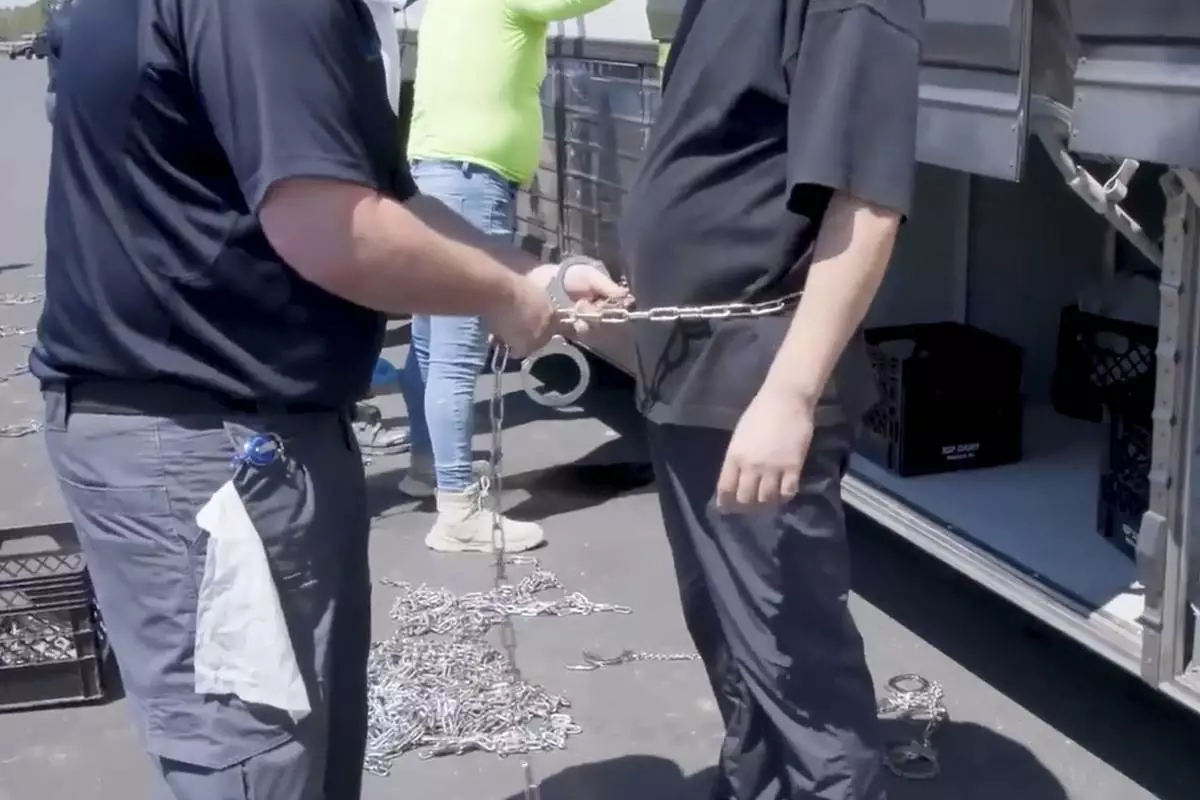
This image from video provided by U.S. Immigration and Customs Enforcement via DVIDS shows a person being handcuffed at the Hyundai Motor Group’s electric vehicle plant, Thursday, Sept. 4, 2025, in Ellabell, Ga. (Corey Bullard/U.S. Immigration and Customs Enforcement via AP)
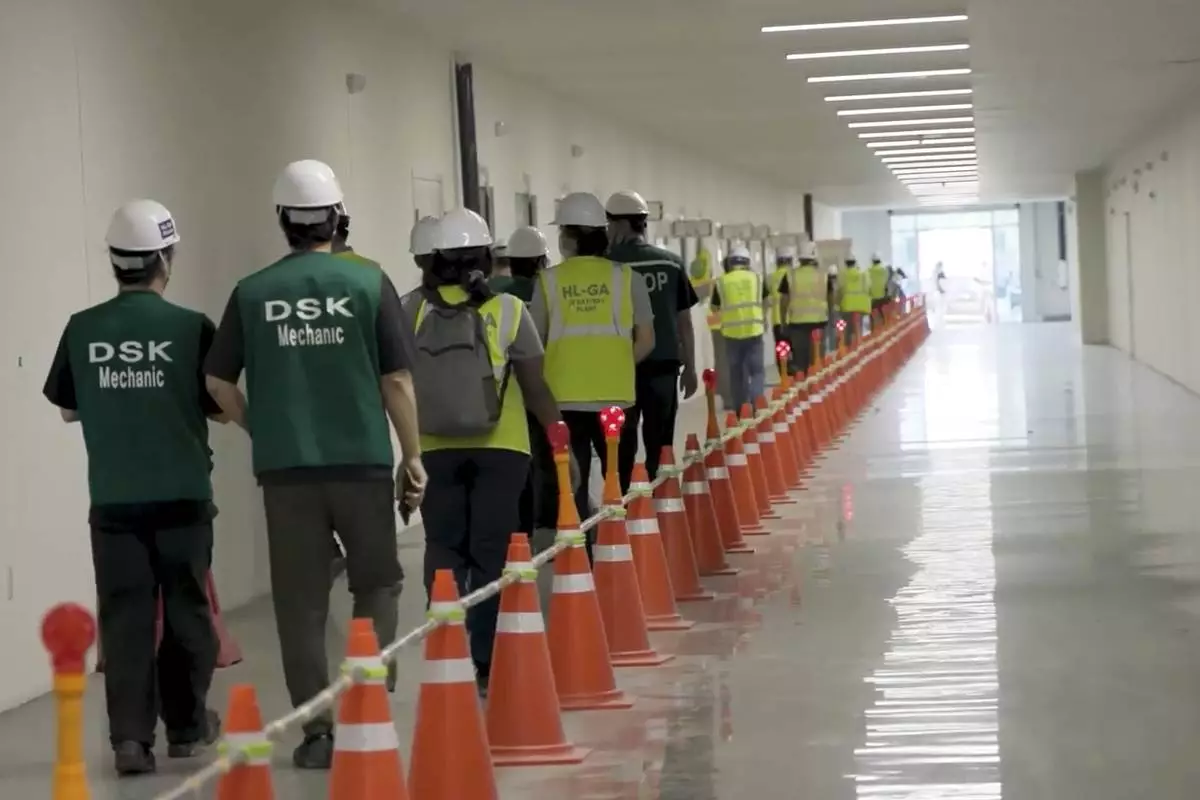
This image from video provided by U.S. Immigration and Customs Enforcement via DVIDS shows manufacturing plant employees being escorted outside the Hyundai Motor Group’s electric vehicle plant, Thursday, Sept. 4, 2025, in Ellabell, Ga. (Corey Bullard/U.S. Immigration and Customs Enforcement via AP)
A federal appeals panel on Thursday reversed a lower court decision that released former Columbia University graduate student Mahmoud Khalil from an immigration jail, bringing the government one step closer to detaining and ultimately deporting the Palestinian activist.
The three-judge panel of the 3rd U.S. Circuit Court of Appeals didn’t decide the key issue in Khalil’s case: whether the Trump administration’s effort to throw Khalil out of the U.S. over his campus activism and criticism of Israel is unconstitutional.
But in its 2-1 decision, the panel ruled a federal judge in New Jersey didn’t have jurisdiction to decide the matter at this time. Federal law requires the case to fully move through the immigration courts first, before Khalil can challenge the decision, they wrote.
“That scheme ensures that petitioners get just one bite at the apple — not zero or two,” the panel wrote. “But it also means that some petitioners, like Khalil, will have to wait to seek relief for allegedly unlawful government conduct.”
Thursday’s decision marked a major win for the Trump administration’s sweeping campaign to detain and deport noncitizens who joined protests against Israel.
Tricia McLaughlin, a Homeland Security Department spokesperson, called the ruling “a vindication of the rule of law.”
In a statement, she said the department will “work to enforce his lawful removal order” and encouraged Khalil to “self-deport now before he is arrested, deported, and never given a chance to return.”
It was not clear whether the government would seek to detain Khalil, a legal permanent resident, again while his legal challenges continue.
In a statement distributed by the American Civil Liberties Union, Khalil called the appeals ruling “deeply disappointing."
“The door may have been opened for potential re-detainment down the line, but it has not closed our commitment to Palestine and to justice and accountability," he said. "I will continue to fight, through every legal avenue and with every ounce of determination, until my rights, and the rights of others like me, are fully protected.”
Baher Azmy, one of Khalil's lawyers, said the ruling was “contrary to rulings of other federal courts."
“Our legal options are by no means concluded, and we will fight with every available avenue,” he said.
The ACLU said the Trump administration cannot lawfully re-detain Khalil until the order takes formal effect, which won't happen while he can still immediately appeal.
Khalil’s lawyers can request that the panel's decision be set aside and the matter reconsidered by a larger group of judges on the 3rd Circuit Court of Appeals, or they can go to the U.S. Supreme Court.
An outspoken leader of the pro-Palestinian movement at Columbia, Khalil was arrested last March. He then spent three months detained in a Louisiana immigration jail, missing the birth of his first child.
Federal officials have accused Khalil of leading activities “aligned to Hamas,” though they have not presented evidence to support the claim and have not accused him of criminal conduct. They also accused Khalil, 31, of failing to disclose information on his green card application.
The government justified the arrest under a seldom-used statute that allows for the expulsion of noncitizens whose beliefs are deemed to pose a threat to U.S. foreign policy interests.
In June, a federal judge in New Jersey ruled that justification would likely be declared unconstitutional and ordered Khalil released.
President Donald Trump's administration appealed that ruling, arguing the deportation decision should fall to an immigration judge, rather than a federal court.
Khalil has dismissed the allegations as “baseless and ridiculous,” framing his arrest and detention as a “direct consequence of exercising my right to free speech as I advocated for a free Palestine and an end to the genocide in Gaza.”
New York City’s new mayor, Zohran Mamdani, said on social media Thursday that Khalil should remain free.
“Last year’s arrest of Mahmoud Khalil was more than just a chilling act of political repression, it was an attack on all of our constitutional rights,” Mamdani wrote on X. “Now, as the crackdown on pro-Palestinian free speech continues, Mahmoud is being threatened with rearrest. Mahmoud is free — and must remain free.”
Judge Arianna Freeman dissented Thursday, writing that her colleagues were holding Khalil to the wrong legal standard. Khalil, she wrote, is raising “now-or-never claims” that can be handled at the district court level, even though his immigration case isn't complete.
Both judges who ruled against Khalil, Thomas Hardiman and Stephanos Bibas, were Republican appointees. President George W. Bush appointed Hardiman to the 3rd Circuit, while Trump appointed Bibas. President Joe Biden, a Democrat, appointed Freeman.
The two-judge majority rejected Freeman's worry that their decision would leave Khalil with no remedy for unconstitutional immigration detention, even if he later can appeal.
“But our legal system routinely forces petitioners — even those with meritorious claims — to wait to raise their arguments," the judges wrote.
The decision comes as an appeals board in the immigration court system weighs a previous order that found Khalil could be deported to Algeria, where he maintains citizenship through a distant relative, or Syria, where he was born in a refugee camp to a Palestinian family.
His attorneys have said he faces mortal danger if forced to return to either country.
Associated Press writers Larry Neumeister and Anthony Izaguirre contributed to this story.
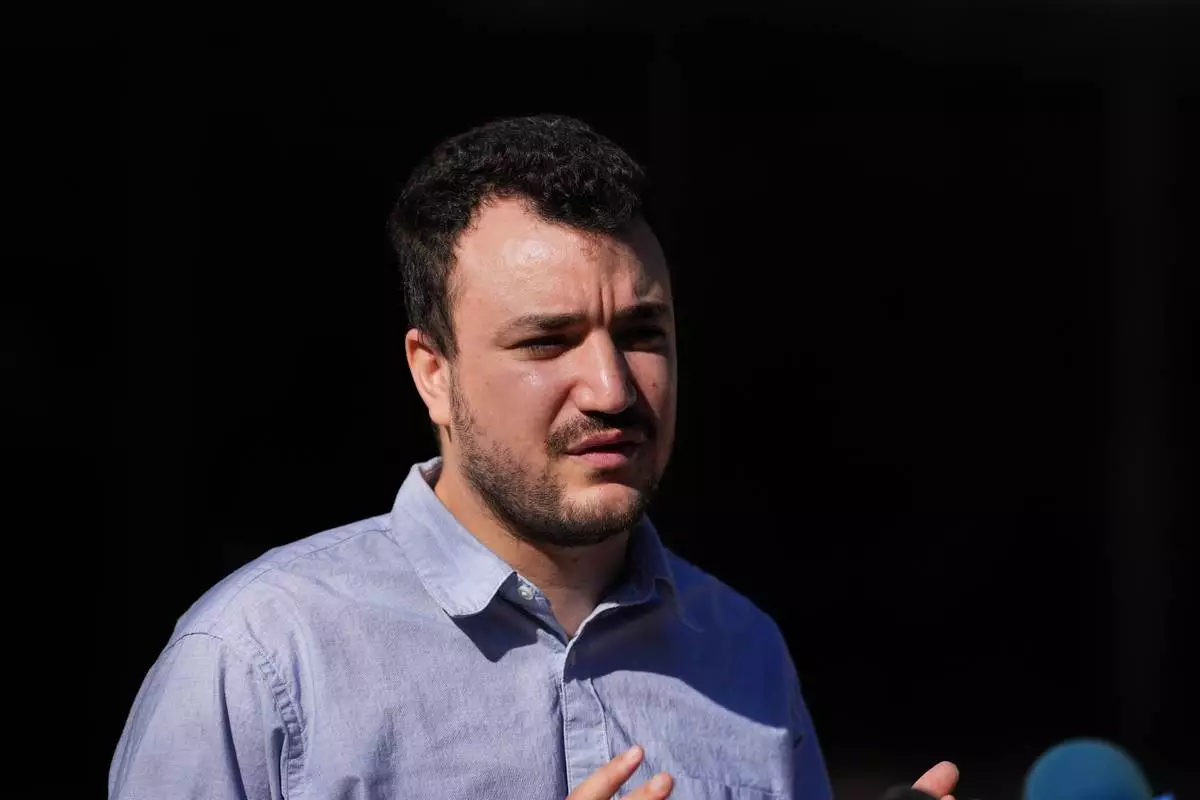
FILE - Palestinian activist Mahmoud Khalil holds a news conference outside Federal Court on Tuesday, Oct. 21, 2025 in Philadelphia (AP Photo/Matt Rourke, File)