China's Xinjiang is rapidly building a modern, integrated transport network at an unprecedented pace and scale, bringing both economic opportunities and greater convenience to local people.
From expressways cutting through mountains to railways crossing vast deserts, the autonomous region's expanding transport arteries are helping industries grow and making travel faster and easier.
Officials say the network is designed to achieve four key goals: seamless circulation within the region, faster links with the rest of China, smoother travel between southern and northern Xinjiang, and stronger connections with neighboring countries.
Speeding through the heart of the Tianshan Mountains, construction of the Urumqi-Yuli Expressway is in full swing. In just over two months, the expressway -- the first ever to traverse the mountains to connect southern and northern Xinjiang -- will be ready for traffic.
Along the route, new industrial parks and cold-chain logistics hubs are already taking shape.
In Hejing County, which will be linked to the expressway, a dairy company producing 40,000 tons of fresh milk annually is expanding storage facilities and purchasing refrigerated trucks to launch a new milk distribution line.
"Once the Urumqi-Yuli expressway opens, we will be able to cross the Tianshan Mountains in just 20 minutes. We've calculated that this will save us 15 million yuan (around 2 million U.S. dollars) a year in transport costs. We are very much looking forward to the expressway's opening and to seeing Xinjiang's high-quality milk reach the whole country quickly," said Yu Ruihong, chairman of the dairy company.
Across the vast expanse of Xinjiang, areas once isolated from the outside world are being filled with modern transportation hubs.
From Tashkurgan Khunjerab Airport, the region's first high-altitude airport at 3,258 meters, to the Yuli-Ruoqiang expressway built on extreme geographic conditions, and the Hotan-Ruoqiang Railway cutting through the Taklimakan Desert, the integrated transport network has made travel for people of all ethnic groups much easier.
"I'm going to Korla and will arrive tomorrow morning. In the past, the journey would have taken at least six or seven days. Now this one train can carry so many people, and you can go anywhere you want. It's just wonderful," said passenger Mairupu Bake.
So far, Xinjiang's railway network has reached 9,557 kilometers in length, covering more than 80 percent of county-level areas. The region now has 28 airports, the largest number among all Chinese provincial-level regions, operating 628 air routes.
Its road network has also expanded to 231,900 kilometers, with expressways linking all prefectures and cities, national and provincial highways crisscrossing the land, and rural roads reaching villages and households. Even once rugged herding trails have been transformed into scenic routes connecting grasslands, forests and villages.
"Now the roads are really good, and more tourists are coming. Just this summer, we earned 100,000 yuan (about 14,000 U.S. dollars), and we are very happy," said Rebati Nuerdanbek, a villager from Xinyuan County, Ili Kazakh Autonomous Prefecture.
As Xinjiang's transport web continues to expand, the region is drawing ever closer to the rest of China and the wider world.
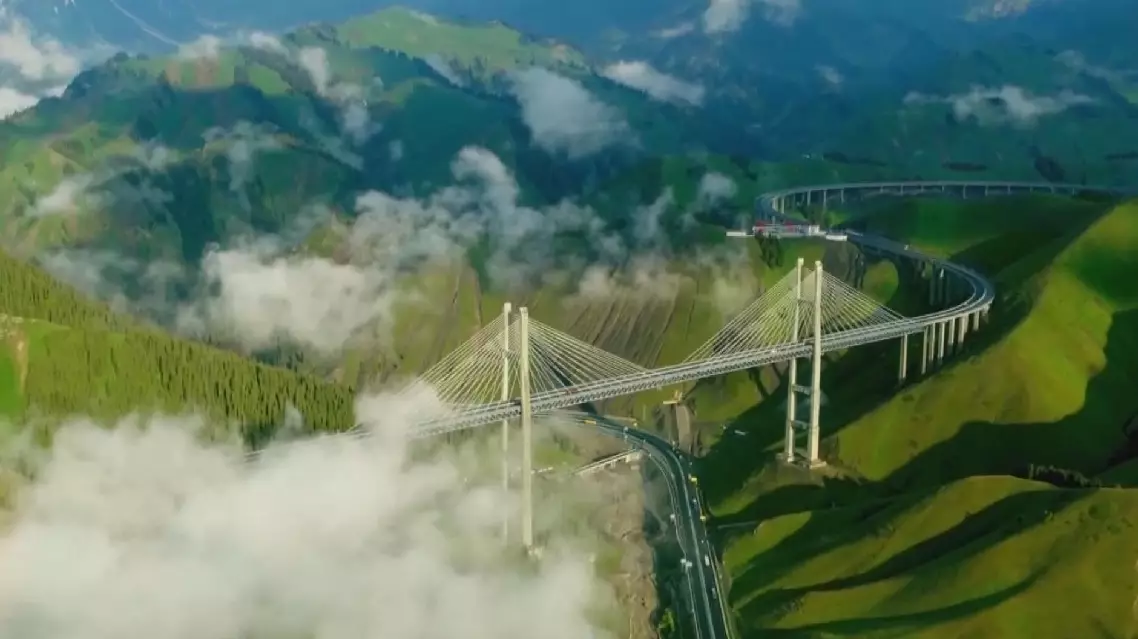
Expanding transport network spurs growth, connectivity across Xinjiang
Expanding transport network spurs growth, connectivity across Xinjiang