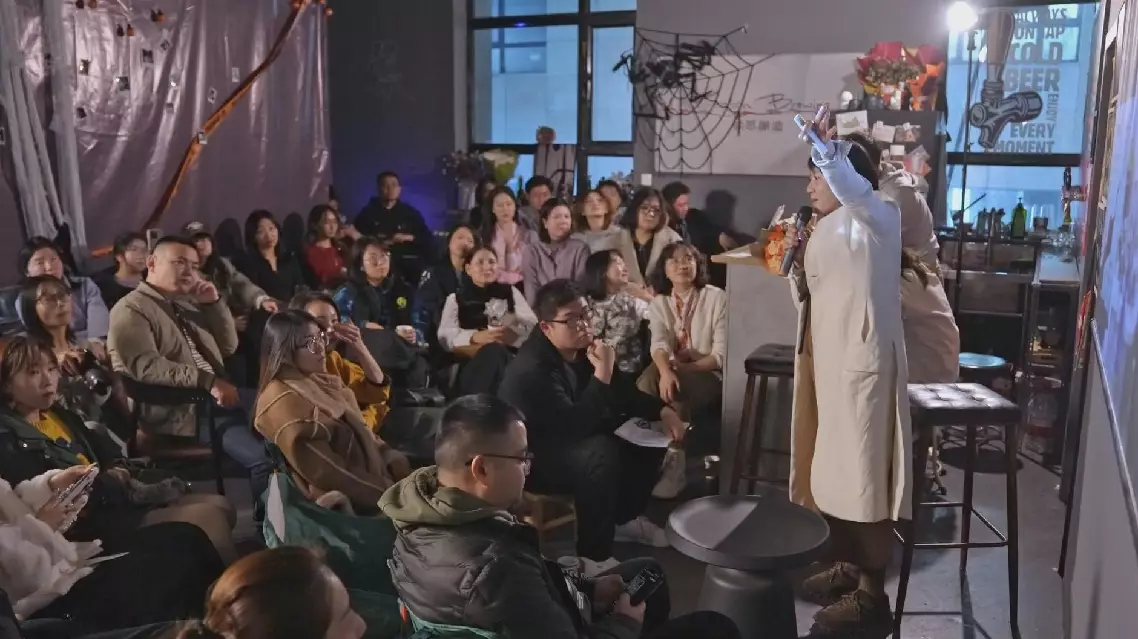
In a distinctive bar in Urumqi, capital city of northwest China's Xinjiang Uygur Autonomous Region, a youth-led community named "Wanshou Xinjiang" is redefining how academic exchange and public life can intersect—far from formal classrooms and traditional lecture halls.
Since its inception in late 2022, the group has been organizing events that bring professors, researchers, and curious citizens together in a relaxed setting to discuss topics ranging from public art and social work to community governance—all over drinks in a bar. Such bar has earned its name as "Academic Bar."
"At the end of 2022, we put up a post about an offline reading club, and it actually got a lot of attention from many other ambitious young people. What started as a small gathering of about 50 people later turned into a 100-person 'Academic Bar' event, and then into tiny, intimate chats with just three or four people. Our goal is to do something meaningful for the community and this land through collective action," said Hewang, initiator of the community.
Bingying, a member of the community, drew comparisons with the public spaces of major Chinese cities.
"Shanghai has countless bars and cafes, and Chengdu has numerous teahouses. These places, despite being commercial spaces, still serve as public gathering spots. A city's resilience often lies in its vibrant public spaces brimming with diverse activities. I think many bars prioritize the carnival vibe to pull in customers. But we feel like that lacks depth. It doesn't truly resonate with today's young generation. We believe bars can be spaces for academic discussions or even presentations," said Bingying.
The community's recent events have featured academics such as Xiao Kun, who teaches art at Xinjiang Normal University, and Wang Xieping, a specialist in social work. Bingying expressed deep admiration for both.
"We came up with the 'Awakening Public Life' theme and invited Mr. Xiao Kun of the Art Institute and Ms. Wang Xieping (nicknamed Ermao) of Social Work from Xinjiang Normal University. We all really admire Ms. Wang Ermao. She's not only knowledgeable but also actively involved in organizing social services, as well as disability support programs. She's both a researcher and an activist. As for Mr. Xiao Kun, he's dedicated to making public art more accessible. There isn't even a 'Public Art' program at Xinjiang's universities, so he is very satisfied with an event like this because it helps to introduce more people to the concept of 'Public Art.' I think both of them are remarkably attuned to their audiences," said Bingying.
Hewang believed that the informal setting helps break down barriers. To his surprise, what began as an experiment has since evolved into a meaningful movement. And he hopes the "Academic Bar" initiative will continue to grow and sustain its impact.
"Bringing professors into a bar setting creates an environment that is relaxed, open, and egalitarian. This makes academics more approachable. It's a great way to invite more people into the academic world. Our community, at its core, aspires to go beyond mere entertainment. We want to build and create something that leaves a lasting impact, something that truly matters. We're searching for a common ground that can benefit more people, and that's what really excites us," said Hewang.
"At first, I thought most people were just drawn in merely by the trendy appeal of the 'Academic Bar' event. But it turns out that everyone here shares a genuine passion. As I listened to the discussions, the questions, and the stories participants shared about their work, I realized that regardless of whether they directly aligned with today's topic, there was a palpable energy in the room. From the teachers' perspective, the students were engaged and motivated. From the students' viewpoint, the enthusiasm of those around them was contagious. This is exactly how I've always imagined public discussions should be, where we talk about critical public issues and think about our roles as individuals," he added.
"I hope we can keep this going and make academics and knowledge more accessible to all," said Hewang.
Bar-based youth community promotes academic exchanges in China's Xinjiang