LONDON (AP) — Prime Minister Keir Starmer on Monday condemned “dangerous” comments by Elon Musk after the X and Tesla owner told an anti-immigration rally that violence is coming to Britain and they must fight or die. But the U.K. government resisted opposition calls to sanction Musk for the remarks.
Starmer denounced violence on the fringes of Saturday’s 100,000 or more-strong “Unite the Kingdom” demonstration in London organized by far-right campaigner Tommy Robinson.
Click to Gallery
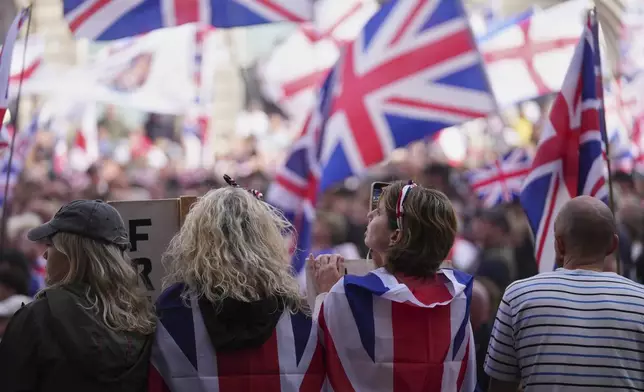
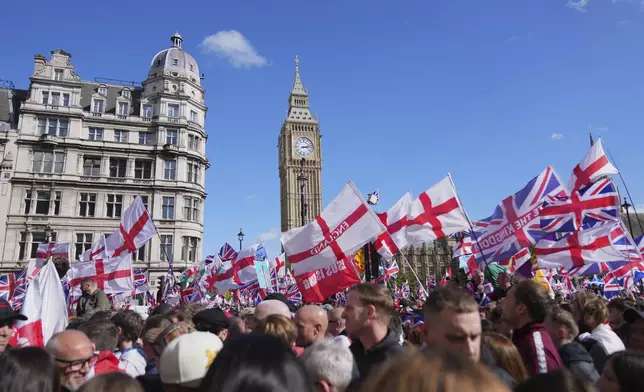
People demonstrate during the Tommy Robinson-led Unite the Kingdom march and rally, in London Saturday Sept. 13, 2025. (AP Photo/Joanna Chan)
People demonstrate during the Tommy Robinson-led Unite the Kingdom march and rally, in London, Saturday Sept. 13, 2025. (AP Photo/Joanna Chan)
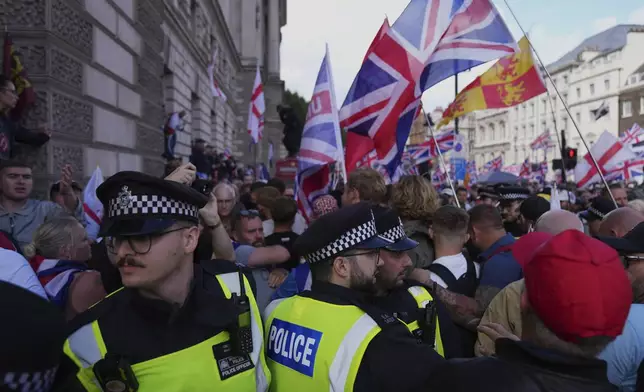
Police officers form a line in front of demonstrators from the Tommy Robinson-led Unite the Kingdom march and rally near Westminster, London, Saturday Sept. 13, 2025. (AP Photo/Joanna Chan)
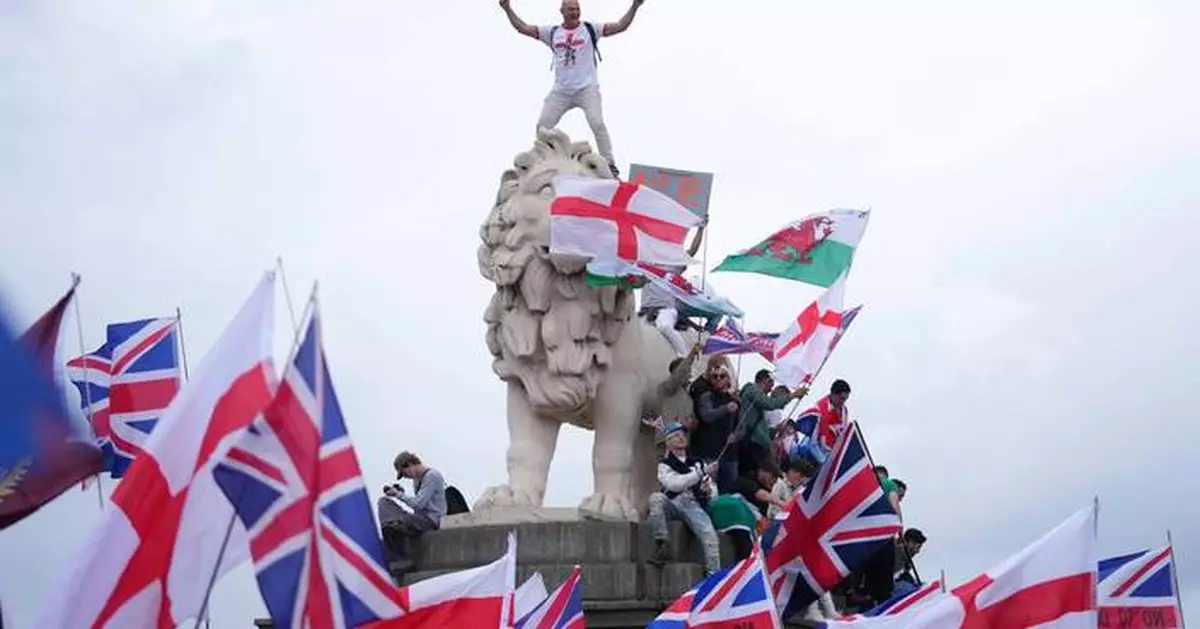
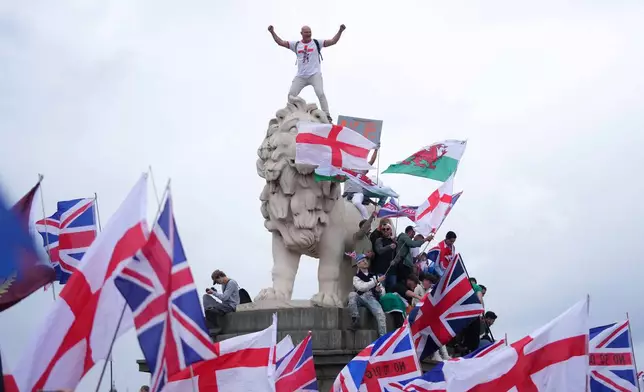
A demonstrator stands on the head of the South Bank lion that sits on the side of the Westminster Bridge, during a Tommy Robinson-led Unite the Kingdom march and rally in London, Saturday, Sept. 13, 2025. (AP Photo/Joanna Chan)
Police said 26 officers were injured, four seriously, as a minority among the protesters tried to breach lines separating them from a smaller anti-racist counter-demonstration. There were 25 people arrested at the event and the Metropolitan Police said more arrests would follow.
Addressing the demonstration by video link, Musk called for the dissolution of Parliament and an early election to remove Starmer's center-left government. He told protesters “violence is coming to you” and “you either fight back or you die.”
Starmer's spokesman, Dave Pares, said he didn't think "the British public will have any truck with that kind of language.
“The U.K. is a fair, tolerant and decent country, so the last thing that British people want is dangerous and inflammatory language which threatens violence and intimidation on our streets,” he said.
Ed Davey, leader of the Liberal Democrats, the third-largest party in Britain’s Parliament, urged Starmer, Conservative opposition leader Kemi Badenoch and Reform UK leader Nigel Farage to join him in condemning Musk’s attempt “to sow discord and incite violence on our streets” and interfere with British democracy.
Davey urged Starmer to block Tesla from getting government contracts.
Starmer's spokesman said the government had no plans to sanction Musk over his comments.
The prime minister wrote on X that peaceful protest “is core to our country’s values. But we will not stand for assaults on police officers doing their job or for people feeling intimidated on our streets because of their background or the color of their skin."
This is not the first time Musk, an erstwhile ally of President Donald Trump, has supported hard-right and far-right figures in Europe, including Robinson, a convicted fraudster and founder of the anti-Islam English Defense League whose real name is Stephen Yaxley-Lennon, and the Alternative for Germany party, or AfD.
Musk also is a critic of attempts by the U.K. and other European governments to clamp down on harmful online content, something he argues restricts free speech.
Saturday's march was billed as a demonstration in support of free speech, with many of the speeches by influencers and far-right politicians from across Europe aimed largely at the supposed perils of migration.
It followed growing political concern about unauthorized immigration, especially the arrival of migrants across the English Channel in small boats. More than 30,000 people have made the dangerous crossing from France so far this year despite efforts by authorities in Britain, France and other countries to crack down on the people-smuggling gangs behind the trips.
The use of hotels to accommodate asylum-seekers has become a major political issued in Britain, sparking dozens of small but heated protests over the summer, some of which turned violent.
Many of the demonstrators waved the U.K.’s Union Jack or red and white St. George flag of England. In recent weeks, the flags have proliferated on lampposts, motorway bridges and road intersections around the country as part of a seemingly grassroots campaign. Red crosses have also been painted on buildings in what some see as an intimidating gesture aimed at ethnic minorities.
The St. George flag, in particular, is a complex symbol. It can express patriotism and pride when supporting England’s sports teams, but has at times been appropriated by anti-immigration protesters and the hard right. The flag featured heavily at anti-asylum protests this summer, which were attended and in some cases organized by far-right activists.
“Flags can unite and divide as they are flown by people with different motives and meanings,” said Sunder Katwala of British Future, a think tank that looks at issues including integration and national identity.
James Freeman, a senior lecturer in political history at the University of Bristol, said the use of flags “to intimidate or demark certain areas as being out of bounds” was a historical phenomenon, though the link between the St. George flag and the hard right is “relatively recent.”
Starmer, who has expressed support for flying flags as symbols of national pride, wrote on X that “Britain is a nation proudly built on tolerance, diversity and respect. Our flag represents our diverse country and we will never surrender it to those that use it as a symbol of violence, fear and division.”
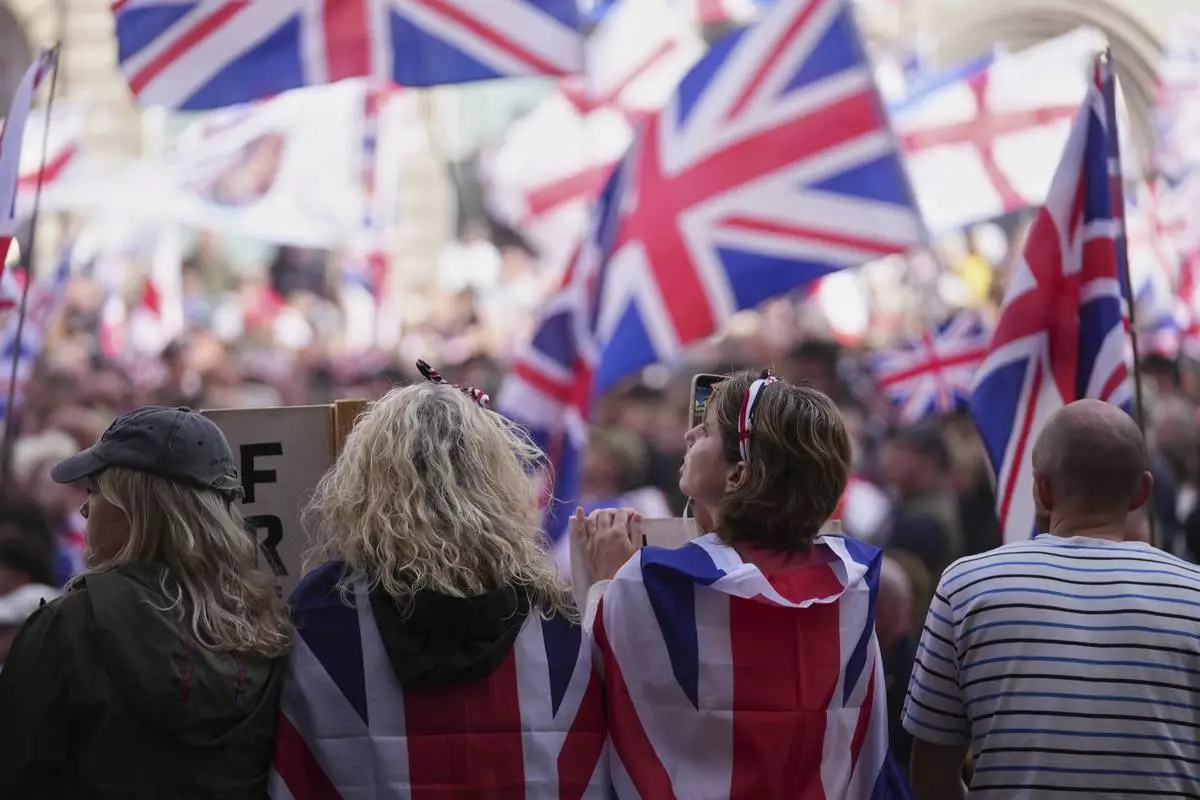
People demonstrate during the Tommy Robinson-led Unite the Kingdom march and rally, in London Saturday Sept. 13, 2025. (AP Photo/Joanna Chan)
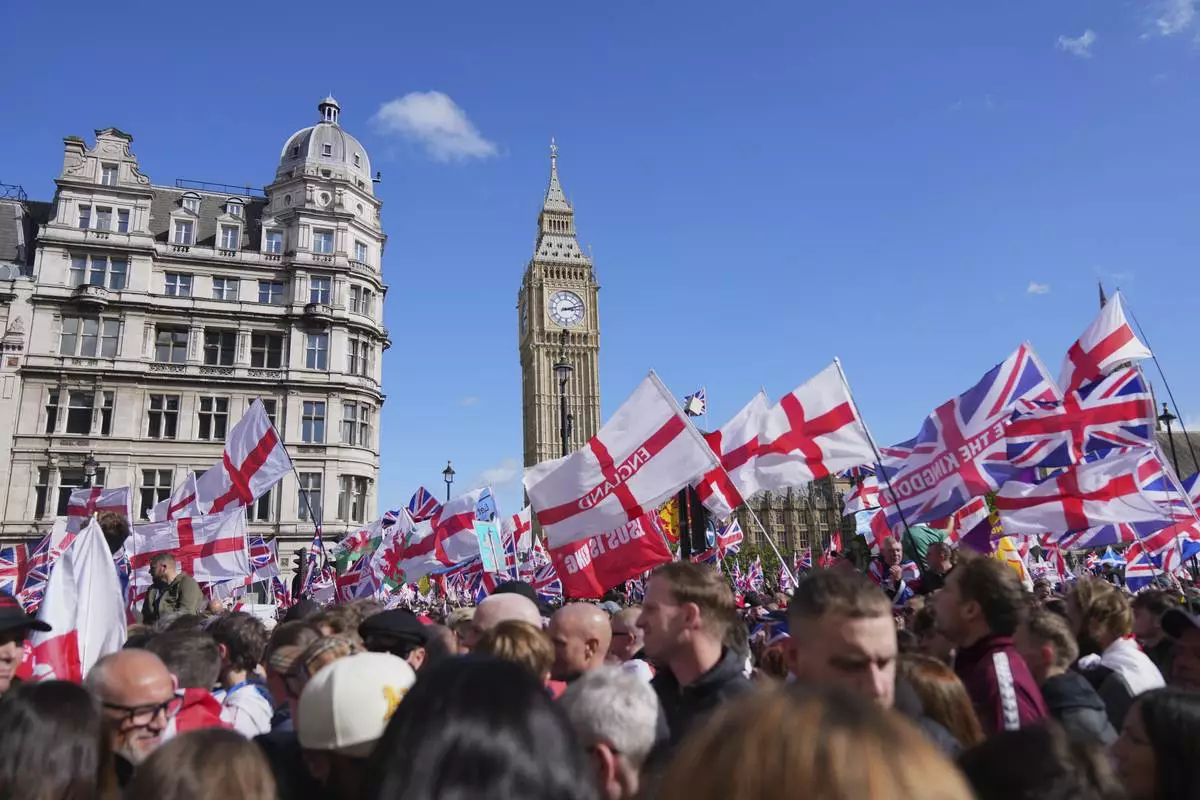
People demonstrate during the Tommy Robinson-led Unite the Kingdom march and rally, in London, Saturday Sept. 13, 2025. (AP Photo/Joanna Chan)
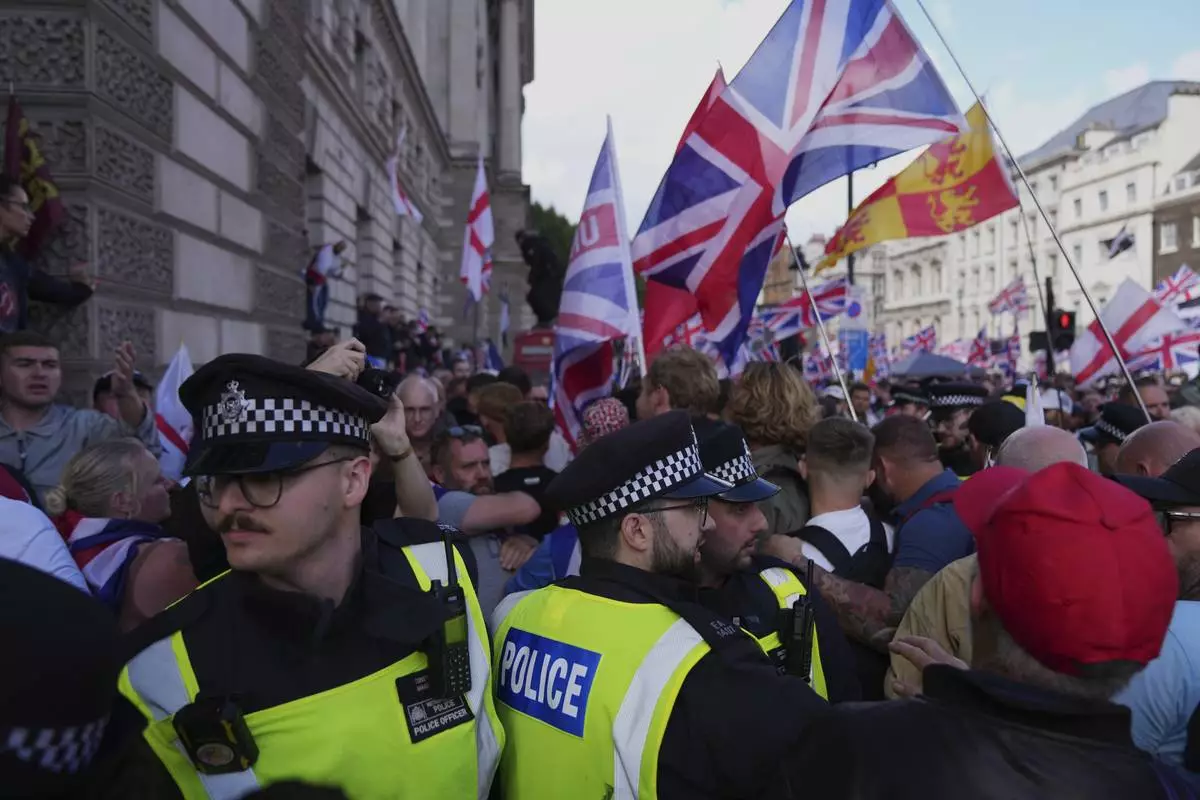
Police officers form a line in front of demonstrators from the Tommy Robinson-led Unite the Kingdom march and rally near Westminster, London, Saturday Sept. 13, 2025. (AP Photo/Joanna Chan)
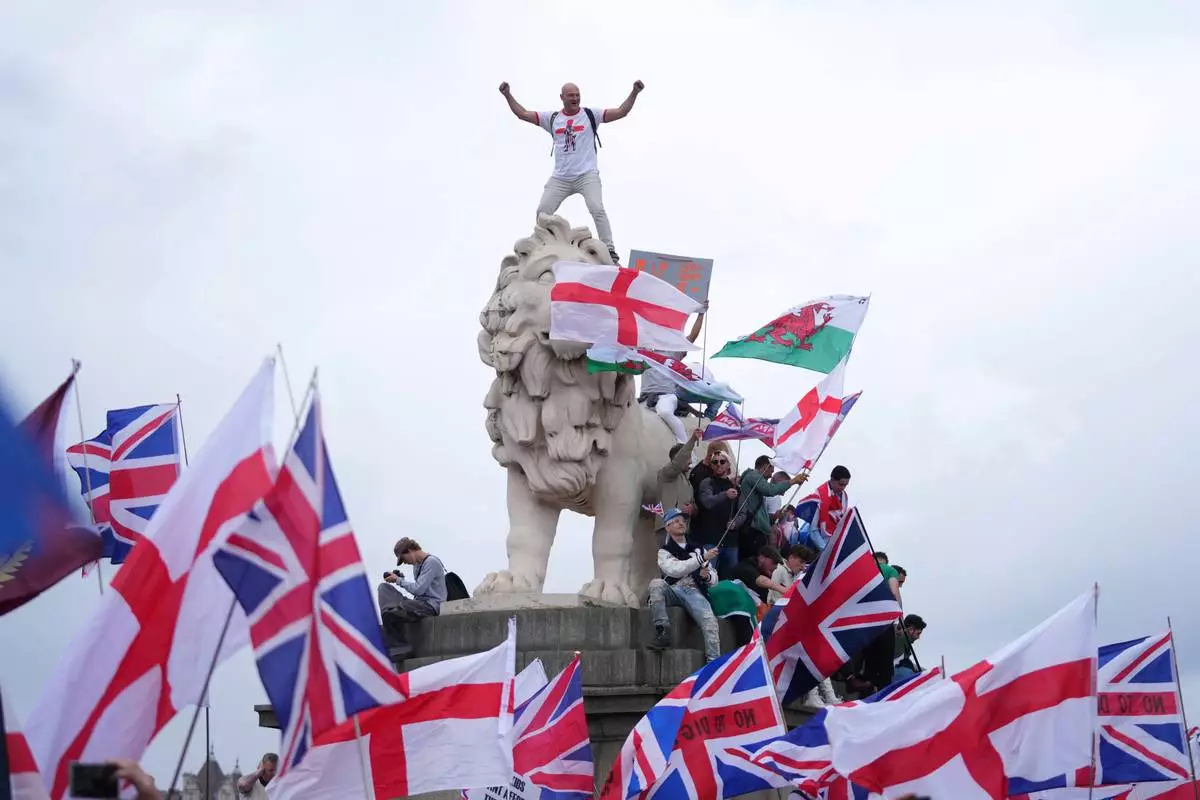
A demonstrator stands on the head of the South Bank lion that sits on the side of the Westminster Bridge, during a Tommy Robinson-led Unite the Kingdom march and rally in London, Saturday, Sept. 13, 2025. (AP Photo/Joanna Chan)
President Donald Trump threatened on Thursday to invoke the Insurrection Act to justify deploying troops as protests against Immigration and Customs Enforcement persist in Minneapolis.
Trump made the threat to “quickly put an end to the travesty” after a federal officer shot a man in the leg while being attacked with a shovel and broom handle on Wednesday. The incident further heightened the sense of fear and anger radiating across the city a week after an immigration agent fatally shot a woman in the head.
Trump has repeatedly threatened to invoke the rarely used federal law to deploy the U.S. military or federalize the National Guard for domestic law enforcement, over the objections of state governors.
The Latest:
The governor of Maine and the mayors of its two largest cities acknowledged widespread speculation that ICE enforcement actions are imminent in the state, which is home to large immigrant communities from Somalia and other African nations.
Democratic Gov. Janet Mills said aggressive enforcement actions that undermine civil rights are “not welcome” in the state. Mills, the mayors of Portland and Lewiston and Maine’s largest school district all acknowledged that the possibility of ICE enforcement has created a nervous atmosphere in Maine.
“But if they come here, I want any federal agents — and the president of the United States — to know what this state stands for: We stand for the rule of law. We oppose violence. We stand for peaceful protest. We stand for compassion, for integrity and justice,” Mills said in video released Wednesday.
Democrats across the country are proposing state law changes to rein in federal immigration officers and protect the public following the shooting death of a protester in Minneapolis and the wounding of two people in Portland, Oregon.
Many of the measures have been proposed in some form for years in Democratic-led states, but their momentum is growing as legislatures return to work amid President Donald Trump’s national immigration crackdown following the killing of Renee Good by an Immigration and Customs Enforcement agent in Minneapolis. Republicans are pushing back, blaming protesters for impeding enforcement of immigration laws.
When Trump entered office, immigration was among his strongest issues. An AP-NORC Poll published Thursday suggests that it has since faded, a troubling sign for Trump who campaigned on crackdowns to illegal immigration.
Just 38% of U.S. adults approve of how Trump is handling immigration, down from 49% at the start of his second term. The most recent poll was conducted January 8-11, shortly after the death of Renee Good, who was shot and killed by a U.S. Immigration and Customs Enforcement officer in Minneapolis.
There are still signs that Americans give Trump some leeway on immigration issues. Nearly half of Americans — 45% — say Trump has “helped” immigration and border security in his second term.
Homeland Security Secretary Kristi Noem wrote Thursday on social media, “Motor Tanker Veronica had previously passed through Venezuelan waters, and was operating in defiance of President Trump’s established quarantine of sanctioned vessels in the Caribbean.”
The Veronica is the sixth tanker seized by U.S. forces as the Trump administration moves to control the production, refining and global distribution of Venezuela’s oil products, and the fourth since the U.S. ouster of Venezuela President Nicolás Maduro in a surprise nighttime raid almost two weeks ago.
Noem wrote that the raid was carried out with “close coordination with our colleagues” in the military as well as the State and Justice departments.
“Our heroic Coast Guard men and women once again ensured a flawlessly executed operation, in accordance with international law,” Noem added.
The Associated Press has reached out to the offices of Gov. Tim Walz and Minneapolis Mayor Jacob Frey for comment on Trump’s latest threat to invoke the Insurrection Act.
During a televised speech before the latest shooting, Walz described Minnesota as being in chaos, saying what’s happening in the state “defies belief.”
“Let’s be very, very clear, this long ago stopped being a matter of immigration enforcement,” he said. “Instead, it’s a campaign of organized brutality against the people of Minnesota by our own federal government.”
Threatening to invoke the Insurrection Act and send troops to Minneapolis, Trump noted that presidents have used the 19th century law many times. This is true — but they haven’t necessarily done it in the circumstances found in Minneapolis, where the tensions have arisen from Trump already sending federal authorities into the city.
In modern times, the act has been used to mobilize troops to help local authorities or to ensure a federal court order is carried out.
The law was last used in 1992 by President George H.W. Bush to help quell riots in Los Angeles after local officials asked for the assistance. Presidents Dwight Eisenhower, John F. Kennedy and Lyndon Johnson all invoked it during the Civil Rights Movement to help enforce desegregation orders in Southern states where state and local governments were resisting.
A 1964 Justice Department memo said the act can apply in three circumstances: when a state requests help, when deployment is needed to enforce a federal court order, or when “state and local law enforcement have completely broken down.”
In a statement describing the events that led to Wednesday’s shooting, Homeland Security said federal law enforcement officers stopped a person from Venezuela who was in the U.S. illegally. The person drove away and crashed into a parked car before taking off on foot, DHS said.
After officers reached the person, two other people arrived from a nearby apartment and all three started attacking the officer, according to DHS.
“Fearing for his life and safety as he was being ambushed by three individuals, the officer fired a defensive shot to defend his life,” DHS said.
The two people who came out of the apartment are in custody, it said.
Police Chief Brian O’Hara’s account of what happened largely echoed that of Homeland Security. O’Hara said the man shot was in the hospital with a non-life-threatening injury.
Jacob Frey spoke Wednesday night after federal officers wearing gas masks and helmets fired tear gas into a small crowd while protesters threw rocks and shot fireworks.
“This is an impossible situation that our city is presently being put in and at the same time we are trying to find a way forward to keep people safe, to protect our neighbors, to maintain order,” he said.
Frey described a federal force that is five times as big as the city’s 600-officer police force and has “invaded” the city, scaring and angering residents, some of whom want the officers to “fight ICE agents.”
The Department of Homeland Security says it has made more than 2,000 arrests in the state since early December and is vowing to not back down.
Trump made the threat Thursday after a federal officer trying to make an arrest shot a man in the leg Wednesday after being attacked with a shovel and broom handle. The incident further heightened the sense of fear and anger radiating across the city a week after an immigration agent fatally shot a woman in the head.
Trump has repeatedly threatened to invoke the rarely used federal law to deploy the U.S. military or federalize the National Guard for domestic law enforcement, over the objections of state governors.
“If the corrupt politicians of Minnesota don’t obey the law and stop the professional agitators and insurrectionists from attacking the Patriots of I.C.E., who are only trying to do their job, I will institute the INSURRECTION ACT, which many Presidents have done before me, and quickly put an end to the travesty that is taking place in that once great State,” Trump said in social media post.
▶ Read more about Trump’s latest threats to Minnesota
An AP-NORC poll from January found that about 4 in 10 U.S. adults approve of Trump’s performance as president. That’s virtually unchanged from March 2025, shortly after he took office for the second time.
The new poll also shows subtle signs of vulnerability for Trump, mainly regarding the economy and immigration.
Two senators from opposite parties are joining forces in a renewed push to ban members of Congress from trading stocks, an effort that has broad public support but has repeatedly stalled on Capitol Hill.
Democratic Sen. Kirsten Gillibrand of New York and Republican Sen. Ashley Moody of Florida on Thursday plan to introduce legislation, first shared with The Associated Press, that would bar lawmakers and their immediate family members from trading or owning individual stocks.
It’s the latest in a flurry of proposals in the House and the Senate to limit stock trading in Congress, lending bipartisan momentum to the issue. But the sheer number of proposals has clouded the path forward. Republican leaders in the House are pushing their own bill on stock ownership, an alternative that critics have dismissed as watered down.
▶ Read more about the cross-party effort
Senate Republicans voted to dismiss a war powers resolution Wednesday that would have limited Trump’s ability to conduct further attacks on Venezuela after two GOP senators reversed course on supporting the legislation.
Trump put intense pressure on five Republican senators who joined with Democrats to advance the resolution last week and ultimately prevailed in heading off passage of the legislation. Two of the Republicans — Sens. Josh Hawley of Missouri and Todd Young of Indiana — flipped under the pressure.
Vice President JD Vance had to break the 50-50 deadlock in the Senate on a Republican motion to dismiss the bill.
The outcome of the high-profile vote demonstrated how Trump still has command over much of the Republican conference, yet the razor-thin vote tally also showed the growing concern on Capitol Hill over the president’s aggressive foreign policy ambitions.
▶ Read more about the war powers vote
While President Donald Trump says he’ll take action on Greenland whether its people “ like it or not, ” his newly handpicked U.S. special envoy is setting off on his own approach.
Gov. Jeff Landry, appointed as envoy in December, said he is not interested in meeting diplomats. The Republican has not visited the Arctic island and did not attend Wednesday’s meeting at the White House that included Danish officials, Vice President JD Vance and Secretary of State Marco Rubio. However, the governor was scheduled to travel to Washington on Thursday and Friday for meetings that include the topic of Greenland, Landry’s spokesperson Kate Kelly said.
▶ Read more about Landry 's new role
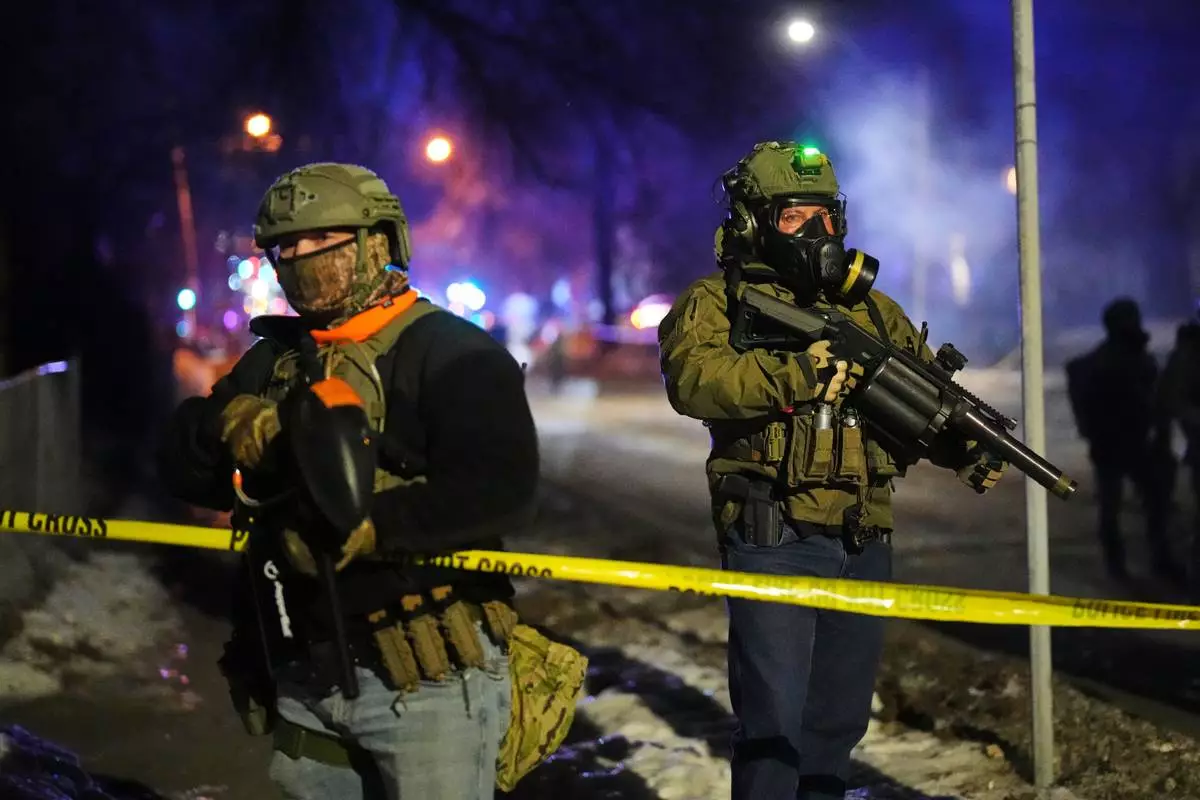
Law enforcement officers at the scene of a reported shooting Wednesday, Jan. 14, 2026, in Minneapolis. (AP Photo/Adam Gray)
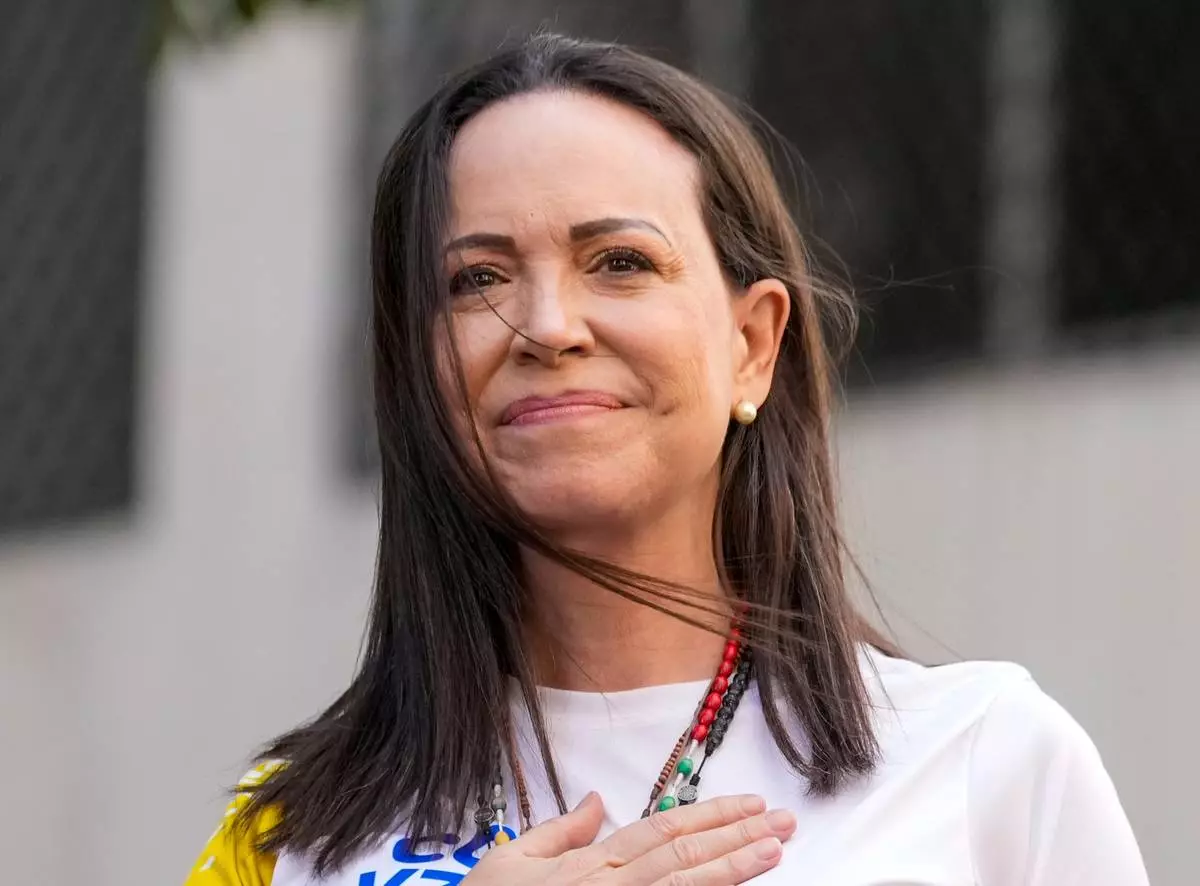
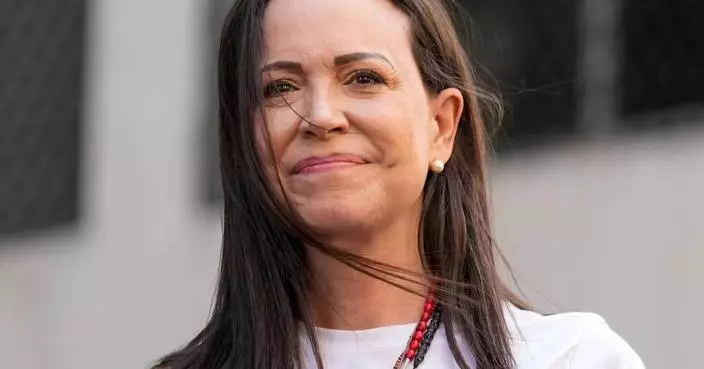
FILE - Opposition leader Maria Corina Machado gestures to supporters during a protest against President Nicolas Maduro the day before his inauguration for a third term, in Caracas, Venezuela, Thursday, Jan. 9, 2025. (AP Photo/Ariana Cubillos, file)
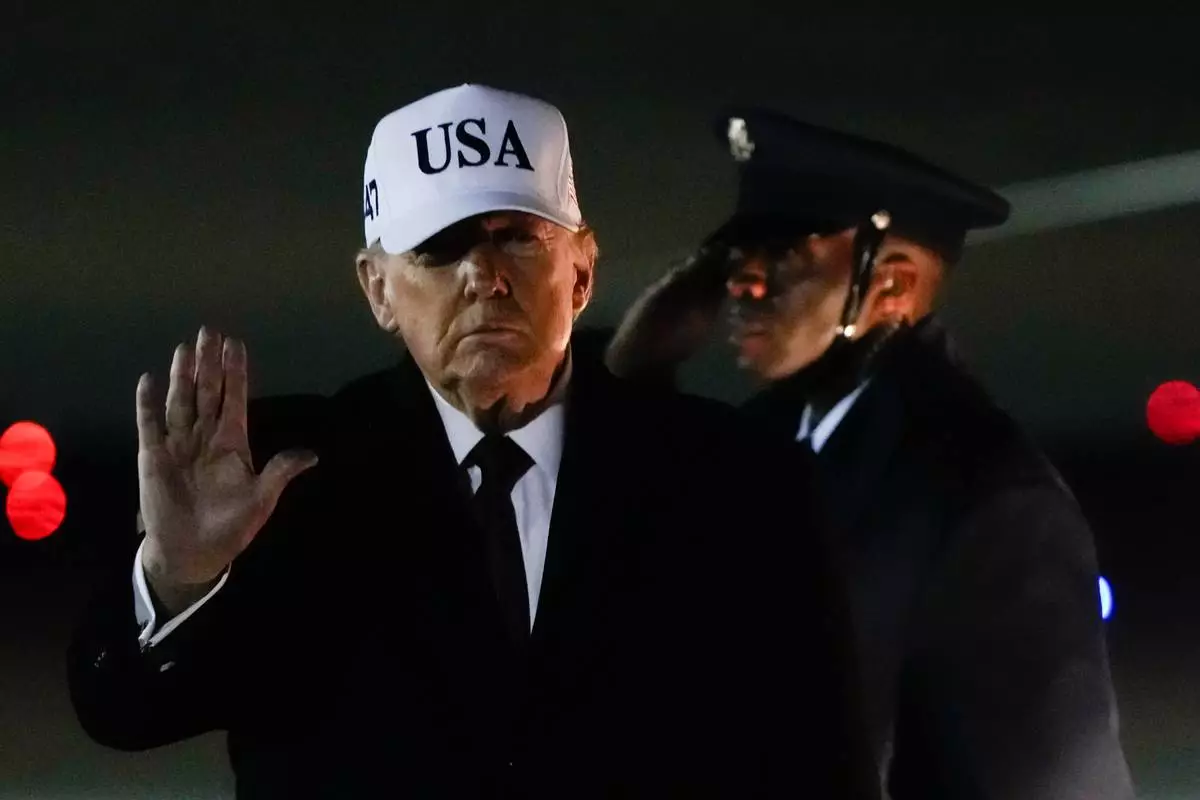
FILE - President Donald Trump waves after arriving on Air Force One from Florida, Jan. 11, 2026, at Joint Base Andrews, Md. (AP Photo/Julia Demaree Nikhinson, File)