Skip to Content Facebook Feature Image

China makes breakthrough in grain output in 2021-2025 period: minister

China

China

China

China makes breakthrough in grain output in 2021-2025 period: minister

2025-09-16 13:37 Last Updated At:15:37

China has made a breakthrough in grain output and better ensured its food security during the 14th Five-Year Plan period (2021-2025), said Minister of Agriculture and Rural Affairs Han Jun on Tuesday.

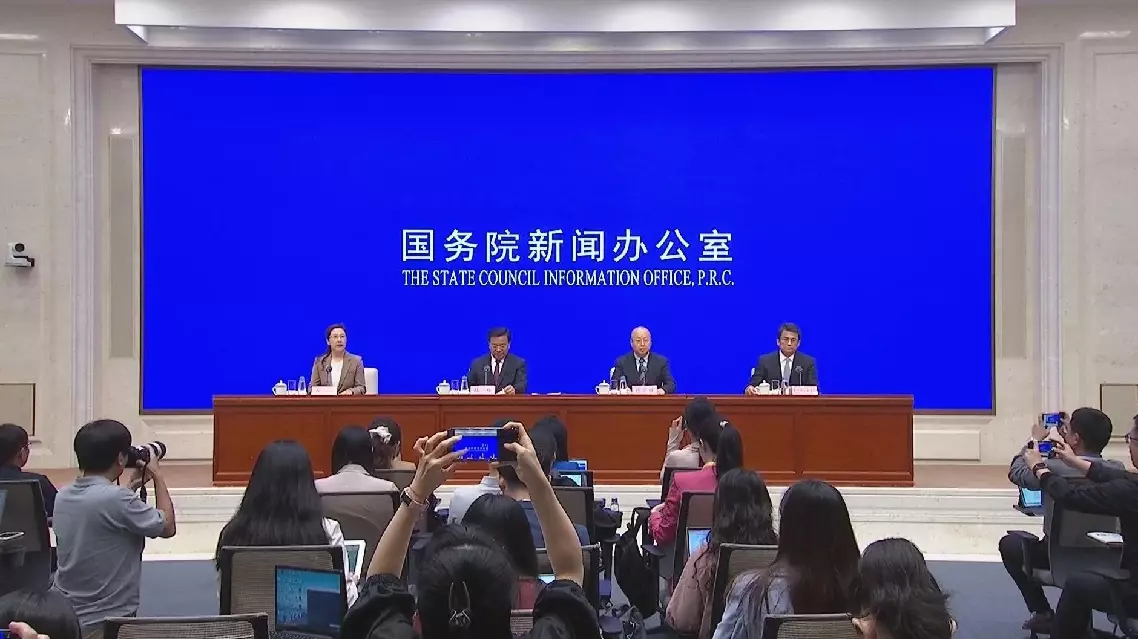
Han made the remarks at a press conference hosted by the State Council Information Office on the achievements in agricultural and rural development during the 14th Five-Year Plan period.

"China has better ensured that food supply remains firmly in its own hands for its 1.4 billion people (during the 14th Five-Year Plan period). The country's grain output has reached a new level during the period, with the total grain output exceeding 1.4 trillion jin (700 million tonnes) for the first time in 2024, an increase of 74 billion jin (37 million tonnes) from 2020. Now China's per capita share of grain has reached 500 kilograms, and our country has achieved basic self-sufficiency in cereal grains and absolute grain security, which fully guarantees national food security," said Han.

According to official data, the rise in production has been underpinned by improvements in farmland infrastructure and agricultural technology.

China has developed more than one billion mu (66.7 million hectares) of high-standard farmland. Meanwhile, sci-tech advancement has become a key driver for grain harvest, with its contribution rate rising to 63.2 percent.

Meanwhile, farmers' incomes have grown at a robust pace since 2021, with rural per capita disposable income reaching 23,119 yuan (about 3,255 U.S. dollars) in 2024, according to the press conference.

China's 2024 grain output hit a record high of 706.5 million tonnes, an increase of 1.6 percent from 2023, official data showed.

Before 2024, the country's annual grain output had been above 650 million tonnes for nine consecutive years, according to data from the National Bureau of Statistics (NBS).

In grain categories, the output of cereals rose 1.7 percent year on year, with rice, wheat and corn all reporting production rises. The output of tubers rose 1.5 percent, the data showed.

Last year's bumper harvest was accompanied by a rise in grain planting areas in the country, which stood at over 119 million hectares, up 0.3 percent year on year. Meanwhile, grain output per unit area also increased 1.3 percent, the data showed.
China makes breakthrough in grain output in 2021-2025 period: minister
China makes breakthrough in grain output in 2021-2025 period: minister
The International Monetary Fund (IMF) has lowered its global economic growth forecasts for 2026 to 3.1 percent in the World Economic Outlook (WEO) report published on Tuesday, while keeping its projection for 2027 at 3.2 percent.

This marks a deceleration from the estimated 3.4 percent growth achieved in 2025. Before the outbreak of the Middle East conflict, the bottom-up forecasts for global growth would have been 3.4 percent in 2026 and 3.2 percent in 2027.

The forecast incorporates the impact of the war and assumes that it will be limited in duration, intensity and scope, with disruptions fading by mid-2026.

Under the reference forecast, global headline inflation is expected to increase to 4.4 percent in 2026 and decline to 3.7 percent in 2027.

If the conflict and the ensuing spike in oil prices last longer, global economic growth in 2026 will fall to 2.5 percent, while global inflation will climb to 5.4 percent, according to the report.

In extreme cases, global economic growth in 2026 could drop to two percent, the report warned.

To be specific, the U.S. economy is projected to grow by 2.3 percent in 2026 and 2.1 percent in 2027, although higher trade barriers introduced since April 2025 are expected to continue to weigh on activity.

In the euro area, growth is projected to decline from 1.4 percent in 2025 to 1.1 percent in 2026 before edging up to 1.2 percent in 2027. The forecasts for 2026 and 2027 are each 0.2 percentage point lower than those compared in the January 2026 WEO Update.

The 2026 growth forecast for emerging market and developing economies is revised down by 0.3 percentage point, to 3.9 percent, while the outlook for advanced economies remains broadly unchanged. With risks still tilted to the downside since the January 2026 WEO Update, the IMF suggested a comprehensive policy package combining domestic measures with coordinated international actions to strengthen resilience and foster adaptability.

It also stated in the report that "trade restrictions play a limited role in correcting imbalances but can worsen output," and urged countries to cooperate and take coordinated actions to restore stability to international economic relations.

IMF lowers global growth forecast for 2026 to 3.1 pct

IMF lowers global growth forecast for 2026 to 3.1 pct

Recommended Articles