Advanced technology is being adopted to help the tomato industry flourish in the Yanqi County of northwest China's Xinjiang Uygur Autonomous Region, with the improved farming and processing procedures enhancing efficiency, lowering costs and ensuring better quality.
With long hours of sunlight and large diurnal temperature variations, Xinjiang has optimal conditions for tomato cultivation. The region ranks among the world's top three centers for tomato processing, while tomato sauce exports from Xinjiang make up 70 percent of China's total.
With September being the peak season for tomato harvesting in Yanqi, harvest machines are roaring back and forth through the more than 5,000-plus hectares of tomato fields across the county, sorting ripe red tomatoes from unripe green ones.
Local farmers note how smart technology is helping to almost instantaneously complete this otherwise rigorous process. "There is a specialized laser selection device inside the harvester, which can identify whether a tomato is green or red. If the tomato does not meet the standards, it will be ejected," said Xu Weizhen, a local tomato farmer.
With the help of this state-of-the-art tomato selection equipment, Xu said he has contracted dozens of hectares of tomato fields this year, making previously arduous work much simpler.
"In the past, harvesting our own one or two hectares of land took more than a week due to the lack of mechanization, and labor costs were significantly higher," said Xu.
Yanqi began cultivating and processing tomatoes back in the 1950s, and the county now contributes 40 percent of Xinjiang's total tomato output.
But while the emphasis is on delivering the best and freshest produce, even unripe tomatoes will not be totally discarded, as they will instead be supplied to local skincare and healthcare companies for their antioxidant properties and ability to combat sun damage.
"We have discovered that unripe tomatoes contain hexahydro- and octahydro-lycopene, which possess greater antioxidant activity and enhanced protection against sun damage compared to traditional lycopene, making them more valuable for skincare and health products," said Wang Xueming, an agricultural engineer.
As of 2024, the areas dedicated to growing tomatoes in Xinjiang have exceeded 80,000 hectares, with the entire processing tomato industry chain now being fully mechanized.
Over 200 companies in Xinjiang are producing a wide range of tomato products, including sauces, juice, lycopene, and seed oil, which are exported to more than 70 countries and regions worldwide.

Advanced tech transforms tomato industry in rural Xinjiang county
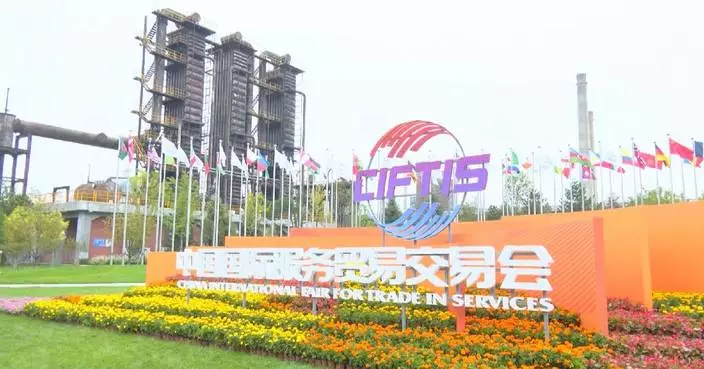
China's homegrown humanoid robots were an interesting highlight at the just-concluded 2026 China International Fair for Trade in Services (CIFTIS), showcasing evolving technologies spanning whole-body locomotion, underlying control, and data collection.
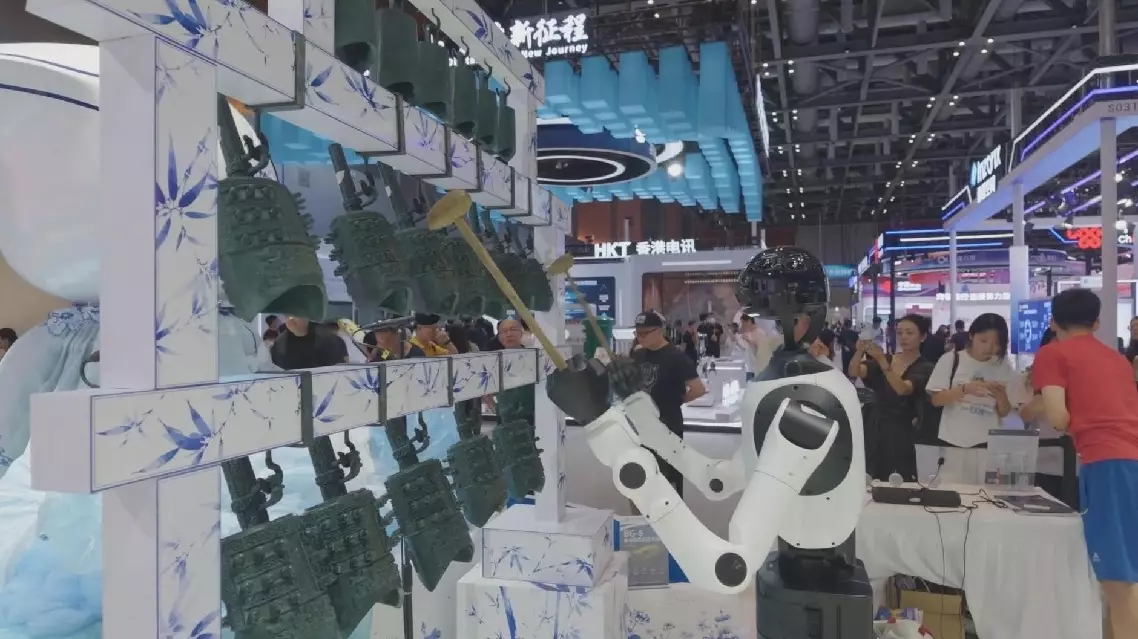
At the telecommunications, computer and information services exhibition area, one highlight is a humanoid robot rhythmically striking a set of ancient bronze bells. With carefully controlled force and steady timing, the machine demonstrates precisely tuned motion and control capabilities that have proved a crowd favorite at this year's fair.
The telecommunications, computer and information services exhibition area features more than 130 enterprises and institutions.
Among the debuts is a domestically developed robot electronic architecture platform. Designed as a unified base layer, the architecture meets functional and performance demands of everyday, industrial and medical scenarios alike, paving the way for more refined real-world deployment.
"This electronic architecture strengthens security functions and can effectively defend against cyberattacks or virus damage. By merging the robot's 'brain' and 'cerebellum' on a unified architecture and simplifying the network, it greatly reduces cost while delivering better performance and easier development," said Li Ping, a representative of the exhibitor.
The high cost of data collection and calibration has long been a bottleneck for the embodied AI sector. To address this, a Chinese company showcased its independently developed simulation training system, which closely replicates physical reality and allows robots to practice and learn from trial and error repeatedly in virtual environments, sharply cutting training costs for embodied AI firms.
To date, the company has made more than 100,000 hours of human behavior datasets open source to the global community, covering over 15,000 distinct scenarios.
"We hope this helps small and medium-sized enterprises and research institutes in China's embodied AI sector train models faster. We are also pushing data standardization, so that multiple teams can reuse one dataset," said Dong Xiaochao, another exhibitor representative.
The 2026 CIFTIS, which concluded in Beijing on Sunday, drew participants from 90 countries, regions, and international organizations, with over 1,800 companies exhibiting services and technologies on site.
The core exhibition area debuted a showcase of more than 140 innovation cases spanning all 12 categories of services trade, including artificial intelligence, large language models, and intelligent agents, offering a glimpse of where China's services sector is headed.
Humanoid robots demonstrate full-chain technological evolution at 2026 CIFTIS in Beijing