Skip to Content Facebook Feature Image

China's coastal Guangdong, Fujian provinces activate emergency response as Typhoon Mitag approaches

China

China

China

China's coastal Guangdong, Fujian provinces activate emergency response as Typhoon Mitag approaches

2025-09-19 15:47 Last Updated At:18:07

China's coastal Guangdong and Fujian provinces have activated emergency response as Typhoon Mitag, the 17th typhoon of 2025, is forecast to make landfall along Guangdong's coast between Huilai and Taishan from Friday afternoon to evening.

Typhoon Mitag is expected to bring strong winds and heavy rainfall to most parts of Guangdong, according to meteorological forecasts.

Due to its impact, torrential rainstorms are expected to affect parts of Guangdong and east China's Fujian Province from Friday to Sunday, the National Meteorological Center said.

Guangdong Province raised its emergency response for wind prevention from level IV to level III at 10:00 on Friday.

At present, 60 passenger ferry routes across Guangdong have been suspended, and over 2,000 people have been evacuated from 35 wind power platforms along the coast.

In the Shenzhen waters, all 1,278 recreational vessels and yachts have returned to port to take shelter from the wind, and all high-speed passenger ships on routes other than those to Hong Kong and Macao have been suspended.

The Fujian Maritime Safety Administration has initiated a Level-IV emergency response for typhoon prevention, designating Zhangzhou as a key area. It has continuously issued typhoon warning information to remind vessels passing by at sea to avoid the impact of the typhoon.

At present, four professional rescue helicopters, 50 coast guard boats and 111 port tugboats have been dynamically deployed to ensure that any maritime danger can be dealt with promptly and effectively.

China's coastal Guangdong, Fujian provinces activate emergency response as Typhoon Mitag approaches

China's coastal Guangdong, Fujian provinces activate emergency response as Typhoon Mitag approaches

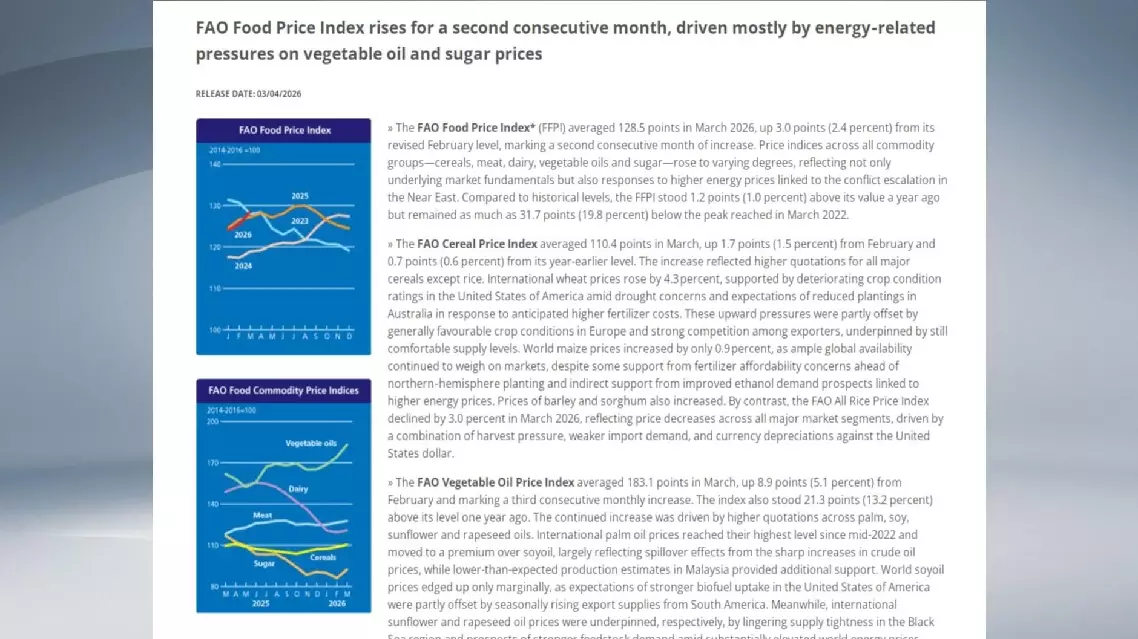
Global food commodity prices climbed for a second consecutive month in March, driven mainly by higher energy costs linked to escalating conflict in the Middle East, the Food and Agriculture Organization of the United Nations (FAO) said in report released on Friday.

The FAO Food Price Index, which tracks monthly changes in the international prices of a basket of globally traded food commodities, averaged 128.5 points in March, up 2.4 percent from February and 1.0 percent above its level a year ago.

According to the report, the FAO Vegetable Oil Index and Sugar Price Index showed the largest increases, up 5.1 percent and 7.2 percent, respectively.

The FAO Cereal Price Index increased by 1.5 percent from the previous month, driven primarily by higher world wheat prices, which rose 4.3 percent.

The FAO Meat Price Index rose by 1.0 percent from the previous month, and the FAO All-Rice Price Index declined by 3.0 percent in March, according to the report.

FAO stated that rising energy and fertilizer prices have been driving up agricultural input costs.

If the conflict stretches beyond 40 days, farmers will have to choose to farm the same with fewer inputs, plant less, or switch to less intensive fertilizer crops, according to FAO Chief Economist Maximo Torero.

These choices will hit future yields and shape food supply and commodity prices for the rest of this year and beyond, Torero said.

Global food prices rise for 2nd consecutive month in March amid Middle East conflict: FAO

Global food prices rise for 2nd consecutive month in March amid Middle East conflict: FAO

Recommended Articles