A United Nations World Food Programme (WFP) project, supported by China, has provided hot meals for over 100,000 children in Kyrgyzstan so far this year, investing in a brighter future for tens of thousands of young students.
Dilshod Ismanaliev works as the head of the Osh Office for the UN WFP in Kyrgyzstan, in charge of the UN's school meal programs in the country's southern region. His work involves overseeing hundreds of schools, traveling thousands of kilometers of roads, conducting dozens of quality inspections, and leading a full team of experts in their daily collaborations.
Raised in the Osh region, Ismanaliev still has a memory of how his friends struggled to focus in class due to skipping breakfast. This memory fueled his determination to ensure children have access to meals, inspiring his work to put food on their tables as an adult.
The UN project is implemented in partnership with China's International Development Cooperation Agency, with support from the South-South Cooperation Assistance Fund.
This year alone, the project has provided hot meals for 100,000 school children in Kyrgyzstan. More than 1,700 tons of food will be delivered to 300 schools across the country.
"The project will continue until 2027. A diverse diet is very important for children's health and growth. When we hear words of gratitude from their parents, from school administrators, it means a lot to us, to our organization. We are genuinely happy for them," said Ismanaliev.
Both children and school canteen staff are happy with the project.
"I had delicious soup today. My friends and I love coming to our cafeteria and having lunch together," said Maksut Zhusupov, a first-grade student.
"Here, we prepare hot meals for 370 children. This support from the UN and the Chinese government is not just aid for today, it's an investment for the future. Studies show that children who receive hot meals perform better in school and get sick less often," said Salima Faizilova, a canteen staff member.
Ismanaliev said the project even helped to improve school attendance.
"School attendance has improved since the introduction of the hot meal programs. Students now come to class and also get to enjoy a hot meal," he said.
This year marks the 80th anniversary of the founding of the United Nations. Ismanaliev said as a UN staff in Kyrgyzstan, he is delighted to see his daily work is not only benefiting his home country, but making the world a better place.
"I hope my work in the UN matters not just for one village, one district, or one city, but for the entire country. We want to help people even beyond the borders," said Ismanaliev.
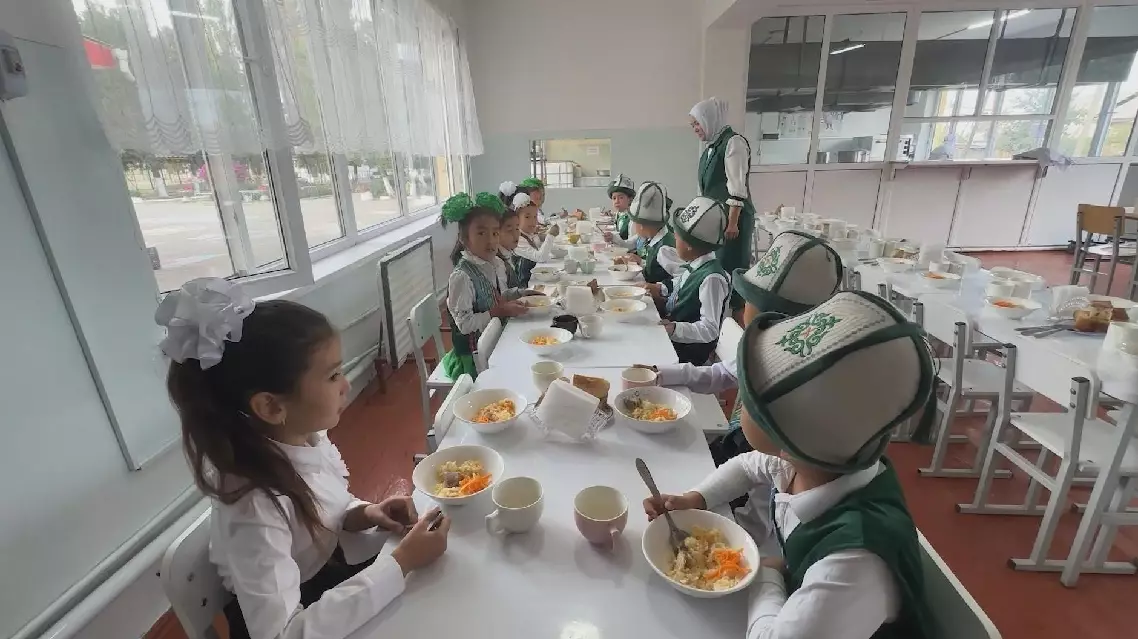
China-supported UN project provides school meals for children in Kyrgyzstan
China's Large High Altitude Air Shower Observatory (LHAASO), a high-altitude cosmic ray observatory in Sichuan Province, is pushing the boundaries of astrophysics by bringing humanity closer to answering the century-long question of the origins of ultra-high-energy cosmic rays.
Completed in 2021, LHAASO sprawls across an area the size of 190 football fields. It is the world’s highest-altitude, largest-scale, and most sensitive observatory for detecting cosmic ray particles as they enter Earth’s atmosphere.
The project traces back two decades, when physicist Cao Zhen envisioned China taking a decisive role in this frontier of science.
"Each particle has the energy much higher than what we can produce on Earth. We don't know where it was produced. This is the fascinating question that has bothered people for 100 years already. First of all, (we) go to the high altitude -- the higher [you go], the less the influence from the atmosphere. And then we decided to build such a large-scale experiment: the larger, you get more cosmic rays," said Cao Zhen, chief scientist at LHAASO and a researcher at the Institute of High Energy Physics under the Chinese Academy of Sciences (CAS).
LHAASO functions as a giant set of "eyes" -- detectors that track cosmic ray particles invisible to the human eye. At its core lies a warehouse the size of 2.5 National Aquatic Centers, housing the world's most sensitive gamma-ray telescope.
Surrounding it are raised mounds -- muon detectors engineered to absorb photons and electrons while allowing only highly penetrating muons to pass through. Scattered among them, 18 blue, container-shaped telescopes complete the vast array.
Despite the thin atmosphere at an altitude of over 4,400 meters, China completed the construction of LHAASO in under five years, showcasing a remarkable feat of human endurance.
"Some of our detectors work perfectly fine in the lab, but they might malfunction when installed here because of the high-altitude environment. During the day, with the sun, the humidity is only about 20 to 30 percent, but at night it rises rapidly, reaching 100 percent. In addition, the detectors are also affected by temperature, wind, and extreme weather," said Wang Yudong, a researcher at the Institute of High Energy Physics.
The effort quickly began to yield results. In 2020, even before the observatory was fully completed, scientists using LHAASO's partial array identified 12 ultra-high-energy gamma-ray sources. Two years later, in October 2022, the facility captured an extraordinary event: a millennial gamma-ray burst, a dazzling "cosmic firework" triggered by the collapse of a massive star some two billion years ago.
LHAASO is but one of 77 mega-science infrastructures now operating across China. Over the past five years, these facilities have propelled the country to the forefront of high-impact publications and patent applications, unraveling cosmic mysteries, advancing core technologies, and driving industrial progress along the way.
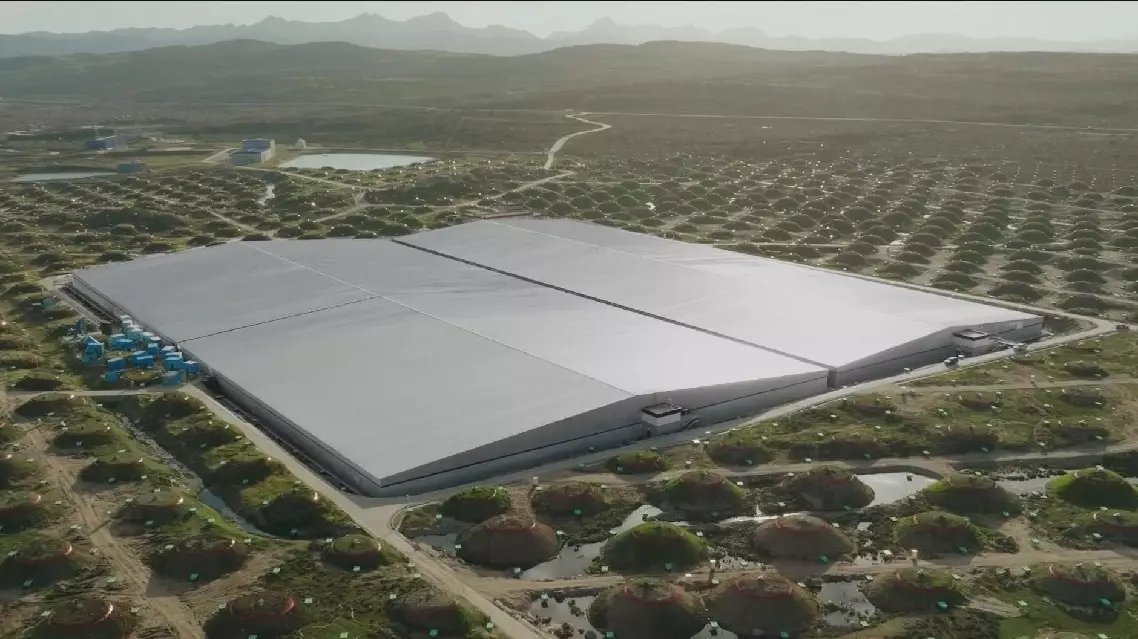
China's LHAASO edges closer to solving cosmic ray mystery