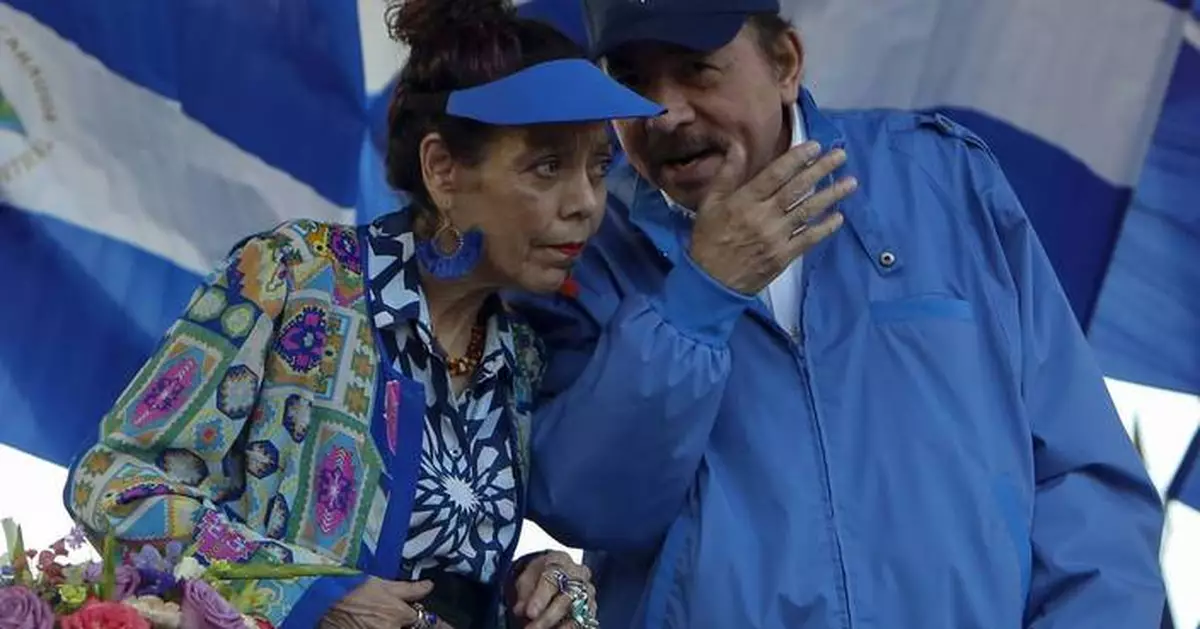
MEXICO CITY (AP) — A new United Nations report details a Nicaragua tightly in the grasp of co-Presidents Daniel Ortega and his wife Rosario Murillo, where the legislative and judicial branches answer to the executive and basic human rights protections are gone.
Little of that will come as a surprise to the tens of thousands of Nicaraguans who have the fled country in recent years, but the report of the U.N. High Commissioner for Human Rights discusses the Central American country’s continuing deterioration in the starkest terms.
The report scheduled to be presented in Geneva Tuesday, was compiled from more than 200 interviews with victims, witnesses and other sources. The U.N. human rights office does not have access to Nicaragua and the government did not respond to its questionnaire.
A major constitutional reform adopted in January reduces “the legislative and judicial branches to entities coordinated by and subordinated to the presidency,” while the public prosecutor’s office “was placed under direct presidential control,” the report said.
The U.N. denounced “the constitutional recognition of paramilitary forces, the institutionalized use of informant networks and surveillance and the misapplication of criminal offenses.”
“Such frameworks have created a context in which any person perceived as opposing the authorities may be subjected to retaliation,” the report said.
Andrés Sánchez Thorin, the U.N. Human Rights Office representative in Central America, said Ortega and Murillo had essentially wiped out Nicaraguan civil society.
“Since 2018, eight of every 10 organizations have been canceled or had to close, many of them religious and their assets confiscated,” he said. “Add to this a reform to the electoral system that puts political pluralism in serious danger, and with it, people’s fundamental right to participate in the democratic life of the country.”
The crackdown started with violent government repression of 2018 protests that left more than 300 dead and led to an exodus of journalists and civil society. Ortega has framed those protests as an attempted coup with foreign backing.
Since then, the Nicaraguan government “has deliberately transformed the country into an authoritarian state,” U.N. experts said in February.

FILE - Nicaragua's President Daniel Ortega and his wife and Vice President Rosario Murillo attend a rally in Managua, Nicaragua, Sept. 5, 2018. (AP Photo/Alfredo Zuniga, File)
PORTLAND, Ore. (AP) — A group of mostly Democratic U.S. senators sent a letter Thursday to the U.S. Postal Service, voicing concern that mail processing changes could affect postmark dates for mail-in ballots during an election year that will determine control of Congress.
Updated agency policy says postmarks might not indicate the first day the Postal Service received the mail but rather the day it was handled in one of its processing centers. Those centers are increasingly likely to be further away from certain communities because of recent USPS consolidations, which could further delay postmarks, the 16 senators wrote.
“Postmark delays are especially problematic in states that vote entirely or largely by mail,” they wrote to Postmaster General David Steiner, noting that many states use postmark dates to determine whether a mail ballot can be counted. “These changes will only increase the likelihood of voter disenfranchisement.”
The consequences could be particularly acute in rural areas where mail has to travel farther to reach regional processing centers, they added.
“In theory, a rural voter could submit their ballot in time according to their state law, but due to the changes you are implementing, their legally-cast ballot would not be counted as it sits in a local post office,” they wrote. “As we enter a year with many local and federal elections, the risk of disrupting this vital democratic process demands your attention and action.”
The Postal Service has received the letter and will respond directly to those who sent it, spokesperson Martha Johnson said.
The agency addresses the issue on its website.
“While we are not changing our postmarking practices, we have made adjustments to our transportation operations that will result in some mailpieces not arriving at our originating processing facilities on the same day that they are mailed,” its website says. “This means that the date on the postmarks applied at our processing facilities will not necessarily match the date on which the customer’s mailpiece was collected by a letter carrier or dropped off at a retail location.”
Johnson said the language in the final rule “does not change any existing postal operations or postmarking practices.” She added that the agency looked forward to “clarifying the senators' misunderstanding.”
“Our public filing was made to enhance public understanding of exactly what a postmark represents, its relationship to the date of mailing and when a postmark is applied in the process,” she said.
People dropping off mail at a post office can request that a postmark be applied manually, ensuring the postmark date matches the mailing date, the Postal Service's website says. Manual postmarks are free of charge.
The agency said the “lack of alignment” between the mailing date and postmark date will become more common as it implements its initiative to overhaul processing and transportation networks with an emphasis on regional hubs. The aim of the initiative is to cut costs for the agency, which has grappled with losses in the billions of dollars in recent years.
Under the plan, the Postal Service got rid of twice-daily mail dispatches from local post offices to regional processing centers. That means mail received after the only transfer truck leaves sits overnight until the next daily transfer, the senators wrote.
Election officials in states that rely heavily on voting by mail expressed concern with the change.
“Not being able to have faith that the Postal Service will mark ballots on the day they are submitted and mail them in a timely manner undermines vote-by-mail voting, in turn undermining California and other elections,” California Secretary of State Shirley Weber said in a statement.
She said her office will “amplify messaging to voters” who use mailed ballots that they must return their ballots early if they plan to use the post office.
Election officials in Washington state, where voting is done almost entirely by mail, are recommending that those who return their ballot within a week of Election Day do so at a drop box or voting center.
“Given the operational and logistical priorities recently set by the USPS, there is no guarantee that ballots returned via mail will be postmarked by the USPS the same day they are mailed,” the secretary of state's office said in a statement.
The senators urged Steiner to restore “timely postmarks” and fully stand up an election mail task force. The lawmakers who signed the letter represented California, Nevada, Oregon, Washington, Minnesota, Wisconsin, Illinois, Maine, Connecticut, New Jersey and Maryland. All are Democrats but one, an independent who typically aligns with the Democratic Party.
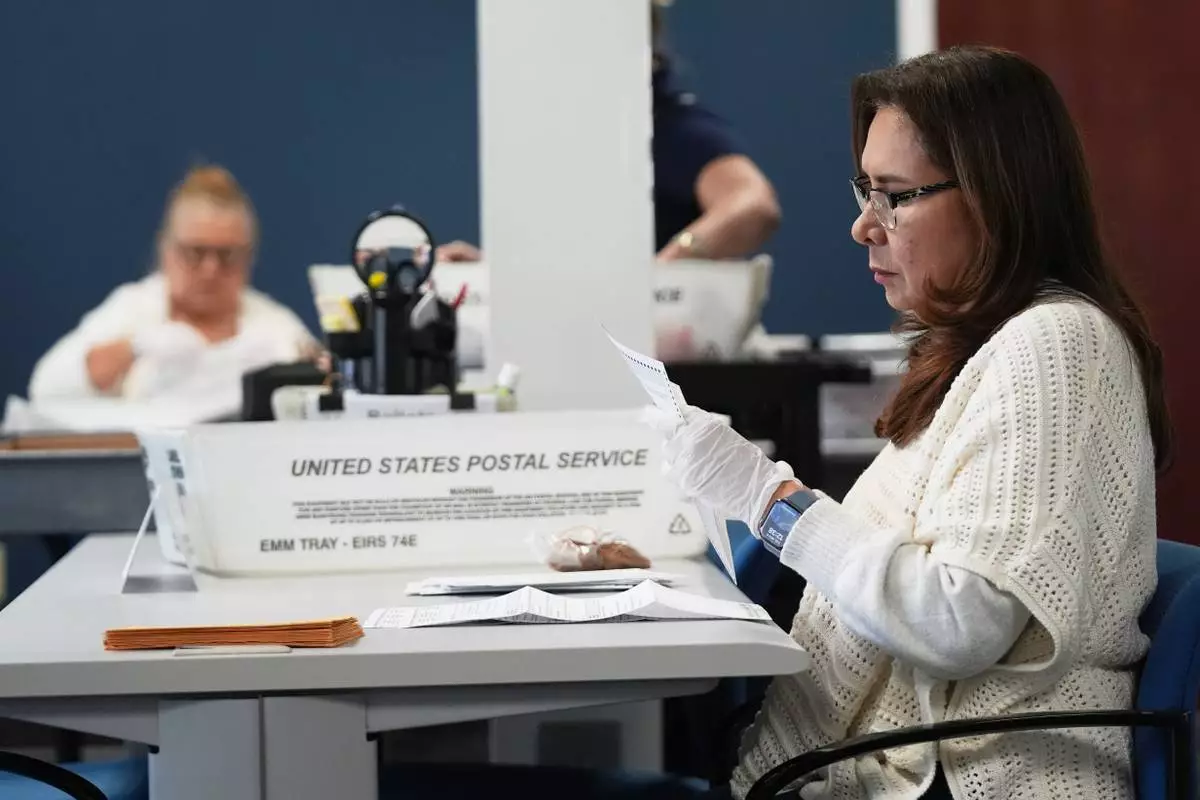
FILE - Employees sort vote-by-mail ballots from municipal elections on Election Day at the Miami-Dade County Supervisor of Elections Office, Nov. 4, 2025, in Doral, Fla. (AP Photo/Lynne Sladky, File)