Nearly 1,000 protesters on Friday took to the street of New York City, calling for an immediate ceasefire and an end to blockade and bombardment in the Gaza Strip, while Israeli Prime Minister Benjamin Netanyahu addressed the United Nations General Assembly (UNGA).
Holding placards with contents including calls for an immediate ceasefire and a stop of U.S. aid to Israel, these protesters marched from Times Square to UN headquarters.
Some of them voiced their concerns, saying that the conflict in Gaza has transformed into a severe humanitarian disaster, as continuous bombing left countless civilians homeless, which led to the spread of famine and disease. They urged the international community to take immediate action to halt the violence and push for a ceasefire.
"We are witnessing the murder of innocent people, the Palestinians. This is what is required of the General Assembly. It's incumbent upon them to stand up and do what's right. There shouldn't be another day, another hundreds of deaths," said Yisroel Dovid Weiss, a protester.
"Right now, the people of Gaza are starving to death in a world where there's food 100 meters away and they can't get to it. That's a genocide," said Savitri, another protester.
Some protesters also maintained that the military support and the political indulgence from the United States to Israel would further deteriorate the situation.
"We're supplying Israel with bombs and weapons to allow these atrocities to happen. It's outrageous. Our government should be as complicit in the genocide that's going on in Gaza," said Jeff, a protester.
"Israel is using the U.S. and the U.S. is using Israel. It's an instrumentalized, transactional relationship. It's not based on anything except transactionality. And it has to stop," said Savitri.
While the protest proceeded on the street, many delegates walked out of the UNGA hall, also in protest following the beginning of Netanyahu's speech at the UN.
In his address, Netanyahu criticized those countries announcing their recognition of the State of Palestine over the past few days, saying, "You know what message the leaders who recognized a Palestinian state this week sent to the Palestinians? It's a very clear message. Murdering Jews pays off."
France, Britain, Portugal, Australia and Canada are among Western nations that have recently recognized the State of Palestine in support of the two-state solution over the past few days. So far, more than 150 UN member states have recognized Palestine as a state.
Scores of delegates walked out of the General Assembly hall in protest when Netanyahu took the stage. He was booed by some delegates, but was applauded by some others.
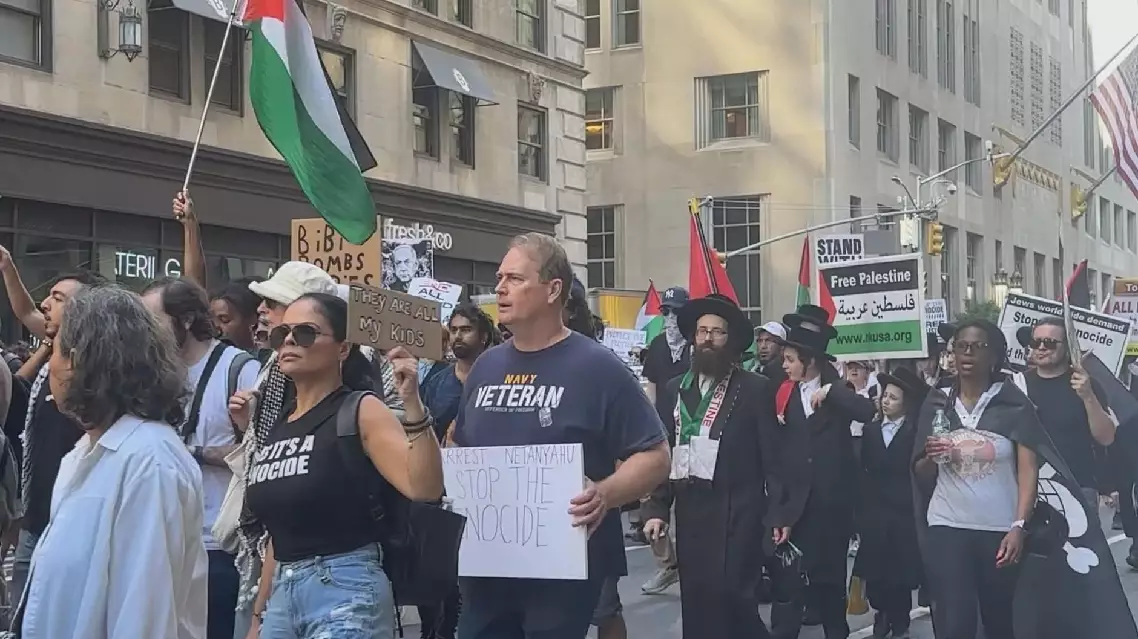
Large protest unfolds in New York City against Netanyahu’s speech in UN
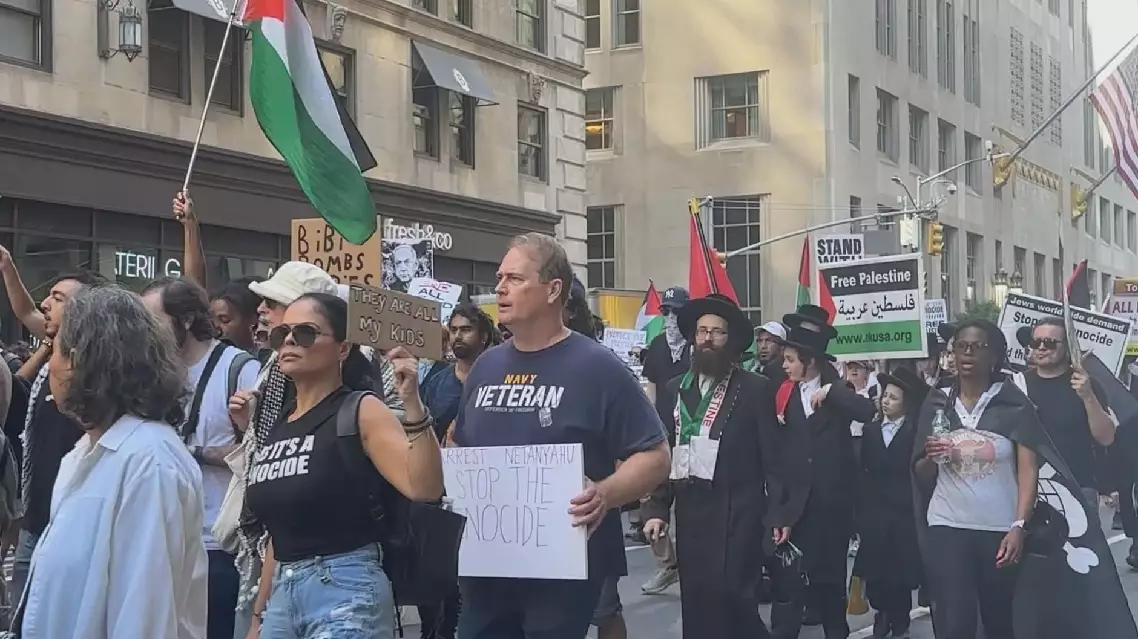
Large protest unfolds in New York City against Netanyahu’s speech in UN