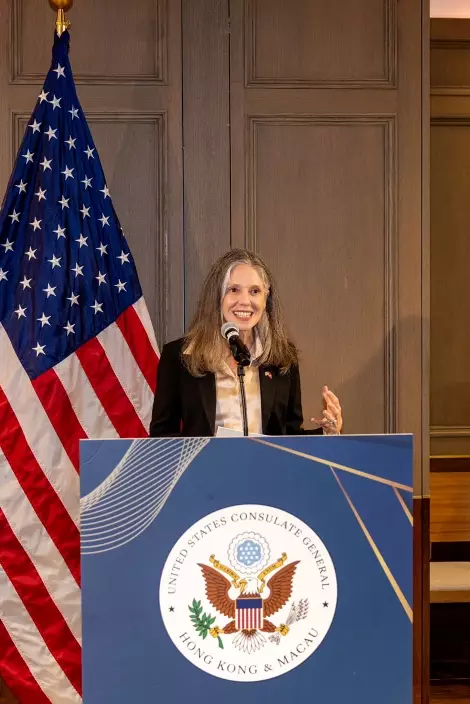
According to a statement from the Foreign Ministry Commissioner's Office in Hong Kong, Commissioner Cui Jianchun had met with the city's new US Consul General, Julie Eadeh who paid a formal visit to the Office on September 23.
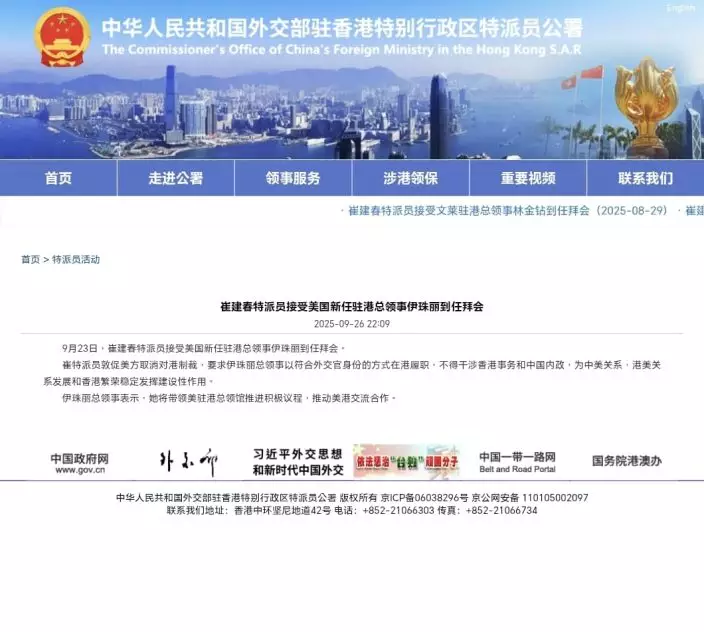
The official press release from the Foreign Ministry Commissioner's Office.
During Eadeh’s visit, Cui bluntly advised the US to drop its sanctions against Hong Kong and demanded that Eadeh stick to her job as a diplomat. The message was unmistakable: stop meddling in Hong Kong and China's internal affairs, and start acting constructively for the good of China-US relations and the city's stability.
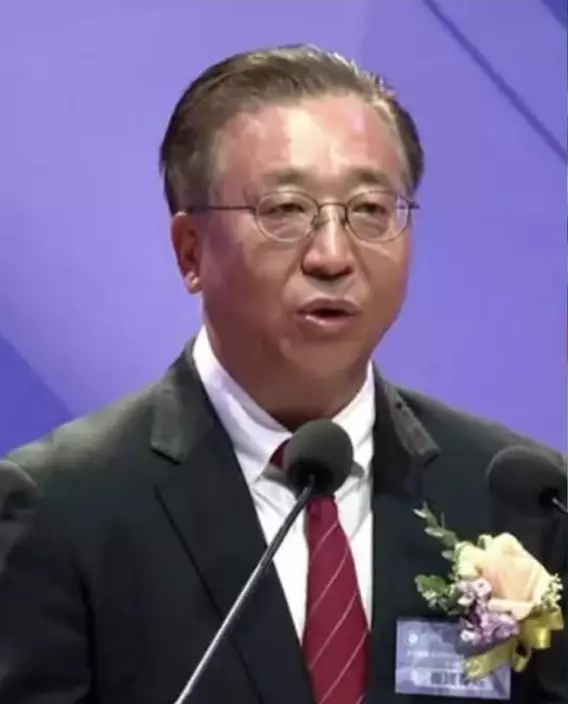
Commissioner Cui Jianchun lays down the rules for new US Consul General Julie Eadeh during their first official meeting on September 23.
According the FMCO statement, Eadeh responded by saying that she would lead the consulate to push a "positive agenda" and foster exchanges between the US and Hong Kong.
Eadeh, who took over as Consul General for Hong Kong and Macau in August, has already caused a stir. She recently held two inaugural receptions and made a point of inviting opposition figures like Anson Chan and Emily Lau. Beijing was not amused, viewing her actions as overstepping, provocatively motivated, and a clear case of interfering in China's domestic politics.
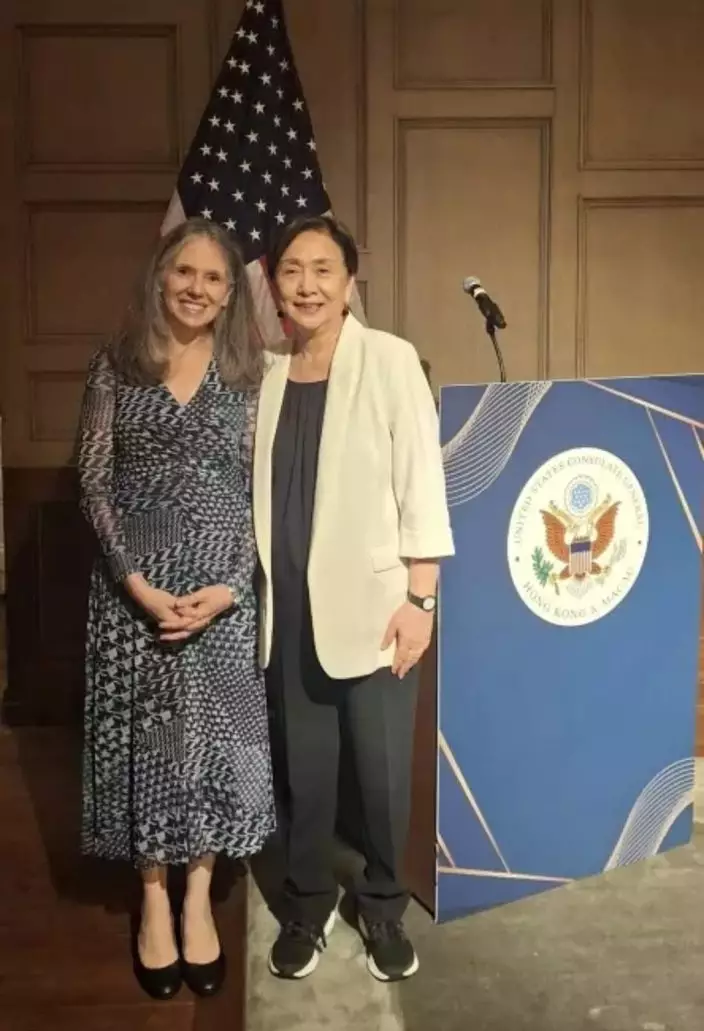
Opposition figure Emily Lau's Facebook post with Julie Eadeh, which helped trigger the diplomatic friction.
According to one expert, Cui Jianchun's pointed reminder for Eadeh to "act like a diplomat" and "stay out of Hong Kong's affairs" was nothing less than drawing a red line. The message is simple: if Eadeh continues to meddle, she can expect a forceful response.
Ariel
** 博客文章文責自負,不代表本公司立場 **
It seems some people just can't take a hint. The new US Consul General to Hong Kong and Macau, Julie Eadeh, who only just took up her post last month, is already making waves.
Déjà Vu: The US Plays Its Old Hand
Julie Eadeh recently hosted two receptions, inviting none other than former Chief Secretary for Administration Anson Chan and former Democratic Party chairwoman Emily Lau. In a swift and unambiguous response, the Hong Kong and Macao Affairs Office (HKMAO) on Wednesday twice republished articles from Wen Wei Po, calling out Chan and Lau by name. The message was crystal clear: collusion with forces aiming to incite chaos will not be tolerated, and their subversive actions have been put on notice.
The Wen Wei Po report republished by the HKMAO, titled "Citizens Rally at US Consulate, Slam Consul’s Collusion with Troublemakers" put Anson Chan squarely in the spotlight.
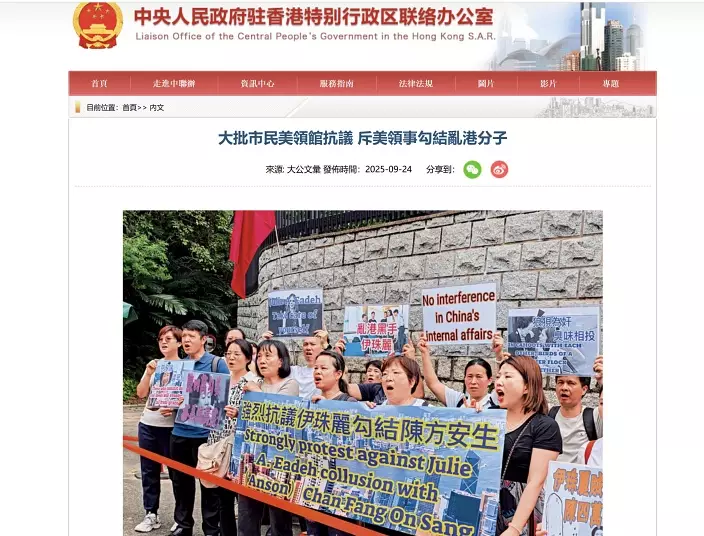
Wen Wei: Strong Citizen Pushback at US Consulate
According to the report, Consul General Julie Eadeh seems to be picking up right where her predecessors left off. Online media reported her attempt to collude with Anson Chan, a known chaos-inciting element, to stir up trouble in Hong Kong. On September 23rd, numerous citizens gathered outside the US Consulate General to protest, demanding that the US and its personnel stop meddling in Hong Kong's affairs and, by extension, China's internal matters.
The article, citing local online sources, noted that Chan had recently been invited by Eadeh to an event at The American Club in Central. This news prompted several groups of citizens to organize spontaneous protests. Around 20 demonstrators gathered outside the Consulate, unfurling a banner that read, "Strongly condemn Julie Eadeh for colluding with anti-China, chaos-inciting element Anson Chan." They held signs with slogans like "Colluding with anti-China, chaos-inciting elements is shameful" and "Do not bring chaos to Hong Kong," while repeatedly chanting their condemnation of Eadeh's actions.
On the same day, the HKMAO website shared another Wen Wei Po piece, titled "National Security Barrier is Firmly in Place, Chaos-Inciting Forces Will Not Be Tolerated." This article widened the net, not only scrutinizing the Eadeh-Chan meeting but also putting Emily Lau on blast.
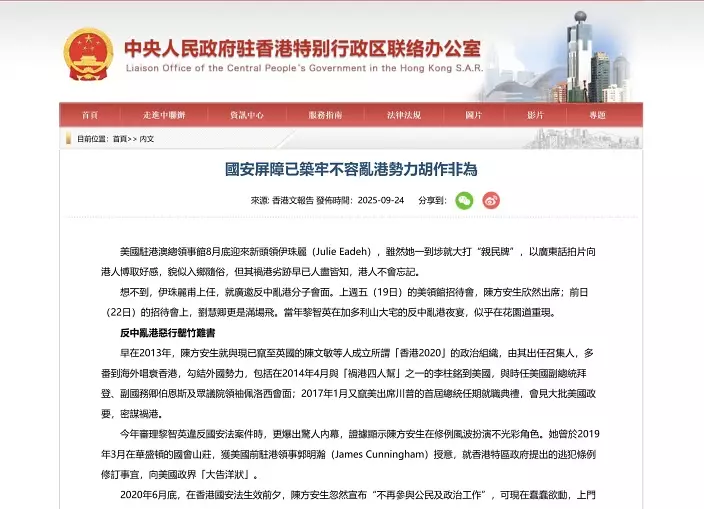
Wen Wei article republished by HKMAO: No Room Left for Chaos—National Security Barrier Sealed
Describing her as "unwilling to be forgotten," the article pointed out that "after the implementation of the Hong Kong National Security Law, she has not stopped engaging in soft resistance, and even after the disbandment of the Democratic Party, she has shown no signs of restraint." Her behavior at the US consulate's reception, where she was seen "flitting about the room," was compared to the infamous anti-China banquets once hosted by Jimmy Lai at his Kadoorie Hill mansion.
The Usual Suspects Reemerge
The article delved into Anson Chan's long history of colluding with foreign powers. As far back as 2013, she, along with Johannes Chan—who has since fled to the UK—and others, founded the political group "Hong Kong 2020." She repeatedly traveled abroad to smear Hong Kong's name, including a trip to the US in April 2014 with Martin Lee to meet with then-Vice President Joe Biden, Deputy Secretary of State William Burns, and House Speaker Nancy Pelosi. In January 2017, she again scurried to the US for Donald Trump's presidential inauguration, meeting with numerous American officials to conspire against Hong Kong.
Furthermore, this year's trial of Jimmy Lai for violating the National Security Law unearthed some shocking details. Evidence revealed that Anson Chan played a disgraceful part in the 2019 anti-extradition bill turmoil. It came to light that in March 2019, on Capitol Hill in Washington, she was instructed by former US Consul General James Cunningham to "lodge a complaint with foreigners," effectively bad-mouthing the SAR government's proposed amendments to US political circles.
Remember when Anson Chan announced she would "no longer participate in civic and political work" right before the National Security Law was enacted in June 2020? Well, that promise has seemingly gone out the window. Her recent re-emergence to kowtow to Julie Eadeh shows her integrity is bankrupt. Her claim of retiring from politics was nothing more than a disingenuous, self-deceiving lie.
Emily Lau: A Desperate Grab for Relevance
The article argues that Emily Lau is even more "unreconciled" than Chan. Since the National Security Law's implementation, she has relentlessly engaged in "soft resistance." Even after the Democratic Party disbanded, she hasn't slowed down. She uses her personal channel, "ChatDP with Emily Lau," to give a platform to anti-China, chaos-inciting figures, and is a frequent visitor to Stanley Prison, always making sure to post a photo on social media after visiting her incarcerated comrades.
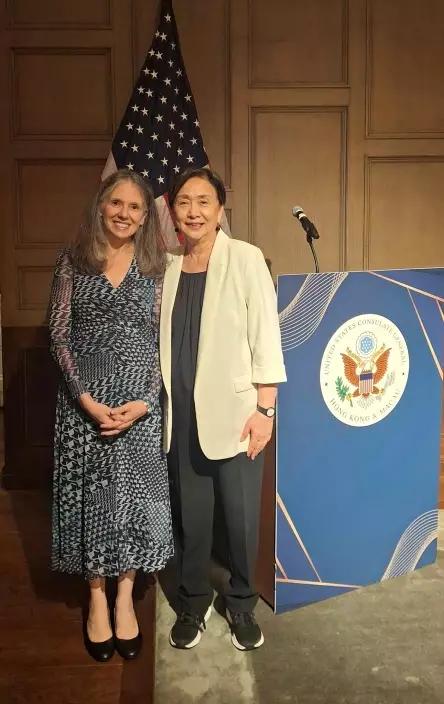
Emily Lau Flaunts Meeting With US Consul Julie Eadeh (FB photo)
Her quick response to Eadeh's "call to assemble" at the US consulate is seen as a blatant attempt to claw back some political capital and "add value" to her own dwindling relevance.
This isn't Eadeh's first rodeo. The article recalls how in August 2019, when she was the head of the US consulate's political unit, she held a secret meeting with Joshua Wong and Nathan Law of the now-defunct anti-China group "Demosistō" in an Admiralty hotel. The day after their clandestine meeting, "Demosistō" announced plans for a city-wide class boycott.
2019: Eadeh Caught in Secret Hotel Meet-Up with the “Demosistō ringleaders” (FB photo)
Back then, the Office of the Commissioner of the Ministry of Foreign Affairs in Hong Kong acted swiftly. It urgently summoned senior officials from the US Consulate General to make a solemn representation, demanding that they "immediately make a clean break from anti-China forces who stir up trouble in Hong Kong, stop sending out wrong signals to violent offenders, refrain from meddling with Hong Kong affairs, and avoid going further down the wrong path." The warning was stern and direct.
The New Reality in Hong Kong
The article concludes with a powerful reminder. With the Hong Kong National Security Law and the Safeguarding National Security Ordinance now firmly in place, Hong Kong has "built an indestructible national security barrier." The city will absolutely not allow internal and external anti-China forces to act recklessly again. It's a stark warning to those pawns who still harbor ambitions of acting as agents for foreign powers: watch your step.
As one pundit noted, the open collusion between Anson Chan, Emily Lau, and foreign forces prompted this rare public warning from the HKMAO via republished articles. It underscores a new reality: the perfected national security legal framework will not tolerate any reckless behavior from anti-China, chaos-inciting elements. All sectors in Hong Kong must remain vigilant against the revival of these destructive forces.