The world's largest indoor ski center officially opened in south China's Shenzhen City on Monday, giving visitors the chance to experience the thrill of snow sports all year round in a city which is typically known for its tropical climate.
The Shenzhen Huafa Qianhai Ice and Snow World covers about 100,000 square meters, equivalent to the size 11 soccer fields, and has been recognized by the Guinness World Records as the largest facility of its kind anywhere on the globe. The complex boasts five ski runs, the longest one stretching 450 meters, as well as an 83-meter-high ski jump.
The groundbreaking project is poised to redefine winter sports in southern China, offering a fresh tourism experience and driving economic growth in the region.
The facility is set to see a big influx of visitors during China's week-long National Day holiday period which began Wednesday, and even from its opening day, the resort has drawn skiing enthusiasts from all around the world.
"There's no snow in Shenzhen unfortunately, but as Shenzhen's got money [to develop this], it gets a wonderful mountain, small mountain [at this indoor facility]," said Landais Christophe, a visitor from France.
China has already opened several other indoor ski venues, including one in the nearby city of Guangzhou, but what makes this new snow resort stand out from others is its record-breaking scale and world-class infrastructure.
"This is the world's largest indoor snow resort, spanning 100,000 square meters. Our facility features five ski slopes, each equipped with cable cars and conveyor belts. Two of our slopes are certified by the International Ski Federation for professional competitions," said Zhang Ye, manager of the training center of the Shenzhen Qianhai Huafa Ice and Snow Sports.
Beyond skiing, the project is set to become a major economic driver for the Greater Bay Area, a major city cluster across south China, and is expected to entice visitors from other countries across the region.
"This facility is not only going to attract people in Shenzhen but also people in the Greater Bay Area and the southeastern part of Asia, for example, like Thailand, like Vietnam. This differentiation will bring economic and social and cultural benefits to the whole society," said Wu Haifeng, director of the Center for Sustainable Finance at the Chinese University of Hong Kong (Shenzhen).
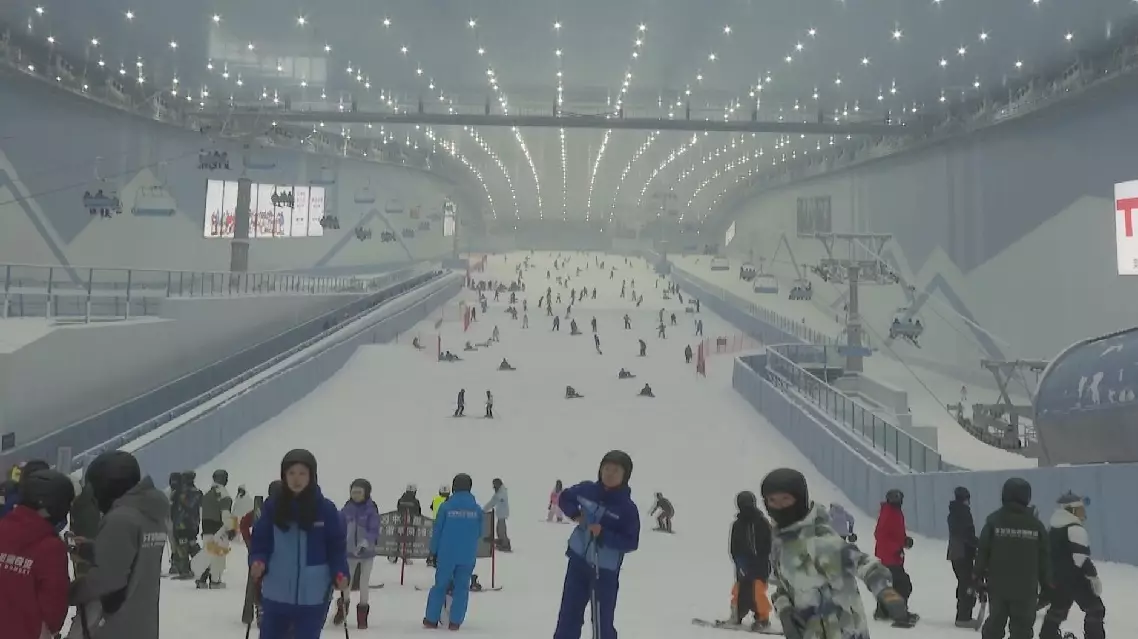
World's largest indoor ski center opens in south China's Shenzhen

The disciplinary body of the Communist Party of China (CPC) has called for reinforced anti-corruption efforts during the 15th Five-Year Plan period (2026-2030).
The call was made in a communique adopted at the fifth plenary session of the 20th CPC Central Commission for Discipline Inspection (CCDI), held from Monday to Wednesday in Beijing.
Xi Jinping, general secretary of the CPC Central Committee, Chinese president and chairman of the Central Military Commission, attended the session and delivered an important speech.
The plenary session reviewed the discipline inspection and supervision work during 2025 and assigned tasks for 2026. It adopted a work report delivered by Li Xi, a member of the Standing Committee of the Political Bureau of the CPC Central Committee and secretary of the CCDI, on behalf of the Standing Committee of the CCDI.
The session unanimously agreed to take guidance from Xi's important speech, persistently strengthen political oversight, and remain steadfast in improving conduct, enforcing discipline, and combating corruption.
It was noted at the session that in 2025, the top disciplinary body investigated, punished, and publicly exposed typical cases of discipline violations, to further promote improved work conduct and foster new practices across the Party.
Efforts were intensified to address corruption in key sectors such as finance, state-owned enterprises, energy, firefighting, tobacco, pharmaceuticals, higher education, and sports.
Campaigns were deepened to tackle misconduct and corruption that occurred at people's doorsteps. Reform of the discipline inspection and supervision system was also advanced in greater depth.
The session stressed that as China advances into the 15th Five-Year Plan period, the CPC faces fresh imperatives in advancing full and rigorous Party self-governance and must take more forceful and effective measures to eradicate the breeding ground and conditions for corruption.
The session emphasized the necessity of strengthening political oversight to support the achievement of the period's objectives and tasks. It called for taking strict actions against behavior in disregard of the rules, opportunism, sectarianism, a silo mentality, and unprincipled nice-guyism.
The session also urged improving long-term mechanisms to refine codes of conduct, while ramping up efforts to combat corruption in high-priority sectors. It further mandated tough scrutiny and punishment for collusion between officials and businessmen.
In addition, the session demanded more standardized and law-based discipline inspection and supervision work.
Party and state leaders including Li Qiang, Zhao Leji, Wang Huning, Cai Qi, Ding Xuexiang and Li Xi attended the session.
CPC calls for reinforced anti-corruption efforts during 15th Five-Year Plan period