With the Mid-Autumn Festival coinciding with China's National Day holiday this year, people across the country are celebrating the occasion with activities steeped in traditional culture.
Celebrated annually on the 15th day of the eighth month on the Chinese calendar, the Mid-Autumn Festival is a celebration of the harvest season and an occasion for family reunions. As one of China's most cherished traditional holidays, it carries a long history and deep cultural significance.
In Pingjiang Road Historic and Cultural Block, a riverside street in Suzhou City in east China's Jiangsu Province with a rich history spanning over 2,500 years, people enjoyed pingtan performances and tasted Suzhou-style mooncakes during the festival, soaking up the history of the ancient waterways.
"As the National Day and Mid-Autumn Festival fall together this year, it was great fun for our whole family to spend our holiday here together, and activities featuring intangible cultural heritage are also very educational for children," said Yang Jiawei, a tourist.
In July 2023, Chinese President Xi Jinping visited the site, and noted that the fine traditional Chinese culture embodies qualities such as resilience, patience, and perseverance, which have become an integral part of the Chinese national spirit.
China's traditional festivals, each featuring its unique cultural significance and rich history, have become vital carriers of Chinese traditional culture and form a strong spiritual connection between Chinese people.
"We now organize folk activities for every major traditional festival, so more people can experience and pass down our cultural traditions," said Qiao Mai, the representative inheritor of Taohuawu New Year woodcut prints, an intangible cultural heritage practiced in Suzhou.
Across the country, lively festivities brought people closer to tradition.
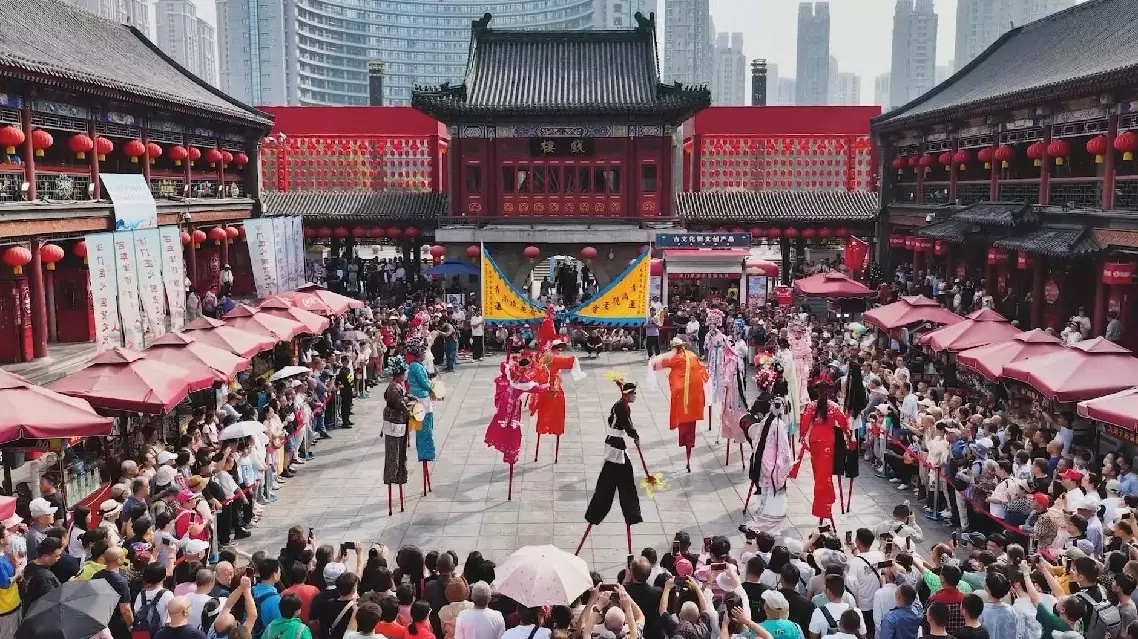
In Beijing's Yuyuantan Park, visitors guessed lantern riddles, made paper lanterns, and admired blooming osmanthus. In the Ancient Culture Street of north China's Tianjin municipality, local artists presented folk performances, including traditional drumming, stilt walking, and lion dancing.
Zhejiang Province's Meicheng Ancient Town celebrated the festival with traditional games such as pitch-pot, calligraphy, and chess. In Tongcheng City in east China's Anhui Province, the melodies of Huangmei Opera echoed as people revisited history and reflected on family and national bonds. This year, tourist sites across China have launched new cultural and tourism offerings during the holiday that highlight China's cultural treasures.
At the Shu Brocade and Embroidery Museum in Sichuan's Chengdu City, visitors were guided by skilled craftsmen making handmade embroideries as Mid-Autumn gifts for loved ones.
In Lanzhou City in Gansu Province, traditional craft demonstrations, moon worship performances, and an immersive drama about the Silk Road recreated the splendor of ancient trade routes.
In Yunmeng County, Hubei Province, an ancient street that dates back to the ancient Chu kingdom (around 1040 - 220 BC) and the Qin Dynasty (221 - 207 BC) was opened to the public during the holiday, with experiences such as Qin-style calligraphy and Chu tea ceremonies reinforcing the sense of history and heritage.
"We uphold the concepts of creative transformation and innovative development, building digital cultural scenes such as interactive multimedia installations and reconstructed historical settings to make Chinese civilization more vivid and tangible," said Luan Li, deputy curator of the Yunmeng County Museum.
In Hong Kong, Fire Dragon Dance, a tradition that dates back over 100 years, was staged to celebrate the Mid-Autumn Festival. At this year's event, a team of around 100 youngsters also put up a mini fire dragon illuminated by approximately 10,000 LED lights, symbolizing the passing down of traditional customs.
"The fire dragon dance is an intangible cultural heritage, and I believe every child should carry it on," said a local student.
In Macao, lantern displays have lit up the city as residents and tourists gather for festival celebrations.
"We made this beautiful lantern to help the children learn about traditional culture and festival customs. Everyone is filled with joy, and we come together in harmony," said Huang Meibao, a resident.
The holiday spirit even reached into space, where the Shenzhou-20 mission astronauts aboard China's orbiting Tiangong space station broadcast their best wishes for the Mid-Autumn Festival back to earth on Monday.
"With the full moon on this mid-autumn night, may all families be reunited," the three crew members chorused.
"Although we are in the vastness of space, and cannot be with our families, our hearts are always closely linked with our motherland and people, and with our families," said astronaut Chen Dong.
"From China's space station, we wish everyone a happy Mid-Autumn Festival," said the astronauts in their holiday message.
Traditional culture to the fore as China celebrates Mid-Autumn Festival