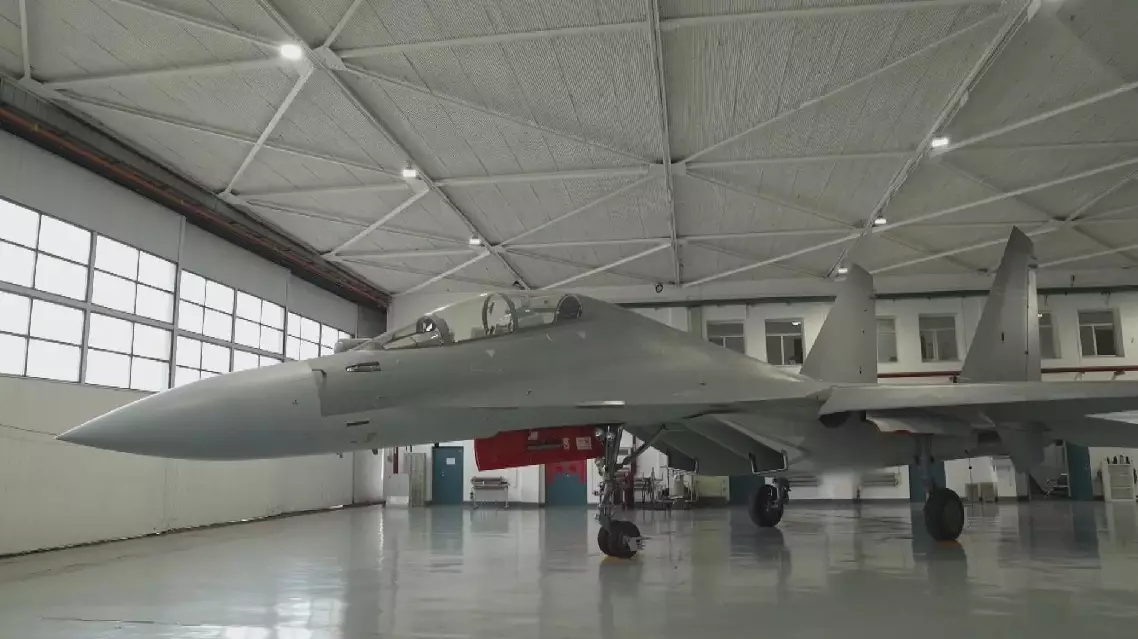
China's domestically developed J-16 fighter jet, a fourth-generation multirole aircraft, is a highly rated piece of military hardware among engineer for its aerodynamic design, heavy weapon load, and evolving combat capabilities, including air, sea, and land strike missions.
This praise is rooted in the jet's advanced structural design.
According to Ai Zhiqiang, an engineer at AVIC Shenyang Aircraft Design and Research Institute, the J-16 features large-strake wing-body integration, a conventional twin-vertical-tail layout, and clipped-tip tail fins, elements that enhance its aerodynamic performance.
"In my opinion, the J-16 is flawless, and the soldiers also often say this aircraft has no shortcomings. Its smooth overall aerodynamic design, superb flight control capability and high combat effectiveness really make it stand out among fourth-generation fighters," Ai said. "The aircraft's nose section has an avionics system and equipment tailored for combat missions, and at the front is the main fire-control radar, complemented by auxiliary systems like electro-optical radars and other detection radars," he added.
Beyond the core flight and combat systems, the engineer also highlighted functions of other key components of the aircraft such as the drag chute.
"This is the drag chute. Also, at the front [of the J-16] are compartments for countermeasure munitions like flare and decoy cartridges. During landing, the drag chute, a parachute-like canopy, is deployed from the rear to rapidly decelerate the aircraft and assist in landing," said Ai.
Ai also highlighted the J-16's strength as a combat platform, noting that its versatility has led to specialized variants like the J-16D, China's new electronic warfare aircraft built on the same foundation.
"The platform of the aircraft is truly excellent. We have numerous innovative technologies being demonstrated, verified, and having their capabilities upgraded or unleashed on this platform. Therefore, participation in the J-16's development involves extensive subsequent work like optimization, iteration, capability demonstration, verification, and continuous functional upgrades," Ai said.
China's J-16 fighter jet gains praise for versatility, aerodynamic power
Japanese citizens took to the streets of Tokyo's Shinjuku district on Saturday, voicing strong opposition to Prime Minister Sanae Takaichi's administration for lifting the ban on lethal weapons exports, advancing a "National Intelligence Agency" bill, and pushing for the revision of the country's postwar pacifist constitution.
On Tuesday, the Japanese government, led by Prime Minister Sanae Takaichi, officially revised the "three principles on transfer of defense equipment and technology" and their implementation guidelines.
The revisions scrap the restrictions that had limited arms exports to five non-combat categories, allow, in principle, the export of lethal weapons, permit transfers to nations engaged in active conflict under specified circumstances, and sideline parliament from the decision-making process, crossing a line that previous governments had at least nominally upheld.
"Allowing the export of lethal weapons and even attempting to possess nuclear arms, the Takaichi administration is leading Japan toward war, despite our postwar commitment of never starting a war again. Many people are worried. This must be stopped," said a protester.
The cornerstone of Japan's pacifist constitution is Article 9, which renounces the nation's right to engage in war or to resort to military force to resolve international conflicts. For decades, this article has been a fundamental constraint on Japan's military endeavors.
"I am firmly opposed to amending the Constitution. Takaichi claims 'the time has come,' but that's just her own decision. Without Article 9 of the Constitution, Japan could be swept into America's wars. That must not happen," said another participant.
"Japan once invaded other Asian countries and has maintained a pacifist constitution ever since. But now the government has arbitrarily decided to lift the ban on exporting lethal weapons without sufficient parliamentary debate. It's unacceptable," said another demonstrator.
"If we abandon our stance as a peaceful nation under the constitution, it would be absolutely intolerable. Thanks to Article 9, Japan hasn't waged war or been pulled into conflict. For Japan's place in the international community, Article 9 must not be changed," said another protester.

Tokyo protesters oppose Takaichi’s lethal weapons export, constitution revision plans

Tokyo protesters oppose Takaichi’s lethal weapons export, constitution revision plans