Sentencing is due tomorrow for three masterminds behind a 2020 domestic terror plot that targeted a hospital and a border checkpoint. After a 159-day trial, a jury found Ho Cheuk-wai, Lee Ka-pan, and Cheung Ka-chun guilty of conspiracy to cause explosions. Court evidence revealed a chilling escalation of violence, including plans for a 20kg bomb in a residential area and the use of high-performance TATP explosives, a plot that was only stopped by timely police intervention.
This case was prosecuted under the Counter-Terrorism Ordinance, as it predated the Hong Kong National Security Law, and carries a sentence of up to 20 years. But the charges barely capture the reality: this was a coordinated attempt to carry out indiscriminate attacks on the public. Had police not uncovered their plan to detonate a massive homemade bomb in Tseung Kwan O, a massacre would have been unavoidable.
An Attack on a Hospital
The terror campaign began on January 27, 2020. At 2:20 AM, an improvised explosive device, packed with "Rocket Candy," blew up in a men's toilet at Caritas Medical Centre's A&E. A police officer, there by chance, helped manage the evacuation. The blast was powerful enough to shatter pipes. A Telegram channel, "Kau Chim 92," later claimed responsibility, stating the attack was meant to force a strike by medical staff.
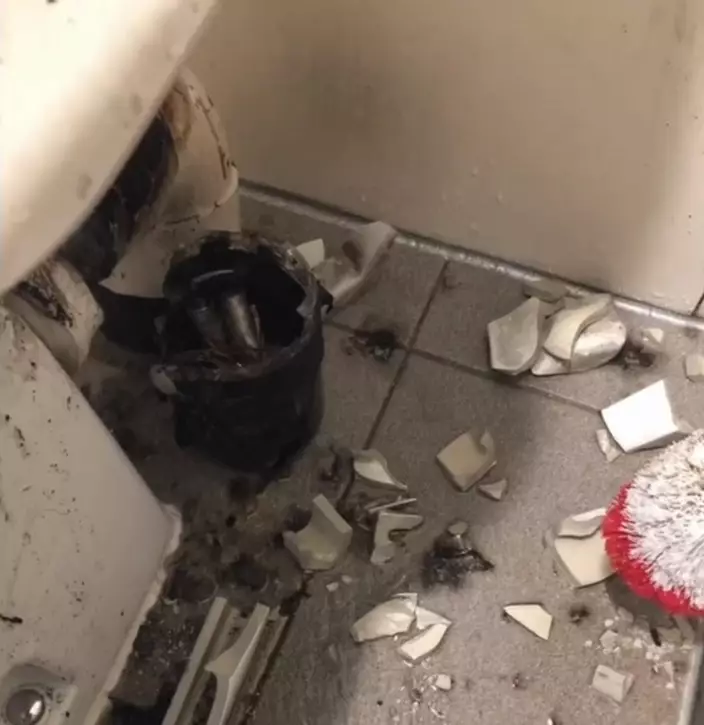
The wreckage: What a 'Rocket Candy' bomb did to a toilet stall in Caritas Medical Centre's A&E.
Explosives expert Superintendent Lo Ping-sin told the court what his team found in the wreckage: a shattered glass bottle containing up to a kilogram of a nitrate-based explosive. Wired to a circuit board and wrapped in black tape, it was a classic improvised explosive device (IED) designed to produce intense flames and smoke that water couldn't extinguish—powerful enough to kill, maim, or cause massive damage.
Another expert, Acting Senior Superintendent Li Chin-chiu, confirmed the device was a "Rocket Candy" bomb. He testified that the dense, high-temperature smoke it produced could have caused lung burns and blocked escape routes, a deadly scenario in a hospital filled with immobile patients on wheelchairs.
"Baked Alive" on a Train
The second attack came on February 2. A cleaner on an MTR train pulling into Lo Wu Station found a bag containing a suspicious object with a flashing red light. She immediately moved it to the platform just as it began spewing thick smoke, averting disaster. The same Telegram group claimed responsibility, demanding the government close the border.
Click to Gallery
The wreckage: What a 'Rocket Candy' bomb did to a toilet stall in Caritas Medical Centre's A&E.
Averted disaster: This bag held a bomb designed to fill a train with deadly smoke. A cleaner's quick action at Lo Wu MTR station prevented mass casualties.
The target: Terrorists planned to detonate a 20kg 'tombstone bomb' here, at a memorial event in Tseung Kwan O, on March 8, 2020. (Image source: Sing Tao Daily)
An urban bomb factory: Police display some of the massive cache of explosives and raw materials seized from two units in Tai Kok Tsui. (Image source: Sing Tao Daily)
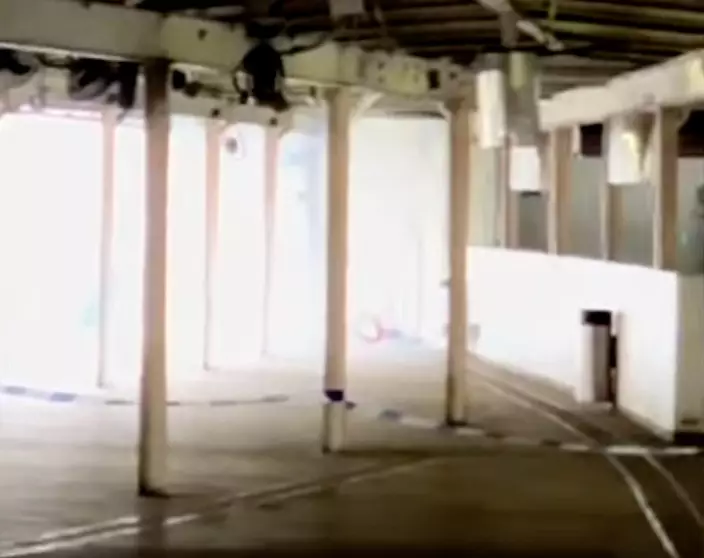
Averted disaster: This bag held a bomb designed to fill a train with deadly smoke. A cleaner's quick action at Lo Wu MTR station prevented mass casualties.
Superintendent Lo confirmed two IEDs were recovered from the scene at Lo Wu. One contained about a kilogram of low-grade explosives. Both were built with the same radio-controlled design using potassium nitrate and sugar, and both were fully capable of causing death or serious injury.
A Meticulously Planned Massacre
Acting Senior Superintendent Li painted an even grimmer picture. He testified that if the cleaner hadn't found the bomb, the casualties would have been catastrophic. Had it gone off in the enclosed carriage, passengers would have been blinded by smoke and potentially "baked alive" by the heat. Li believed the bomb was "meticulously designed" not for Lo Wu, but to detonate 40 minutes later, when the train returned to a crowded urban area, leaving passengers with "nowhere to run."
The third plot was the most ambitious: a 20kg "tombstone-shaped bomb" to be detonated outside Sheung Tak Estate car park in Tseung Kwan O. The target date was March 8, during a memorial event for HKUST student Chow Tsz-lok. Police uncovered the plot just in time, arresting the suspects on March 7 after monitoring their Telegram group where they discussed the plan.
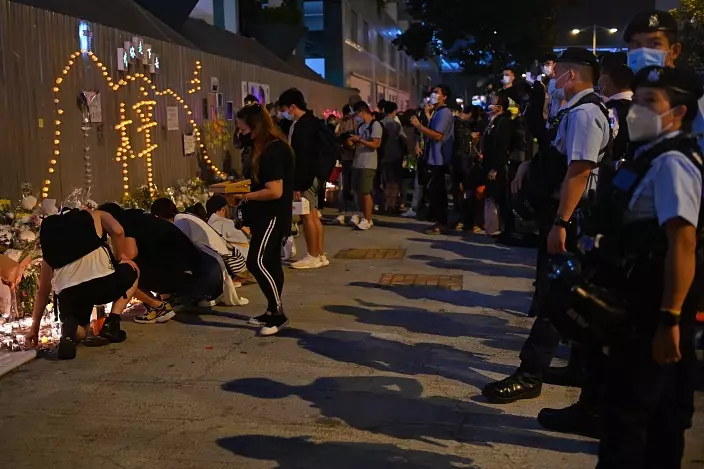
The target: Terrorists planned to detonate a 20kg 'tombstone bomb' here, at a memorial event in Tseung Kwan O, on March 8, 2020. (Image source: Sing Tao Daily)
According to Li Chin-chiu's court testimony, a 20kg "glitter powder" bomb would have had astonishing power. Its kill radius would have been dozens of meters, with the shockwave and sound felt from 300 meters away.
The Urban Bomb Factory
Beyond the attacks, the case exposed the group's arsenal. The first two defendants, Ho Cheuk-wai and Lee Ka-pan, rented two units in INNO CENTRE, Tai Kok Tsui. Police discovered what one expert called an "explosives warehouse," a ticking time bomb that endangered the entire building and surrounding community.
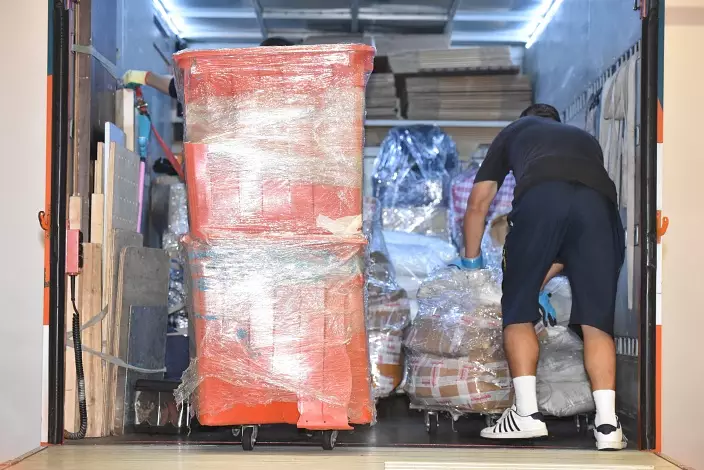
An urban bomb factory: Police display some of the massive cache of explosives and raw materials seized from two units in Tai Kok Tsui. (Image source: Sing Tao Daily)
The court heard that in March 2020, police raids on the units turned up a terrifying inventory. Room 503 contained TATP explosives, 35.2kg of raw materials like potassium nitrate and aluminum powder, protective gear, and remote-detonation circuit boards. Room 1008 held over a ton of potassium nitrate (1090.75kg) and 57.5kg of an ammonium nitrate/aluminum powder mixture.
Li Chin-chiu testified that the mix of ammonium nitrate and aluminum powder could produce about 70kg of AN/AL explosive, a favorite of terrorist organizations worldwide. The units also contained over 100kg of aluminum powder and 92kg of magnesium powder to boost destructive power. As for the TATP found, it's an infamous high-performance explosive, once dubbed "the mother of Satan" for its immense power.
The Terrorist's Playbook
Another expert, Superintendent Cheung Lap-tak, testified that the seized electronic matches, batteries, circuits, and fuses were the four key elements for any IED: power, initiator, switch, and explosive. He confirmed the devices were lethal, with the "Rocket Candy" bomb capable of causing serious damage within a 2-meter radius, and that a fire in Room 1008 would have been catastrophic due to the other chemicals stored there.
During the investigation, police found an image on a defendant's phone of a bomb designed to be packed with iron nails. Li Chin-chiu stated in court that adding shrapnel like nails or screws is a classic terrorist tactic designed to maximize indiscriminate carnage by causing direct piercing injuries to anyone nearby.
This case lays bare the real and evolving threat of domestic terrorism to Hong Kong's public safety. The bomb-making technology used by these extremist groups advanced rapidly, and their attack plans grew ever more ambitious. If not for the diligent work of the police, an indiscriminate attack on citizens would have led to unimaginable consequences.
Ariel
** 博客文章文責自負,不代表本公司立場 **
Ta Kung Pao recently published a series of commentaries under the byline "Gong Zhiping" over three consecutive days. The series, titled "Safeguarding Hong Kong's High-Quality Development with High-Level Security," was reposted on the website of the Hong Kong and Macao Affairs Office (HKMAO) for three days running, drawing public attention.
The Ta Kung Pao articles point out that, at present, the HKSAR Government and all sectors of society are more clear-eyed, more conscious and more resolute in coordinating development and security, and in safeguarding the new development paradigm with a new security architecture.
Chief Executive John Lee has led the SAR's executive, legislative and judicial authorities in firmly discharging the constitutional responsibility of safeguarding national security, continuously consolidating the bedrock of high-level security for high-quality development.
Under the protection of security, Hong Kong's development momentum is growing ever stronger and its pace ever faster. Security has become an advantage for Hong Kong's development. The full text of the article follows:
Hong Kong's journey from chaos to order, and from order to prosperity, proclaims a simple truth: only with security every step of the way has there been development every step of the way. Security is not a "tightening spell," the incantation in Journey to the West that constricts the Monkey King's headband. It is a "protective talisman" and a "booster." Security not only provides the most solid foundation for development, it also creates new dividends for development.
Today, the HKSAR Government and all sectors of society are more clear-eyed, more conscious and more resolute in coordinating development and security, and in safeguarding the new development paradigm with a new security architecture.
Chief Executive John Lee has led the SAR's executive, legislative and judicial authorities in firmly discharging the constitutional responsibility of safeguarding national security. In doing so, they continuously consolidate the bedrock of high-level security for high-quality development.
The SAR made history in completing the legislation of Article 23 of the Basic Law. The Safeguarding National Security Ordinance was passed unanimously by the Legislative Council and, together with the Hong Kong National Security Law, has built a solid shield for safeguarding national security in the SAR. The principle of "patriots administering Hong Kong" has been fully implemented, and the power of governance in the SAR remains firmly in the hands of patriots.
The Committee for Safeguarding National Security of the HKSAR has earnestly shouldered its principal responsibility for safeguarding national security and strengthened overall coordination. The SAR's law enforcement, prosecution and judicial departments have been fearless and faithful to their duties, cracking down on acts endangering national security in accordance with the law.
The many patriotic groups and individuals who love the country and Hong Kong have carried forward their fine traditions, waging a resolute struggle against words and deeds that undermine, vilify and disrupt Hong Kong. When hostile forces at home and abroad launch attacks and smears in the arena of public opinion, the SAR Government responds with timely and forceful exposure, criticism and rebuttal.
As for the anti-China elements bent on disrupting Hong Kong who fled overseas and continued to flagrantly violate the Hong Kong National Security Law and the Safeguarding National Security Ordinance, the National Security Department of the Hong Kong Police Force has lawfully placed them on the wanted list. Measures have been applied against them as specified absconders.
The SAR Government and all sectors of society have also worked hard to advance national security education. They have held the "April 15 National Security Education Day" events year after year, opened a permanent National Security Exhibition Gallery, and brought national security education into schools, communities and the grassroots. Particular emphasis goes to strengthening such education for young people.
Hong Kong's legal system and enforcement mechanisms for safeguarding national security have been continuously improved, and its capabilities continuously strengthened. The truth that "only when the nation is secure can Hong Kong be secure, and only when the nation is secure can our homes be secure" has taken deep root in people's hearts. The whole of society has formed a mighty collective force for safeguarding national security.
Today, under the protection of security, Hong Kong's development momentum is getting better and better, and its pace faster and faster.
A few examples suffice to give a glimpse. In 2025, Hong Kong retained its ranking as the world's freest economy, held firm as the world's third-ranked international financial center, and rose to fourth globally in talent competitiveness. In 2026, Hong Kong became the world's largest cross-boundary wealth management center and ranked second globally in the World Competitiveness Yearbook. The economy grew 5.9% in the first quarter of 2026, and the SAR Government recently raised Hong Kong's full-year growth forecast from the previously projected 2.5%-3.5% to 3.5%-4.5%.
More encouraging still, Hong Kong is now working at full throttle on the SAR's first-ever five-year plan, painting a bright blueprint for the city's future development. The SAR Government and all sectors of society are earnestly implementing the spirit of President Xi Jinping's important instructions and proactively aligning with the country's 15th Five-Year Plan. They are upholding and refining the executive-led system, better combining a proactive government with an efficient market, and actively recognizing change, adapting to change and seeking change.
This amounts to forward-looking, science-based and systematic planning for Hong Kong's high-quality development in the new stage.
Strong consensus has been forged, and forceful measures proposed, on a range of priorities. These include highlighting the Northern Metropolis as a key focus, using the university town as a lever to drive the integrated development of education, technology and talent, and consolidating and enhancing Hong Kong's status as an international financial, shipping and trade center.
The priority list also includes accelerating the building of an international innovation and technology hub, creating a magnet for high-caliber global talent, and improving people's livelihoods across the board, in particular resolving the housing problem and bidding farewell to subdivided flats and "cage homes."
Hong Kong's development direction is now clearer, and its bright prospects more distinct.
Today, the international community and global investors increasingly agree that Hong Kong is a "safe harbor," and that a "safe harbor" is a "harbor of development." Security has become an advantage for Hong Kong's development. All objective and rational observers can see it plainly: Hong Kong safeguards national security so that the city can develop better, so that its residents can live better lives, and so that investors' lawful rights and interests can be better protected.
Overseas investors have repeatedly said that Hong Kong's safeguarding of national security has injected strong stability, certainty and sustainability into the market. A stream of international mega-events has been held in Hong Kong one after another. Friends from all over the world have come to the city to take part, casting a vote of confidence in Hong Kong.
In 2025, more than 2,700 single family offices were established in Hong Kong, over half of them with assets under management exceeding US$50 million. The number of companies in Hong Kong with parent companies located overseas or in the Chinese Mainland surpassed 11,000, a record high. Also in 2025, more than 31,000 foreign nationals were granted employment visas to work in Hong Kong, more than double the figure of five years ago.
Hong Kong now stands at a new starting point, ushering in its best period of development. The loftier the development goals and the brighter the vision, the less we can afford to slacken the taut string of security.
We must firmly establish the principle that development is an ironclad truth, and that security is no less so. We must do well in both pursuing high-quality development, the foremost task, and safeguarding national security, the matter of paramount importance.
By truly safeguarding high-quality development with high-level security, Hong Kong will surely stride steadily and surely along the broad road from order to prosperity. The city will shine with even greater splendor on the great journey of building a strong nation and realizing national rejuvenation.