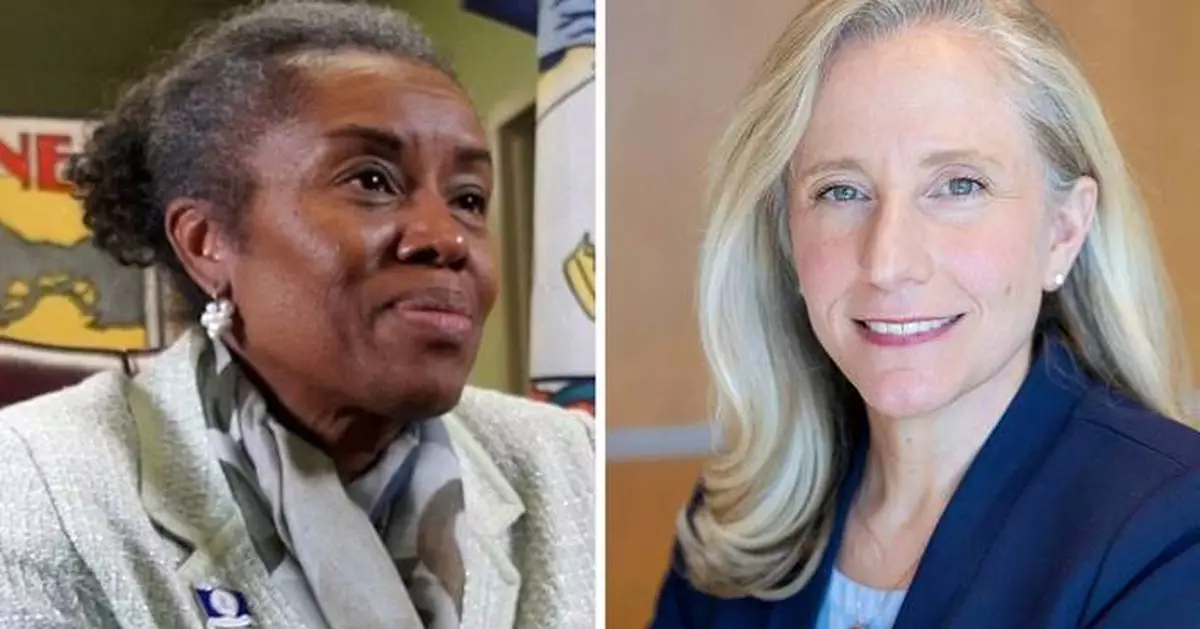
RICHMOND, Va. (AP) — Virginia gubernatorial candidates Republican Winsome Earle-Sears and Democrat Abigail Spanberger faced off Thursday for the first and only time on the debate stage in a fiery affair that was combative from the very first answer.
Earle-Sears, perceived by operatives in both parties to be trailing, went on the offensive throughout the hourlong clash, interrupting almost every one of Spanberger's answers and referring to the congresswoman only by her first name.
Spanberger, who largely avoided addressing her Republican opponent directly, set a more sterile and bipartisan tone. The personal clashes overshadowed the policy fights at times, which focused on violent rhetoric, the federal shutdown and transgender children. The economy was an afterthought.
Here are some takeaways from the debate at Norfolk State University:
Perhaps even more than policy differences, the candidates’ personal styles shaped the debate.
Earle-Sears, with her only chance to confront Spanberger before Election Day, was far more aggressive. She repeatedly turned toward Spanberger and interrupted her answers, despite being admonished by the moderators.
The approach put the Democrat on the defensive after months of running the race largely on her own terms as the perceived frontrunner.
Spanberger, while she criticized her opponent at times, faced forward throughout, avoided eye contact and only rarely addressed Earle-Sears directly. She did not speak during Earle-Sears’ answers, even when her opponent asked direct questions, resulting in moments of awkward silence.
Earle-Sears told Spanberger she was a liar, said she “should have stayed in Congress” and questioned her courage.
“Don’t lie like that, Abigail!” she shouted at one point.
The interruptions lasted up until the very final moments, when the moderators cut off the microphones.
A scandal shaped the very beginning of the debate, although it was not a scandal directly involving either candidate onstage.
Instead, it was the Democratic nominee for attorney general, Jay Jones. He has been heavily criticized in recent days following last week’s publication of text messages from 2022 in which he suggested that Virginia’s former Republican House speaker get “two bullets in the head.”
Earle-Sears, along with President Donald Trump, has demanded that Jones quit his race. Over and over again Thursday night, the Republican pushed Spanberger to do the same.
“Abigail, what if he said it about your three children? Is that when you would say it's time to get out of the race?” Earle-Sears asked. She later added, “She has no courage.”
Facing repeated questions from the moderators and her opponent, the Democratic congresswoman declined to say whether Jones should leave the race, saying it's up to voters to make their own decision.
“I have denounced political violence, political rhetoric, no matter who is leading the charge,” Spanberger responded, pointing to violent rhetoric from Trump that Earle-Sears declined to denounce.
“You routinely refer to me as your enemy. I’m not your enemy. You are not my enemy. We are political opponents,” Spanberger said.
The showdown over the shutdown flared Thursday night.
Underway for more than a week, the federal shutdown is especially prevalent in Virginia, home to roughly 315,000 federal workers. Even before much of the federal government closed its doors last week, many Virginians were already affected by Trump's spring push to slash federal jobs and his ongoing threats to impose more mass firings.
Earle-Sears, a vocal Trump supporter, declined to criticize Trump or call on him to stop firing federal workers when asked directly by the moderators.
Instead, she blamed Democrats for the mess and called on Spanberger to push Virginia Sens. Tim Kaine and Mark Warner, both Democrats, to vote in favor of a spending bill that would end the impasse with the Republican-controlled Congress.
Spanberger responded, “I would encourage everyone, our Democratic senators, our Democratic House members, our Republican House members, to work and come back to the table."
Many voters say they’re most concerned about the economy, but some of the most pointed moments of the debate were on cultural issues.
In particular, Earle-Sears pressed Spanberger on whether she would keep transgender youths out of high school sports and bathrooms.
The Republican lieutenant governor has flooded the airwaves with ads focused on the cultural divide that helped Trump win the presidency last fall, casting Spanberger as unwilling to protect Virginia’s children from sexual predators.
“My answer is that each local community decision should be made between parents and educators and teachers in each community,” Spanberger said, pointing to her background in law enforcement and role as a mother.
“Nothing is more important to me than the safety of all children,” she said.
Spanberger declined to say whether she would rescind the measure signed by Republican Gov. Glenn Youngkin that would require students to go only to the restrooms of their birth gender.
That did not satisfy Earle-Sears, who pressed Spanberger on what she would say if her own children were forced to undress in a bathroom with biological males. The Republican also implied that transgender students are a safety threat when asked.
“We know that biological men are larger in strength than women,” she said. “This is biology.”
Spanberger then sought to put Earle-Sears on the defensive, noting that the Republican opposes abortion rights and wants to outlaw gay marriage — something Earle-Sears didn't object to.
“My opponent has previously said that she doesn’t think that gay couples have the right to marry,” Spanberger said.
“That’s not discrimination,” Earle-Sears interrupted.
Two women stood on the debate stage as the Democratic and Republican nominees for the first time in state history, a reminder that Virginia is poised to elect its first female governor, no matter who wins on Nov. 4.
Spanberger, 46, is a mother of three school-age children. She has represented a congressional district in northern Virginia since 2019. She is a former CIA case officer.
In one of the few warm exchanges of the night, Earle-Sears pointed to Spanberger's role as a mother when asked what qualities she likes about her opponent.
“I believe she is a devoted mom. I truly believe that,” Earle-Sears said. “And I do believe that she cares.”
Earle-Sears, a Marine veteran, may be better known statewide, having served as lieutenant governor for the last four years. A native of Jamaica, the 61-year-old mother of two, is the first Black woman elected to statewide office in Virginia.
Spanberger complimented parts of her record.
“I admire her faith,” Spanberger said, “and her service to this country.”
Peoples reported from New York. Beaumont reported from Des Moines, Iowa. Olivia Diaz is a corps member for The Associated Press/Report for America Statehouse News Initiative. Report for America is a nonprofit national service program that places journalists in local newsrooms to report on undercovered issues.
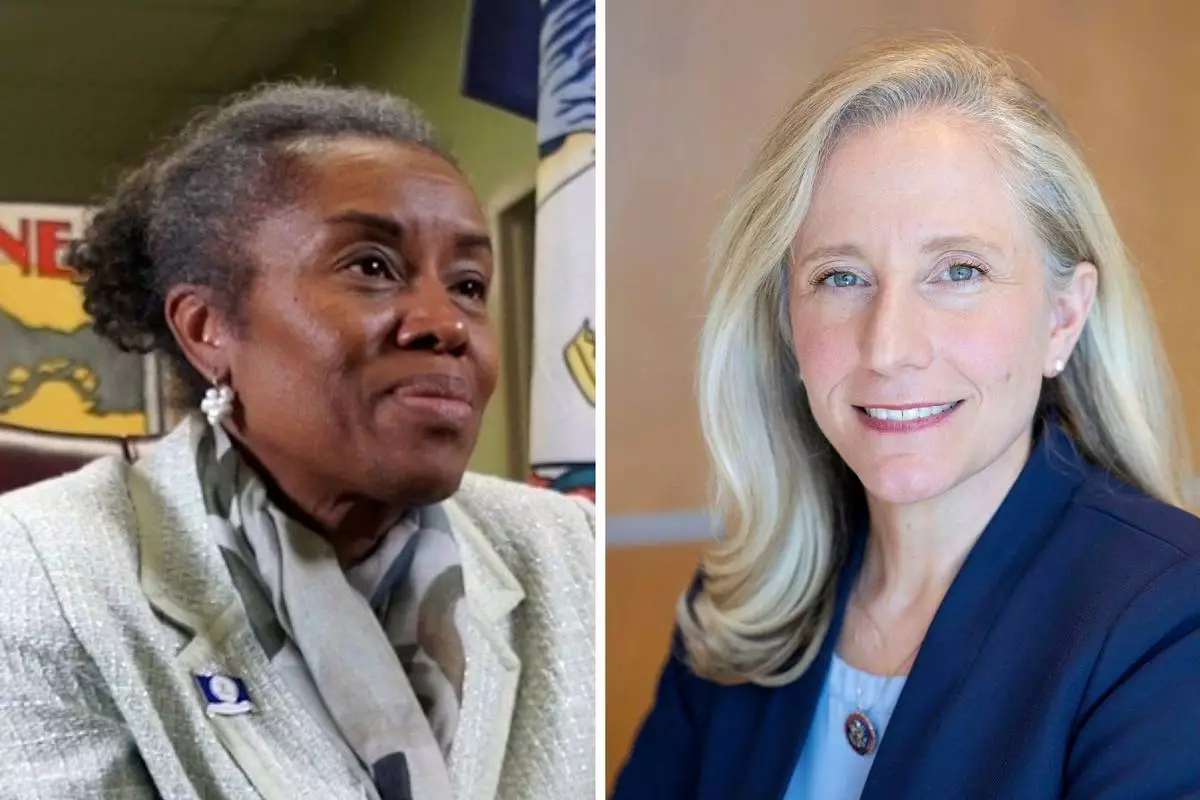
This combo image shows Virginia Republican gubernatorial candidate Winsome Earle-Sears, left, and Democratic gubernatorial candidate Abigail Spanberger, right. (AP Photo)