The United States' belief in its global dominance has led to foreign policy missteps, according to American economist Jeffrey Sachs, who warned that protectionist trade measures will weaken its competitiveness.
In an exclusive interview with China Media Group (CMG) aired on Friday, Sachs, a professor of economics and director of the Center for Sustainable Development at Columbia University, said U.S. political leaders adopted an arrogant mindset after the collapse of the Soviet Union in 1991, assuming they could unilaterally shape global affairs.
"What happened in the United States is quite clear when the Soviet Union ended in December 1991. The U.S. looked around, and by U.S., I mean the leaders, this is the politicians, not the general public, but the politicians looked around and said, 'oh, we run the world now, we're the last ones, no Soviet Union, China -- that's poor rice growing villages.' They didn't even imagine anything about China's development. They looked at the rest of the world. It's us, and they took the mindset now we run the world," said Sachs.
He cited former Secretary of State Madeleine Albright's remarks that the U.S. was "the indispensable country" as emblematic of the era's hubris, saying such exceptionalism led to unchecked decisions, such as military expansion, regime change, and the 2003 Iraq War
"American leaders took it for granted. They could pretty much do what they want. They could decide to expand their militaries if they wanted to. They could overthrow governments if they wanted to. They could go to war, for example, in Iraq, if they wanted to. Other countries were saying 'That's not a good idea. Don't do that.' But the United States wasn't listening. They went to war, of course it was on false pretenses, not just wrong pretenses. We now know it was filled with lies, but they felt the ability to go to war on the basis of lies and that they would make it up in the narrative. That is the mindset that got the U.S. into so much trouble," Sachs continued.
On China's rise, Sachs emphasized that the country is not a threat but a success story.
"Now, China, where does China fit into this? As the U.S. was boasting about its world leadership and being indispensable, China just kept growing. China is not a threat. Talk to China, come to China, work with China, negotiate with China, have diplomacy. Then the threat isn't there, then the possibility of mutual benefit is there," said Sachs.
Turning to trade policy, Sachs criticized protectionist measures in the U.S. and Europe.
"Protectionism doesn't work to spur innovation and advance. Protectionism makes companies protected behind artificial barriers. It typically makes them a little bit lazy. They compete in their home market, but then they can't really compete in the international markets. So if the U.S. and Europe put on protectionist barriers, say, against electric vehicles, which is what they want to do. Yes, the U.S. will have an electric vehicle industry, but who's going to sell electric vehicles all over the world? It's not going to be high-cost American companies. It's going to be China," said Sachs.
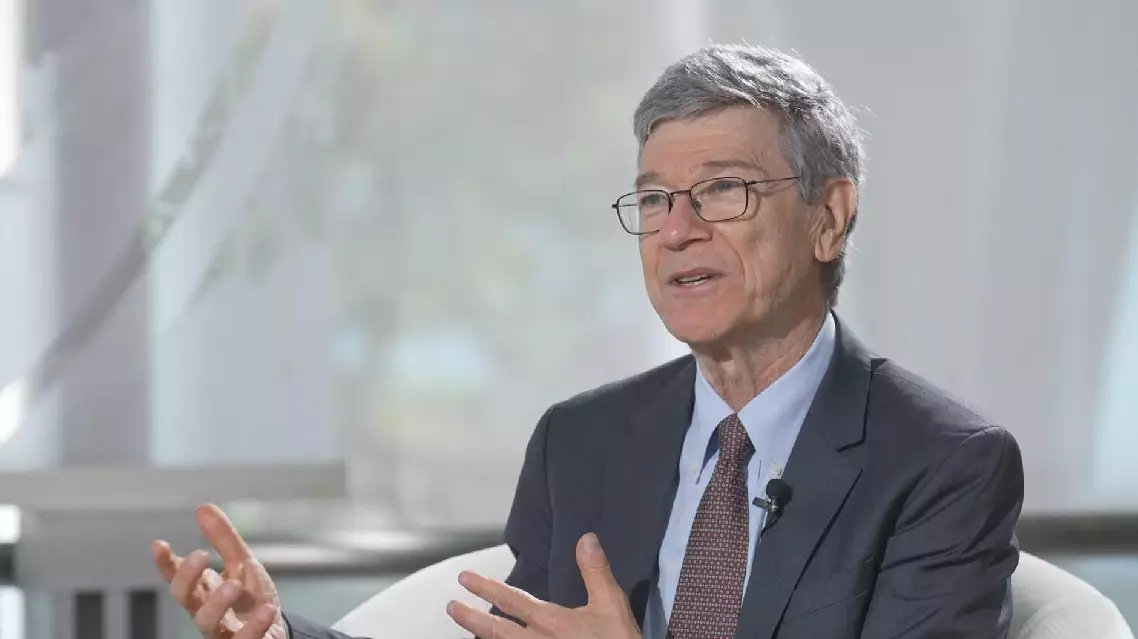
Economist warns of harm of U.S. exceptionalism, protectionism