China’s expanding network of advanced radio telescopes is driving major breakthroughs in deep-space exploration and black hole research, reinforcing the country’s growing role in global radio astronomy.
Radio telescopes serve as humanity's "eyes" for observing the depths of the universe.
China's Five-hundred-meter Aperture Spherical Radio Telescope (FAST), the world's largest single-dish radio telescope, started formal operations in January 2020 and was officially opened to the world in March 2021. The telescope provides astronomers around the globe with a powerful tool to uncover the mysteries and evolution of the universe.
To date, FAST has identified more than 900 new pulsars since its launch in 2016. The number of new pulsars discovered by FAST is more than three times the total number of pulsars found by foreign telescopes during the same period.
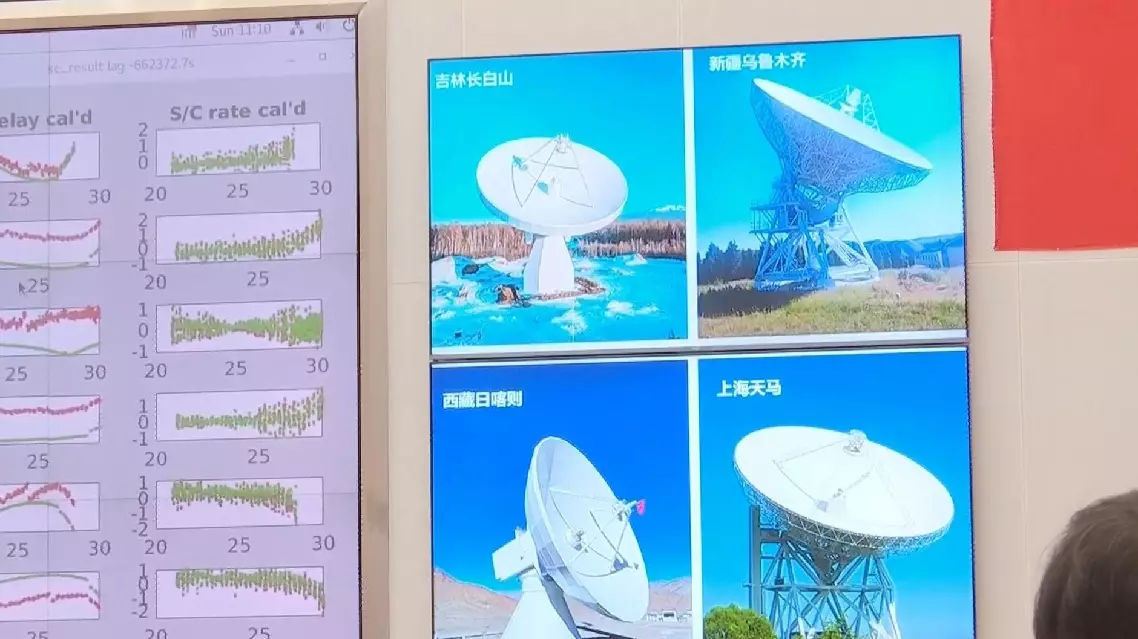
Beyond FAST, China also boasts a radio telescope network for observing the universe. While the six telescopes of the network lack FAST's large aperture, their strategic distribution across the vast expanse of China creates an observational network with an effective aperture equivalent to the country's land area.
This network provides precise orbit positioning for spacecraft, enabling more accurate navigation in deep-space exploration. Recently, these radio telescopes have yielded numerous new discoveries.
At the Data Processing Center of Shanghai Astronomical Observatory of the Chinese Academy of Sciences, scientists are busy observing and processing data from the Tianwen-2 probe.
Tianwen-2 is China's independently developed asteroid probe, which had been in orbit for 125 days as of October 1. Its primary mission is to explore asteroid 2016HO3, a quasi-satellite of Earth.
Tianwen-2 will conduct exploration and sample collection around the asteroid and return the samples to Earth. Additionally, it is conducting scientific exploration of the main-belt comet 311P.
When multiple radio telescopes separated by vast distances observe in sync, they see farther and clearer. In 2019, Event Horizon Telescope Collaboration seized humanity's first capture of a black hole.
Over the years, more radio telescopes have joined this collaboration, deepening humanity's understanding of black hole observations.
The latest discovery of the telescopes shows changes in the black hole's magnetic field.
"What we see here are three images of the supermassive black hole at the center of the M87 galaxy - the subject of the first black hole photograph - taken in different years. The shape and size of these images remained unchanged over the four-year period. This confirms Einstein's theory of general relativity. However, the primary focus of this latest release is the white stripes superimposed on these black hole images. It is evident that in 2017 and 2018, the magnetic field directions of these white lines remained largely consistent. But in 2021, a fundamental reversal occurred - one that caught us off guard. This unexpected fundamental reversal indicates that the physical environment surrounding the black hole is undergoing continuous change," said Shen Zhiqiang, radio astrophysics expert of the Shanghai Astronomical Observatory.
This significant discovery of altered magnetic field polarization patterns around the black hole involved the Tianma Radio Telescope, a 65-meter aperture radio telescope system located in Songjiang District, Shanghai.
Over the years, it has made crucial contributions to verifying black hole spin and multi-wavelength observations.
While fulfilling its critical scientific missions, the Tianma Radio Telescope has also sparked a surge in nearby science tourism. Its location at Shanghai's Sheshan Mountain has become a popular destination for astronomy enthusiasts and visitors alike.
As autumn arrives, many visitors come to capture photos amidst golden rice fields alongside the Tianma Telescope. The village housing the telescope has also developed a tourism village, integrating educational camps, lodging, dining, and other amenities.
China’s expanding radio telescope network boosts space science, global astronomy