UN officials stressed gender equality at the Global Leaders' Meeting on Women in Beijing on Monday, saying that bridging gender digital divide could lift 30 million people from extreme poverty.
Speaking at the opening ceremony of the leaders' meeting, UN Deputy Secretary-General Amina Mohammed said the progress of woman is still very slow.
"Progress for women and girls is moving at a glacial pace. In many areas, it is not just stalled, it is reversing. We stand just five years from the deadline of our 2030 Sustainable Development Goals. The hour is late. We are running out of time to make good on the promise we made three decades ago," she said.
Amina said the world must place women and girls at the very heart of the green and digital transitions, creating more opportunities for them in the new era of technology.
"Our UN Gender Snapshot reveals that bridging the gender digital divide could lift 30 million people from extreme poverty and inject 1.5 trillion dollars into the global economy in just five years. But let me be clear, no economy can reach its full potential while sidelining half of its population an indispensable asset base," she said.
UN Women Executive Director Sima Bahous said the Beijing Declaration and Platform for Action, adopted at the Fourth World Conference on Women in 1995, is a visionary blueprint for gender equality which remains one of the most ambitious frameworks for realizing women's rights.
Thirty years later, the world is standing at a pivotal time in the collective journey towards gender equality, she said.
"Six hundred and seventy six million women and girls live amidst conflict, their opportunities, their health, their safety and their lives in constant jeopardy. If current global trends continue, 351 million women and girls will still live in poverty, in extreme poverty by 2030, and 708 million will remain excluded from the labor force due to unpaid care," she said.
Themed "One Shared Future: New and Accelerated Process for Women's All-round Development", the leaders meeting has gathered many heads of state, government officials, leaders of international organizations and friendly personnel from various continents.
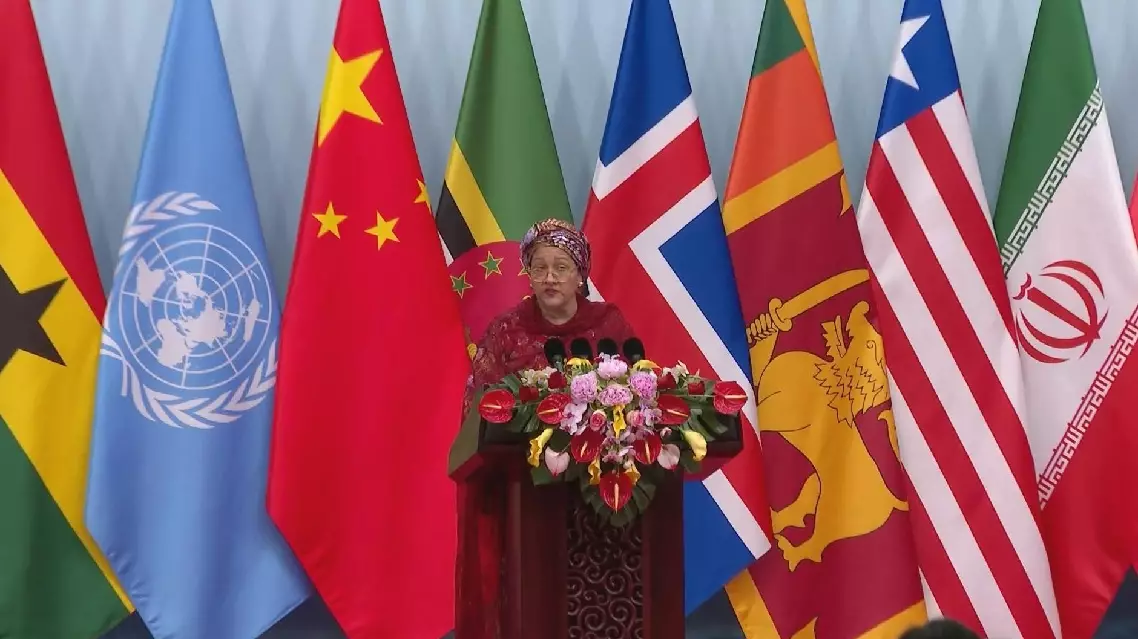
Bridging gender digital divide could lift 30 mln people from extreme poverty: UN official
China will take more effective measures to improve people's wellbeing, especially in education, healthcare, and social security, an official said Thursday in Beijing at a press conference on the interpretation of this year's government work report, which was submitted to the national legislature for deliberation earlier in the day.
Shen Danyang, head of the government work report drafting team and director of the State Council Research Office, said centering on enhancing educational equity and quality, the report made arrangements for education at all educational stages and of all types.
"Regarding preschool education, the policy of free education in the year prior to entering primary school will continue to be implemented this year, which is commonly referred to as free admission to the senior class of kindergartens. So, how can the income reduction of kindergartens be addressed? Subsidies will be provided by both the central and local governments, with the central government taking the lion's share. This year, the funds allocated to support the development of preschool education will increase significantly by 37.8 percent to ensure the implementation of the beneficial policy," he said.
Regarding senior high school education, Shen said the report stated that the supply of regular senior high school places will be increased,
Specifically, for areas with a continuous net inflow of population, a number of regular high schools will be planned and constructed on an annual basis. For regions with a temporary shortage of school places, priority will be given to the renovation and expansion of existing teaching buildings, student dormitories and canteens, he said.
Shen said the report put forward many supportive measures in healthcare.
"For instance, it urged efforts to strengthen coordination in drug use at the grassroots level, which mean improving the list of essential drugs, and optimizing the channels for drug supply and drug use coordination between upper- and lower-level medical and health institutions to make it more convenient for the public to use drugs at their doorstep. Besides, the report has made arrangements for supporting the development of innovative drugs for the third consecutive year. This year, China will strengthen the coordination of supportive policies in an all-round way, further address issues such as the barriers facing innovative drugs entering hospitals, and better meet the diverse medical and medication needs of the people," he said.
In terms of social security, Shen said the report proposed to continue raising the minimum standard of basic pensions for urban and rural residents -- a policy will benefit over 180 million elderly people.
"The central government will allocate 1.25 trillion yuan (about 181.25 billion U.S. dollars) in subsidy funds to ensure the timely and full payment of pensions. In response to the insufficient protection of the rights and interests of people engaging in new occupations, the report proposed to steadily and orderly expand the scale of the pilot program for occupational injury insurance. This year, the policy will cover 31 provincial-level regions across the country and the Xinjiang Production and Construction Corps. Meanwhile, enterprises specializing in travel, instant delivery and intra-city freight delivery will be included in the pilot program, which will ensure the safety of more laborers, such as food delivery workers and online car-hailing drivers," he said.
China to improve people's wellbeing in education, healthcare, social security: official