Skip to Content Facebook Feature Image

Lions' inability to create big plays on offense costly in loss to Chiefs

Sport

Lions' inability to create big plays on offense costly in loss to Chiefs
Sport

Sport

Lions' inability to create big plays on offense costly in loss to Chiefs

2025-10-14 08:12 Last Updated At:08:20

DETROIT (AP) — The Detroit Lions struggled in Kansas City on Sunday night.

The Chiefs had an effective game plan set up to stop Detroit and the personnel advantage needed to execute it.

More Images
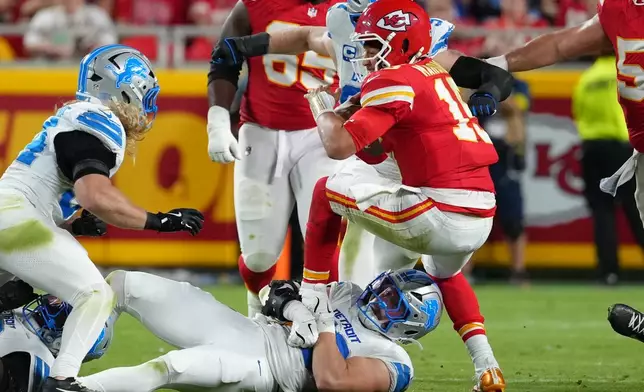
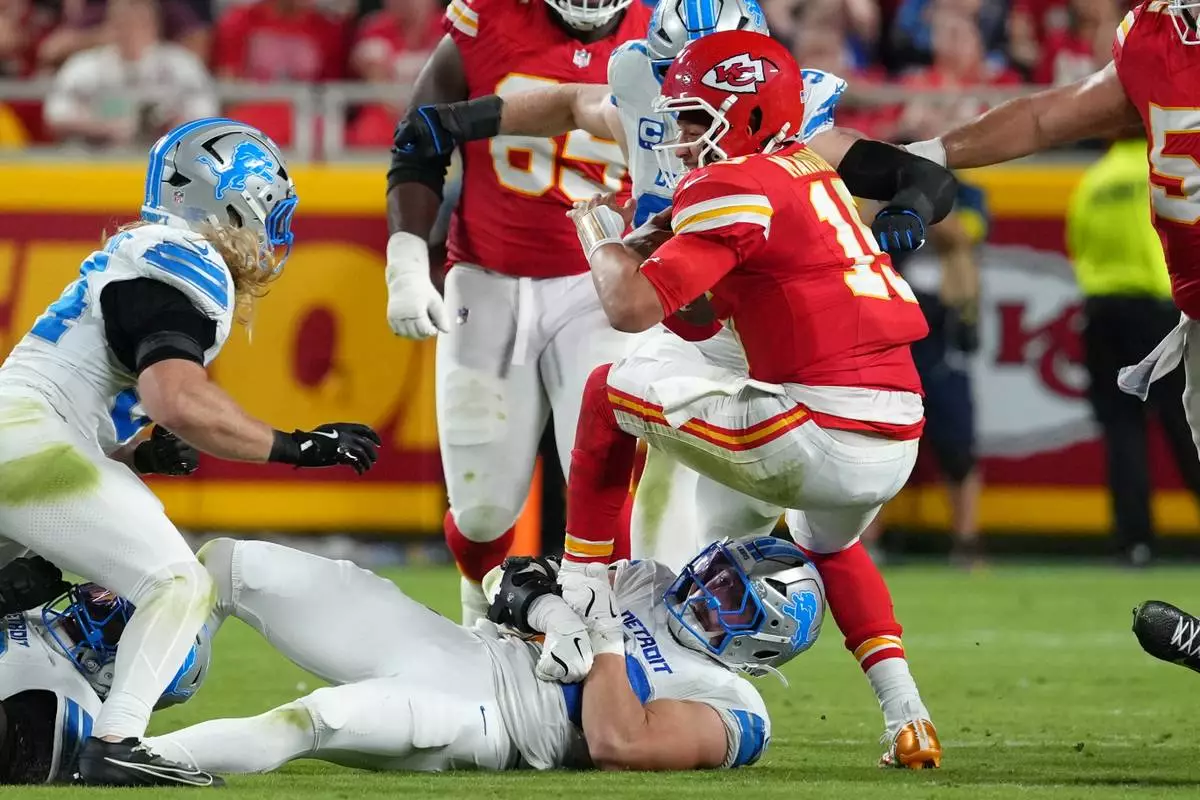
Kansas City Chiefs quarterback Patrick Mahomes, top, struggles for yardage as Detroit Lions linebacker Trevor Nowaske defends during the second half of an NFL football game Sunday, Oct. 12, 2025, in Kansas City, Mo. (AP Photo/Ed Zurga)
Kansas City Chiefs quarterback Patrick Mahomes, top, struggles for yardage as Detroit Lions linebacker Trevor Nowaske defends during the second half of an NFL football game Sunday, Oct. 12, 2025, in Kansas City, Mo. (AP Photo/Ed Zurga)

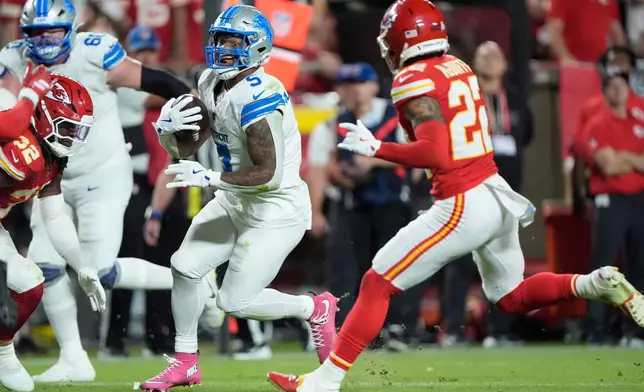
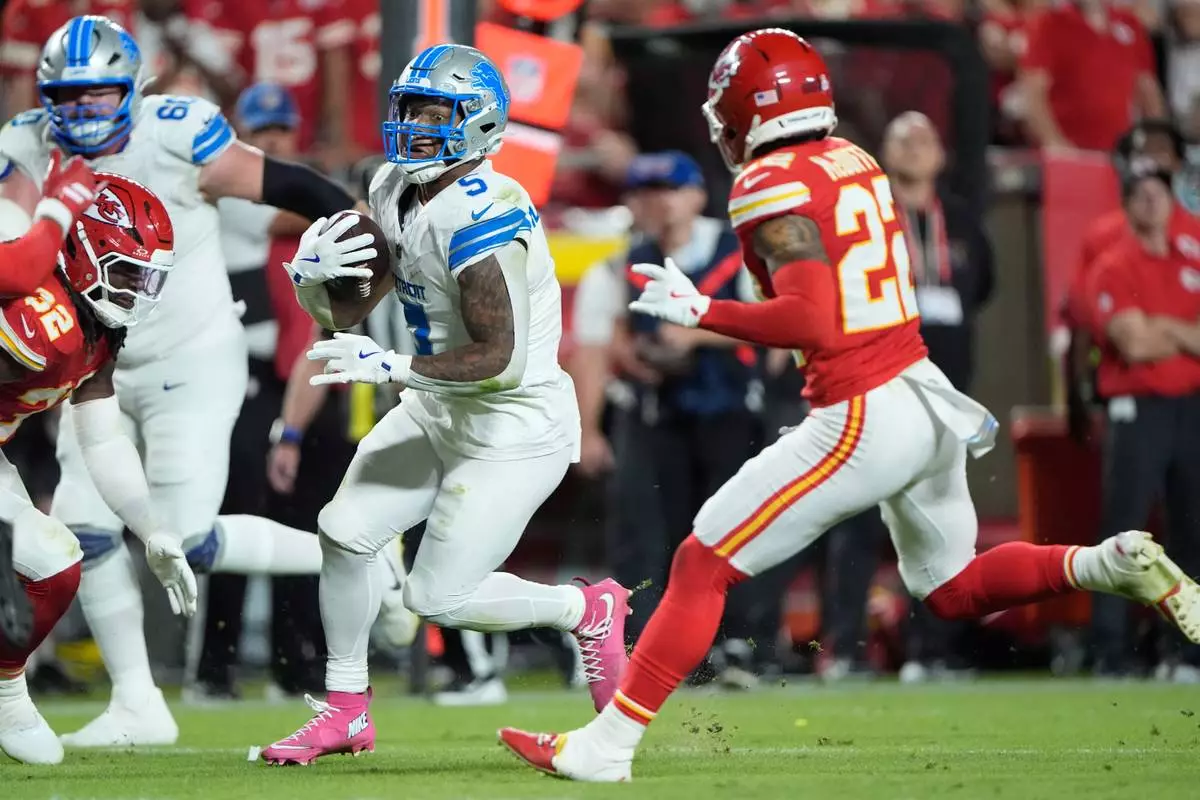
Detroit Lions running back David Montgomery, left, runs for a first down as Kansas City Chiefs cornerback Trent McDuffie (22) defends during the second half of an NFL football game Sunday, Oct. 12, 2025, in Kansas City, Mo. (AP Photo/Charlie Riedel)
Detroit Lions running back David Montgomery, left, runs for a first down as Kansas City Chiefs cornerback Trent McDuffie (22) defends during the second half of an NFL football game Sunday, Oct. 12, 2025, in Kansas City, Mo. (AP Photo/Charlie Riedel)

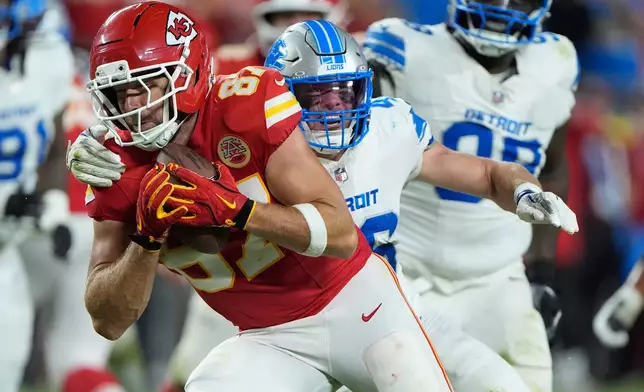
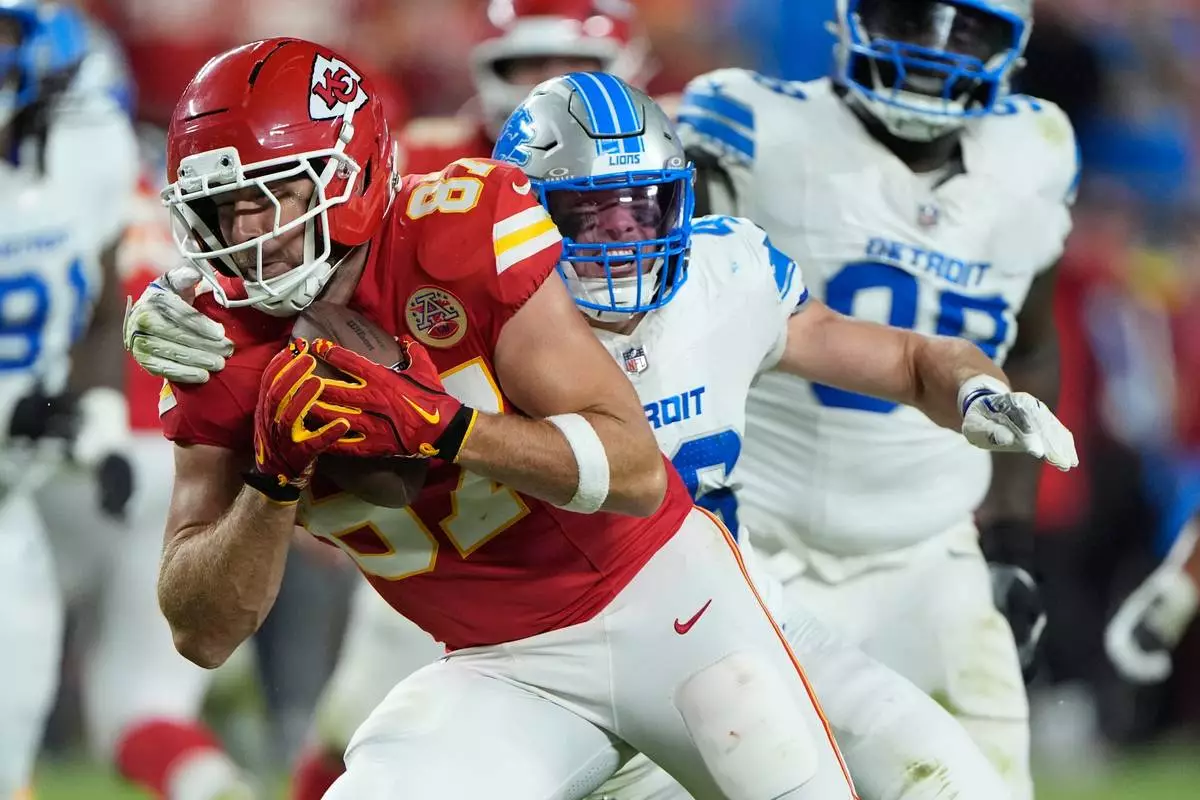
Kansas City Chiefs tight end Travis Kelce, left, gains a first down before being brought down by Detroit Lions linebacker Jack Campbell, right, during the second half of an NFL football game Sunday, Oct. 12, 2025, in Kansas City, Mo. (AP Photo/Charlie Riedel)1
Kansas City Chiefs tight end Travis Kelce, left, gains a first down before being brought down by Detroit Lions linebacker Jack Campbell, right, during the second half of an NFL football game Sunday, Oct. 12, 2025, in Kansas City, Mo. (AP Photo/Charlie Riedel)1

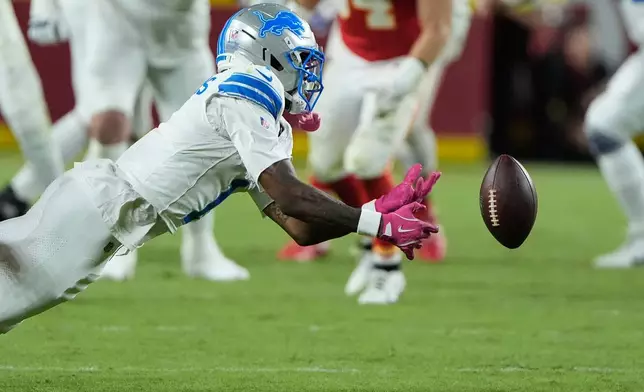
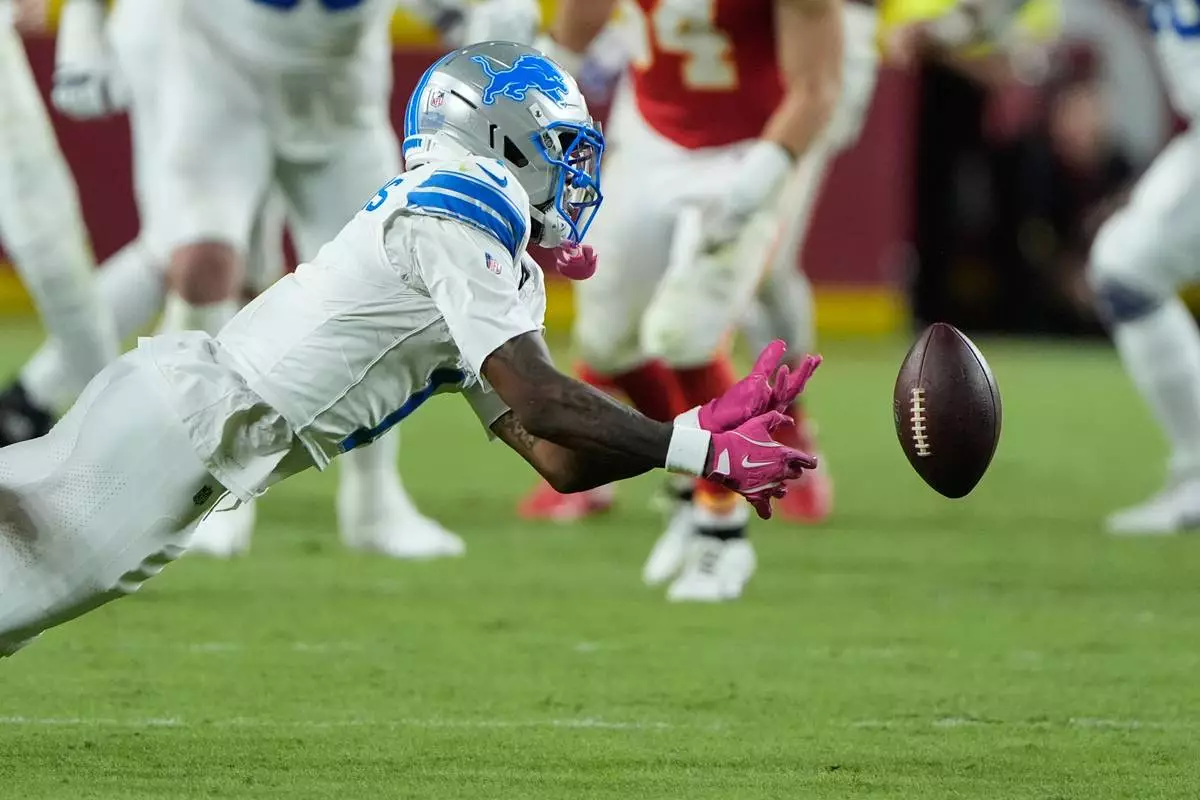
Detroit Lions wide receiver Jameson Williams is unable to catch a pass on fourth down during the second half of an NFL football game against the Kansas City Chiefs Sunday, Oct. 12, 2025, in Kansas City, Mo. (AP Photo/Charlie Riedel)

Detroit Lions wide receiver Jameson Williams is unable to catch a pass on fourth down during the second half of an NFL football game against the Kansas City Chiefs Sunday, Oct. 12, 2025, in Kansas City, Mo. (AP Photo/Charlie Riedel)

The Lions lost 30-17 to the perennial AFC powerhouse.

“I'm disappointed,” Lions coach Dan Campbell said after the game. "It's been a long time since we've watched someone kneel (the ball) three times at the end of a game that isn't even close. We were down two scores and we got worked pretty good.

“So yeah, it is really disappointing.”

Campbell said he expected his team to need at least 30 points to have a chance to win — a prediction that turned out to be accurate.

“I felt like this was the kind of game where we needed at least that many and we couldn't,” he said. “Defensively, we had some opportunities that we have to capitalize on — we didn't get any takeaways — but, really, the offense needed to show up there.”

Jared Goff threw for 203 yards and two touchdowns, and the Lions rushed for 98 yards, but they weren't able to break the big plays the offense usually produces. They didn't have a rushing touchdown for just the second time this season — the other being the Week 1 loss in Green Bay — and the Chiefs took away Detroit's catch-and-run ability.

Goff averaged 8.8 yards per completion, his second-lowest total of the season behind the 7.3 yards against the Packers.

“I don't want to take anything away from how well their defense played,” Goff said. "They were well prepared and did a lot of things that gave us issues. But our mentality was to score on every drive, and when we had long drives, we needed to finish them with touchdowns.

“We didn't do that and they did.”

One drive that ended in a field goal was Detroit's first, although the Lions were originally ruled to have scored a touchdown off one of their many trick plays.

Goff walked up behind center, then went into motion and caught a touchdown pass from running back David Montgomery. However, the officials ruled he hadn't set for 1 second before splitting out wide, making it a penalty for illegal motion.

“I was under the impression that I wasn't declared as a quarterback until I put my hands under center,” Goff said. “But there's a new version of the rule that I had never heard of, and I guess some of our coaches had never heard of, so we'll have to do some research.

“But that wasn't the reason we lost the game.”

After struggling to get speedy Jameson Williams into the passing game all season, he caught six passes for 66 yards and a touchdown. They weren't able to get the ball to him deep — his catches came an average of just 4 yards downfield, but he put up 44 yards after the catch.

Jahmyr Gibbs was held in check by the Kansas City defense, finishing with 18 touches — 17 rushes and one reception — for just 65 total yards.

Aidan Hutchinson finished with one sack and a forced fumble — the fourth straight week he has had at least one of each. That matches the longest streak since 1999, also achieved by Cedric Jones (1999), Simeon Rice (2002), Robert Mathis (2005) and Khalil Mack (2018).

Safety Brian Branch was suspended for one game without pay by the NFL on Monday for unsportsmanlike conduct following a loss at Kansas City. Branch punched Chiefs receiver JuJu Smith-Schuster on Sunday night, setting off a postgame melee.

“I love Brian Branch, but what he did is inexcusable and it is not going to be accepted here,” Campbell said. “It's not what we do, and I apologize to Coach (Andy) Reid and the Chiefs.”

Safety Kerby Joseph missed 11 of Detroit's 64 defensive snaps after aggravating a knee injury. He returned to the game, but it remains unclear how the injury will affect him in upcoming games.

4 — With Branch suspended, Joseph dealing with his knee and cornerbacks D.J. Reed (hamstring) and Terrion Arnold (shoulder) out with injuries, the Lions will be facing the Tampa Bay Buccaneers on Monday night without any of their starting defensive backs at full health.

The Lions will have to find a way to put pressure on Baker Mayfield if they want to avoid him picking apart the banged-up secondary the way Patrick Mahomes did on Sunday night.

AP NFL: https://apnews.com/hub/nfl
Kansas City Chiefs quarterback Patrick Mahomes, top, struggles for yardage as Detroit Lions linebacker Trevor Nowaske defends during the second half of an NFL football game Sunday, Oct. 12, 2025, in Kansas City, Mo. (AP Photo/Ed Zurga)
Kansas City Chiefs quarterback Patrick Mahomes, top, struggles for yardage as Detroit Lions linebacker Trevor Nowaske defends during the second half of an NFL football game Sunday, Oct. 12, 2025, in Kansas City, Mo. (AP Photo/Ed Zurga)

Detroit Lions running back David Montgomery, left, runs for a first down as Kansas City Chiefs cornerback Trent McDuffie (22) defends during the second half of an NFL football game Sunday, Oct. 12, 2025, in Kansas City, Mo. (AP Photo/Charlie Riedel)
Detroit Lions running back David Montgomery, left, runs for a first down as Kansas City Chiefs cornerback Trent McDuffie (22) defends during the second half of an NFL football game Sunday, Oct. 12, 2025, in Kansas City, Mo. (AP Photo/Charlie Riedel)

Kansas City Chiefs tight end Travis Kelce, left, gains a first down before being brought down by Detroit Lions linebacker Jack Campbell, right, during the second half of an NFL football game Sunday, Oct. 12, 2025, in Kansas City, Mo. (AP Photo/Charlie Riedel)1
Kansas City Chiefs tight end Travis Kelce, left, gains a first down before being brought down by Detroit Lions linebacker Jack Campbell, right, during the second half of an NFL football game Sunday, Oct. 12, 2025, in Kansas City, Mo. (AP Photo/Charlie Riedel)1

Detroit Lions wide receiver Jameson Williams is unable to catch a pass on fourth down during the second half of an NFL football game against the Kansas City Chiefs Sunday, Oct. 12, 2025, in Kansas City, Mo. (AP Photo/Charlie Riedel)


Detroit Lions wide receiver Jameson Williams is unable to catch a pass on fourth down during the second half of an NFL football game against the Kansas City Chiefs Sunday, Oct. 12, 2025, in Kansas City, Mo. (AP Photo/Charlie Riedel)
DES MOINES, Iowa (AP) — Pessimism about the country's future has risen in cities since last year, but rural America is more optimistic about what's ahead for the U.S., according to a new survey from the American Communities Project.

And despite President Donald Trump’s insistence that crime is out of control in big cities, residents of the nation’s largest metropolitan centers are less likely to list crime and gun violence among the chief concerns facing their communities than they were a couple years ago.

Optimism about the future is also down from last year in areas with large Hispanic communities.

These are some of the snapshots from the new ACP/Ipsos survey, which offers a nuanced look at local concerns by breaking the nation’s counties into community types, using data points like race, income, age and religious affiliation. The survey evaluated moods and priorities across the 15 different community types, such as heavily Hispanic areas, big cities and different kinds of rural communities.

The common denominator across the communities? A gnawing worry about daily household costs.

“Concerns about inflation are across the board,” said Dante Chinni, founder and director of ACP. “One thing that truly unites the country is economic angst.”

Rural residents are feeling more upbeat about the country's trajectory — even though most aren't seeing Trump's promised economic revival.

The $15 price tag on a variety pack of Halloween candy at the Kroger supermarket last month struck Carl Gruber. Disabled and receiving federal food aid, the 42-year-old from Newark, Ohio, had hardly been oblivious to lingering, high supermarket prices.

But Gruber, whose wife also is unable to work, is hopeful about the nation's future, primarily in the belief that prices will moderate as Trump suggests.

“Right now, the president is trying to get companies who moved their businesses out of the country to move them back,” said Gruber, a Trump voter whose support has wavered over the federal shutdown that delayed his monthly food benefit. “So, maybe we'll start to see prices come down.”

About 6 in 10 residents of Rural Middle America — Newark's classification in the survey — say they are hopeful about the country's future over the next few years, up from 43% in the 2024 ACP survey. Other communities, like heavily evangelical areas or working-class rural regions, have also seen an uptick in optimism.

Kimmie Pace, a 33-year-old unemployed mother of four from a small town in northwest Georgia, said, “I have anxiety every time I go to the grocery store.”

But she, too, is hopeful in Trump. “Trump’s in charge, and I trust him, even if we’re not seeing the benefits yet,” she said.

By contrast, the share of big-city residents who say they are hopeful about the nation's future has shrunk, from 55% last year to 45% in the new survey.

Robert Engel of San Antonio — Texas' booming, second most-populous city — is worried about what's next for the U.S., though less for his generation than the next. The 61-year-old federal worker, whose employment was not interrupted by the government shutdown nor Trump's effort to reduce the federal workforce, is near retirement and feels financially stable.

A stable job market, health care availability and a fair economic environment for his adult children are his main priorities.

Recently, the inflation outlook has worsened under Trump. Consumer prices in September increased at an annual rate of 3%, up from 2.3% in April, when the president first began to roll out substantial tariff increases that burdened the economy with uncertainty.

Engel's less-hopeful outlook for the country is broader. “It's not just the economy, but the state of democracy and polarization,” Engel said. “It's a real worry. I try to be cautiously optimistic, but it's very, very hard.”

Trump had threatened to deploy the National Guard to Chicago, New York, Seattle, Baltimore, San Francisco and Portland, Oregon, to fight what he said was runaway, urban crime.

Yet data shows most violent crime in those places, and around the country, has declined in recent years. That tracks with the poll, which found that residents of America's Big Cities and Middle Suburbs are less likely to list crime or gun violence among the top issues facing their communities than they were in 2023.

For Angel Gamboa, a retired municipal worker in Austin, Texas, Trump's claims don't ring true in the city of roughly 1 million people.

“I don't want to say it's overblown, because crime is a serious subject," Gamboa said. “But I feel like there's an agenda to scare Americans, and it's so unnecessary.”

Instead, residents of Big Cities are more likely to say immigration and health care are important issues for their communities.

Big Cities are one of the community types where residents are most likely to say they’ve seen changes in immigration recently, with 65% saying they’ve seen a change in their community related to immigration over the past 12 months, compared with only about 4 in 10 residents of communities labeled in the survey as Evangelical Hubs or Rural Middle America.

Gamboa says he has witnessed changes, notably outside an Austin Home Depot, where day laborers regularly would gather in the mornings to find work.

Not anymore, he said.

“Immigrants were not showing up there to commit crimes," Gamboa said. "They were showing up to help their families. But when ICE was in the parking lot, that's all it took to scatter people who were just trying to find a job.”

After Hispanic voters moved sharply toward Trump in the 2024 election, the poll shows that residents of heavily Hispanic areas are feeling worse about the future of their communities than they were before Trump was elected.

Carmen Maldonado describes her community of Kissimmee, Florida, a fast-growing, majority-Hispanic city of about 80,000 residents about 22 miles (35 kilometers) south of Orlando, as “seriously troubled.”

The 61-year-old retired, active-duty National Guard member isn't alone. The survey found that 58% of residents of such communities are hopeful about the future of their community, down from 78% last year.

“It's not just hopelessness, but fear,” said Maldonado, who says people in her community — even her fellow native Puerto Ricans, who are American citizens — are anxious about the Trump administration's aggressive pursuit of Latino immigrants.

Just over a year ago, Trump made substantial inroads with Hispanic voters in the 2024 presidential election.

Beyond just the future of their communities, Hispanic respondents are also substantially less likely to say they’re hopeful about the future of their children or the next generation: 55% this year, down from 69% in July 2024.

Maldonado worries that the Trump administration's policies have stoked anti-Hispanic attitudes and that they will last for her adult child's lifetime and beyond.

“My hopelessness comes from the fact that we are a large part of what makes up the United States,” she said, “and sometimes I cry thinking about these families.”

Parwani and Thomson-DeVeaux reported from Washington.

The American Communities Project/Ipsos Fragmentation Study of 5,489 American adults aged 18 or older was conducted from Aug. 18 - Sept. 4, 2025, using the Ipsos probability-based online panel and RDD telephone interviews. The margin of sampling error for adults overall is plus or minus 1.8 percentage points.

President Donald Trump speaks to reporters before boarding Air Force One at Palm Beach International Airport in West Palm Beach Fla., on his way back to the White House, Sunday, Nov. 16, 2025. (AP Photo/Manuel Balce Ceneta)

President Donald Trump speaks to reporters before boarding Air Force One at Palm Beach International Airport in West Palm Beach Fla., on his way back to the White House, Sunday, Nov. 16, 2025. (AP Photo/Manuel Balce Ceneta)

Recommended Articles