WASHINGTON (AP) — The Supreme Court on Wednesday appeared ready to gut a key tool of the Voting Rights Act that has helped root out racial discrimination in voting for more than a half century, a change that would boost Republican electoral prospects, particularly across the South.
During 2 1/2 hours of arguments, the court's six conservative justices seemed inclined to effectively strike down a Black majority congressional district in Louisiana because it relied too heavily on race.
Click to Gallery

Louisiana Attorney General Liz Murrill, right, leaves the Supreme Court after giving arguments in the case drawing new congressional district boundaries, Wednesday, Oct. 15, 2025, in Washington. (AP Photo/Cliff Owen)

Janai Nelson, front center, president of the NAACP Legal Defense Fund, who was arguing on behalf of a group of Black voters speaks with the news media after departing the court, Wednesday, Oct. 15, 2025, in Washington. (AP Photo/Cliff Owen)

Voting rights activists gather outside the Supreme Court in Washington, early Wednesday, Oct. 15, 2025, as the justices prepare to take up a major Republican-led challenge to the Voting Rights Act, the centerpiece legislation of the Civil Rights Movement. (AP Photo/Cliff Owen)

Chief Justice of the United States John Roberts speaks during lecture to the Georgetown Law School graduating class of 2025, in Washington, May 12, 2025. (AP Photo/Manuel Balce Ceneta, File)

Voting rights activists gather outside the Supreme Court in Washington, early Wednesday, Oct. 15, 2025, as the justices prepare to take up a major Republican-led challenge to the Voting Rights Act, the centerpiece legislation of the Civil Rights Movement. (AP Photo/J. Scott Applewhite)

Voting rights activists gather outside the Supreme Court in Washington, early Wednesday, Oct. 15, 2025, as the justices prepare to take up a major Republican-led challenge to the Voting Rights Act, the centerpiece legislation of the Civil Rights Movement. (AP Photo/J. Scott Applewhite)

Voting rights activists gather outside the Supreme Court in Washington, early Wednesday, Oct. 15, 2025, as the justices prepare to take up a major Republican-led challenge to the Voting Rights Act, the centerpiece legislation of the Civil Rights Movement. (AP Photo/Cliff Owen)

Voting rights activists gather outside the Supreme Court in Washington, early Wednesday, Oct. 15, 2025, as the justices prepare to take up a major Republican-led challenge to the Voting Rights Act, the centerpiece legislation of the Civil Rights Movement. (AP Photo/Cliff Owen)

FILE - President Lyndon Johnson, at podium, speaks in the rotunda of the Capitol in Washington, before to signing the Voting Rights Act, Aug. 6, 1965. (AP Photo, File)

FILE - Students and a member of the Zulu Tramps march to a campus polling place on Election Day at Southern University in Baton Rouge, La., Nov. 5, 2024. (AP Photo/Gerald Herbert, File)
Such an outcome would mark a fundamental change in the 1965 voting rights law, the centerpiece legislation of the Civil Rights Movement, that succeeded in opening the ballot box to Black Americans and reducing persistent discrimination in voting.
A ruling for Louisiana could open the door for legislatures to redraw congressional maps in southern states, helping Republican electoral prospects by eliminating majority Black and Latino districts that tend to favor Democrats. Legislatures already are free to draw extremely partisan districts, subject only to review by state courts, because of a 2019 Supreme Court decision.
Just two years ago, the court, by a 5-4 vote, affirmed a ruling that found a likely violation of Section 2 of the Voting Rights Act in a similar case over Alabama’s political boundaries. Chief Justice John Roberts and Justice Brett Kavanaugh joined their three more liberal colleagues in the outcome.
Roberts and Kavanaugh struck a different tone Wednesday, especially in their questions to civil rights lawyer Janai Nelson.
The chief justice suggested the Alabama decision was tightly focused on its facts and should not be read to require a similar outcome in Louisiana.
Kavanaugh pressed Nelson on whether the time has come to end the use of race-based districts under the Voting Rights Act, rather than “allowing it to extend forever.”
The court's liberal justices focused on the history of the Voting Rights Act in combating discrimination. Getting to the remedy of redrawing districts only happens if, as Justice Elena Kagan said, a court finds "a specific identified, proved violation of law.”
A mid-decade battle over congressional redistricting already is playing out across the nation after Republican President Donald Trump began urging Texas and other GOP-controlled states to redraw their lines to make it easier for the GOP to hold its narrow majority in the House.
The court's conservative majority has been skeptical of considerations of race, most recently ending affirmative action in college admissions. Twelve years ago, the court bludgeoned another pillar of the landmark voting law that required states with a history of racial discrimination to get advance approval from the Justice Department or federal judges before making election-related changes.
The court has separately given state legislatures wide berth to gerrymander for political purposes. If the Supreme Court now weakens or strikes down the Voting Rights Act's Section 2, states would not be bound by any limits in how they draw electoral districts. Such a result would be expected to lead to extreme gerrymandering by whichever party is in power at the state level.
The court's Alabama decision in 2023 led to new districts there and in Louisiana that sent two more Black Democrats to Congress.
Now, though, the court has asked the parties to answer a fundamental question: “Whether the state’s intentional creation of a second majority-minority congressional district violates the Fourteenth or Fifteenth Amendments to the U.S. Constitution.”
Louisiana and the Trump administration joined with a group of white voters in arguing to invalidate the challenged district and make it much harder to claim discrimination in redistricting.
The arguments led Justice Sonia Sotomayor to assert that the administration's “bottom line is just get rid of Section 2.”
Justice Department lawyer Hashim Mooppan disagreed and said state lawmakers would have no incentive to get rid of every majority Black district because doing so would create swing districts and imperil some Republican incumbents.
In addition, Mooppan said, only 15 of the 60 Black members of the House represent majority Black districts. “But even if you eliminated Section 2 entirely, fully 75% of the Black congressmen in this country are in districts that are not protected by Section 2.”
In the first arguments in the Louisiana case in March, Roberts sounded skeptical of the second majority Black district, which last year elected Democratic Rep. Cleo Fields. Roberts described the district as a “snake” that stretches more than 200 miles (320 kilometers) to link parts of the Shreveport, Alexandria, Lafayette and Baton Rouge areas.
The court fight over Louisiana’s congressional districts has lasted three years.
The state’s Republican-dominated legislature drew a new congressional map in 2022 to account for population shifts reflected in the 2020 census. But the changes effectively maintained the status quo of five Republican-leaning majority white districts and one Democratic-leaning majority Black district.
Civil rights advocates won a lower-court ruling that the districts likely discriminated against Black voters.
The state eventually drew a new map to comply with the court ruling and protect its influential Republican lawmakers, including House Speaker Mike Johnson. But white Louisiana voters claimed in their separate lawsuit that race was the predominant factor driving it. A three-judge court agreed, leading to the current high court case.
The court is expected to rule by early summer in 2026.
Follow the AP's coverage of the Supreme Court at https://apnews.com/hub/us-supreme-court.

Louisiana Attorney General Liz Murrill, right, leaves the Supreme Court after giving arguments in the case drawing new congressional district boundaries, Wednesday, Oct. 15, 2025, in Washington. (AP Photo/Cliff Owen)

Janai Nelson, front center, president of the NAACP Legal Defense Fund, who was arguing on behalf of a group of Black voters speaks with the news media after departing the court, Wednesday, Oct. 15, 2025, in Washington. (AP Photo/Cliff Owen)

Voting rights activists gather outside the Supreme Court in Washington, early Wednesday, Oct. 15, 2025, as the justices prepare to take up a major Republican-led challenge to the Voting Rights Act, the centerpiece legislation of the Civil Rights Movement. (AP Photo/Cliff Owen)

Chief Justice of the United States John Roberts speaks during lecture to the Georgetown Law School graduating class of 2025, in Washington, May 12, 2025. (AP Photo/Manuel Balce Ceneta, File)

Voting rights activists gather outside the Supreme Court in Washington, early Wednesday, Oct. 15, 2025, as the justices prepare to take up a major Republican-led challenge to the Voting Rights Act, the centerpiece legislation of the Civil Rights Movement. (AP Photo/J. Scott Applewhite)
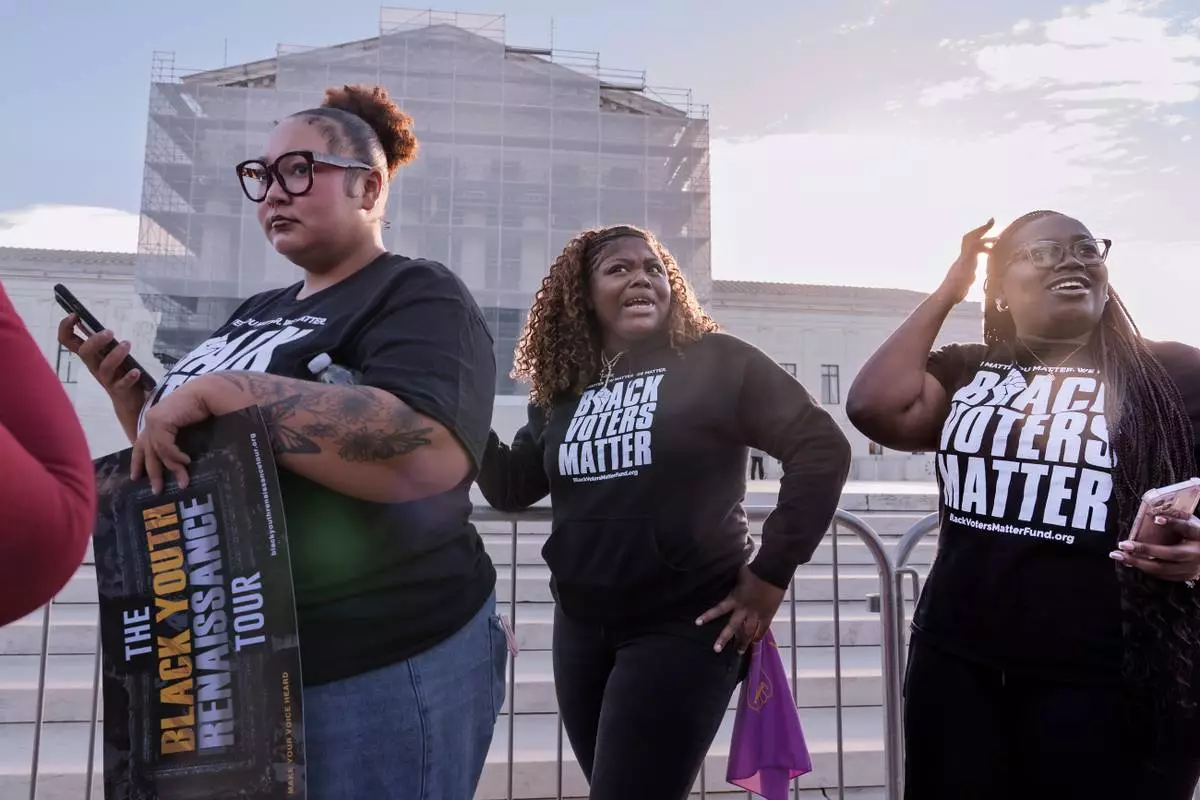
Voting rights activists gather outside the Supreme Court in Washington, early Wednesday, Oct. 15, 2025, as the justices prepare to take up a major Republican-led challenge to the Voting Rights Act, the centerpiece legislation of the Civil Rights Movement. (AP Photo/J. Scott Applewhite)

Voting rights activists gather outside the Supreme Court in Washington, early Wednesday, Oct. 15, 2025, as the justices prepare to take up a major Republican-led challenge to the Voting Rights Act, the centerpiece legislation of the Civil Rights Movement. (AP Photo/Cliff Owen)

Voting rights activists gather outside the Supreme Court in Washington, early Wednesday, Oct. 15, 2025, as the justices prepare to take up a major Republican-led challenge to the Voting Rights Act, the centerpiece legislation of the Civil Rights Movement. (AP Photo/Cliff Owen)

FILE - President Lyndon Johnson, at podium, speaks in the rotunda of the Capitol in Washington, before to signing the Voting Rights Act, Aug. 6, 1965. (AP Photo, File)

FILE - Students and a member of the Zulu Tramps march to a campus polling place on Election Day at Southern University in Baton Rouge, La., Nov. 5, 2024. (AP Photo/Gerald Herbert, File)