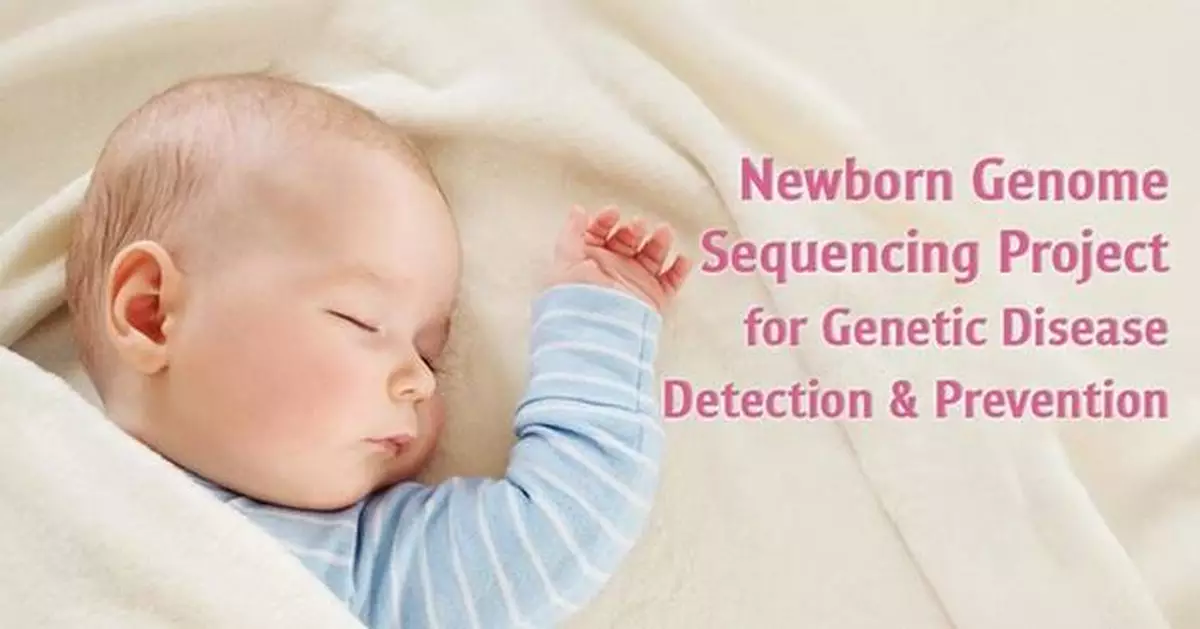
BANGKOK, Oct. 17, 2025 /PRNewswire/ -- The Center of Excellence in Medical Genetics, Faculty of Medicine, Chulalongkorn University, has launched one of the world's first projects to perform long-read whole genome sequencing in newborns. The initiative screens for 113 genetic diseases, with the goal of early prevention and treatment, opening a new frontier in precision medicine and improving lifelong health outcomes.
Genomic Medicine: A New Dimension in Health Care
Modern medicine has entered a new era by decoding the genetic foundations of diseases. Genomic medicine can reveal who is prone to which illness, at what age symptoms may appear, and which medications will work best for an individual. These answers lie hidden in every person's genetic code. Modern medicine, known as genomic medicine, has developed processes and technologies to decode an individual's genetic information to enable more accurate and specific diagnosis, treatment, and disease prevention.
"Why wait until a person is sick to check their genetic information? We can screen newborns and prevent symptoms before they appear, said Prof. Dr. Vorasuk Shotelersuk, Director of the Center of Excellence in Medical Genetics and Deputy Dean for Research, Faculty of Medicine, Chulalongkorn University. "Because our genes stay the same, we can detect disease risk from birth and intervene early."
This principle inspired the launch of the Long-Read Whole Genome Sequencing Screening Project for Genetic Diseases in Newborns.
The Technology: Long-Read Whole Genome Sequencing
The project uses Long-Read Whole Genome Sequencing, one of the world's most advanced DNA sequencing methods, to determine if a child is at risk for serious genetic diseases. Once the data is collected, the child can be monitored and cared for.
Professor Dr. Vorasuk revealed that this project has been approved by the Human Research Ethics Committee of the Faculty of Medicine, Chulalongkorn University, and is now recruiting volunteers (pregnant women). About 300 participants are expected in the first year.
If abnormalities are found, children can receive early, targeted prevention and treatment.
From "One-Size-Fits-All" to Personalized Medicine
Professor Dr. Vorasuk said that in the past, medicine followed a population-based model: a drug might work for 90% of patients, but not for the other 10%, with no way of predicting who would respond or experience side effects.
"Genetic sequencing changes this," Prof. Dr. Vorasuk explained. "We can move from averages to individuals—predicting who will respond, who will not, and who may have adverse reactions. That is personalized medicine."
Professor Dr. Vorasuk outlined three key terms related to the future direction of personalized medicine:
- Personalized Medicine: Medical care focused on individual health and disease treatment.
- Genomic Medicine: Personalized medicine using genetic sequence data for health care and treatment.
- Precision Medicine: Personalized medicine that uses genetic data, environment, and behavior information for individualized care and treatment.
"DNA sequencing technology has been developing since the 1970s, starting with reading a single base pair, advancing to thousands, millions, and billions of base pairs per test."
Today, genetic sequencing has made huge leaps, such as Long-Read Whole Genome Sequencing (WGS), which reads the entire genome of an organism with longer base reads, unlike the more common short-read sequencing.
"Long-read sequencing allows us to read much longer DNA sequences, enabling better detection of complex mutations. This project will use this new technology for genetic screening in newborns."
How the Screening Works
At prenatal care visits at Chulalongkorn Hospital, the medical genetics team explains the project and obtains parental consent. The procedure is safe, free of charge, and painless to both mother and baby. The genetic sequencing data will enable early disease prevention, increasing the child's chance for good health and quality of life.
After delivery at Chulalongkorn Hospital, doctors collect blood from the umbilical cord attached to the placenta. DNA is then extracted and sequenced.
"Neither mother nor baby will feel pain because the blood is taken from the umbilical cord that would otherwise be discarded," said Professor Dr. Vorasuk.
"Blood becomes DNA, which becomes digital data for analysis," Professor Dr. Vorasuk explained. "Humans have over 20,000 genes, but initially, we will analyze 246 genes linked to 113 treatable childhood diseases, with results delivered to parents within 60 days."
Why Early Genetic Knowledge Matters
Long-Read Whole Genome Sequencing reads the entire genome, but the project focuses only on severe, treatable diseases in early childhood—first 5 years of a child's life.
"If the mutation is related to diseases that develop in adulthood, like cancer at age 40, we will not analyze or report it," explained Professor Dr. Vorasuk. "We focus on diseases manifesting within the first 5 years. When the child grows up, they can choose whether to learn about adult-onset risks. We don't want to burden parents with concerns about diseases that may appear decades later."
Examples of detectable conditions include:
- Blood disorders (Thalassemia)
- Neuromuscular diseases (Muscular dystrophy)
- Immune deficiencies (Combined immunodeficiency)
- Hearing loss disorders (Congenital auditory nerve deafness)
- Metabolic conditions (Phenylketonuria)
- Lysosomal storage diseases (Fabry disease)
- Peroxisomal and saccharide metabolism disorders (Glycogen storage disease)
- Endocrine disorders (Congenital adrenal hyperplasia)
"Genetic diseases begin at birth with mutations present from day zero. Symptoms may appear at birth, age 2, or even age 40. The project's goal is to detect them early to prevent symptoms," Professor Dr. Vorasuk said, giving examples.
"A 2-year-old with genetic mutations causing retinoblastoma might have advanced cancer when detected by doctors, requiring eye removal and leading to blindness. This project screens for mutations early so treatment can start when tumors are small, preserving the child's eyesight."
"In another example: four siblings appear healthy at birth, but around age 10, after infections like tooth decay, the siblings are given an antibiotic called aminoglycoside. Without screening, one child suddenly becomes deaf due to a gene mutation triggered by this drug. Screening newborns would reveal the mutation, allowing doctors to avoid aminoglycosides and preserve the child's hearing."
Looking Ahead
Professor Dr. Vorasuk believes genome knowledge will become a cornerstone of future health care.
"Who would live a better life—someone who knows their genome from birth, or someone who does not?" he asked. Knowing your genome means a higher chance of prevention, accurate diagnosis, and targeted treatment. For example, knowing a high risk for colorectal cancer enables prevention and reduces mortality. If at risk for breast cancer, early preventive measures can be taken. One day, I believe every child will be born with their genome mapped."
Genomic medicine is rapidly advancing, with genetic technologies increasingly applicable to complex, multifactorial diseases like diabetes, cholesterol issues, and hypertension.
Though sequencing costs remain high, prices are falling as technology advances. If successful, this project could expand nationwide, giving all Thai children access to their genetic blueprint from birth.
"Knowing one's genome is the foundation of future medicine—not only for prevention and treatment, but eventually for gene editing and gene therapy," Prof. Dr. Vorasuk added.
For those interested in participating in newborn genetic sequencing, contact +662-256-4000 ext. 73102 to 73105 during office hours.
Reference: Center of Excellence in Genomics and Precision Medicine
Read the full article and view photos at: https://www.chula.ac.th/en/highlight/263392/
About Chulalongkorn University
Chulalongkorn University has made the world's top 50 university list for employment outcomes, which reflects both the high employment rate and work ability of Chula graduates. The university is also listed as the best in Thailand for the 15th Consecutive Year (since 2009), according to the newly released QS World University Rankings 2024, putting Chula at 211th in the world, up from 244th last year.
Social Media:
Facebook: https://www.facebook.com/ChulalongkornUniversity
Youtube: https://www.youtube.com/chulauniversity
Linkedin: https://www.linkedin.com/school/15101896/
** The press release content is from PR Newswire. Bastille Post is not involved in its creation. **

Chula Launches Newborn Genome Sequencing Project for Early Detection and Prevention of Genetic Diseases