The 2025 General Assembly of the RCEP Member States World Heritage Cooperation Alliance opened Friday in Huangshan City, east China's Anhui Province, with the aim of facilitating the efficient flow of technology, capital, and talents among member states' heritage sites.
The Regional Comprehensive Economic Partnership World Heritage Cities Alliance (RCEP-WHCA) was jointly launched by heritage site representatives from six RCEP member countries, namely China, Cambodia, Indonesia, Japan, Malaysia and Vietnam, in Huangshan in June 2025.
A total of 180 representatives from heritage management institutions, research and monitoring bodies, cultural and tourism service agencies, and international organizations across the 15 RCEP member countries participated in the assembly.
Home to 178 World Heritage sites, RCEP member countries possess global cultural and natural treasures that serve as vital platforms for regional civilizational exchanges and economic empowerment.
The event aims to advance the Huangshan Initiative launched this June and to establish a cross-sector, interdisciplinary platform for international cooperation in the protection, inheritance and promotion of World Heritage sites.
The conference also seeks to raise the global profile of RCEP heritage sites and expand opportunities for cultural and tourism development.
The participants discussed the sustainable and high-quality development of cultural tourism at World Heritage sites, focusing on new approaches, technologies, and models for cultural-tourism integration.
Peter Semone, chairman of the Pacific Asia Travel Association (PATA), emphasized that RCEP-WHCA provides a vital platform bridging borders, disciplines, and sectors to exchange knowledge, build capacity, and develop innovative models for conservation and sustainable tourism.
The 15 RCEP member countries are Brunei, Cambodia, Indonesia, Laos, Malaysia, Myanmar, Philippines, Singapore, Thailand, Vietnam, Australia, China, Japan, New Zealand, and South Korea.
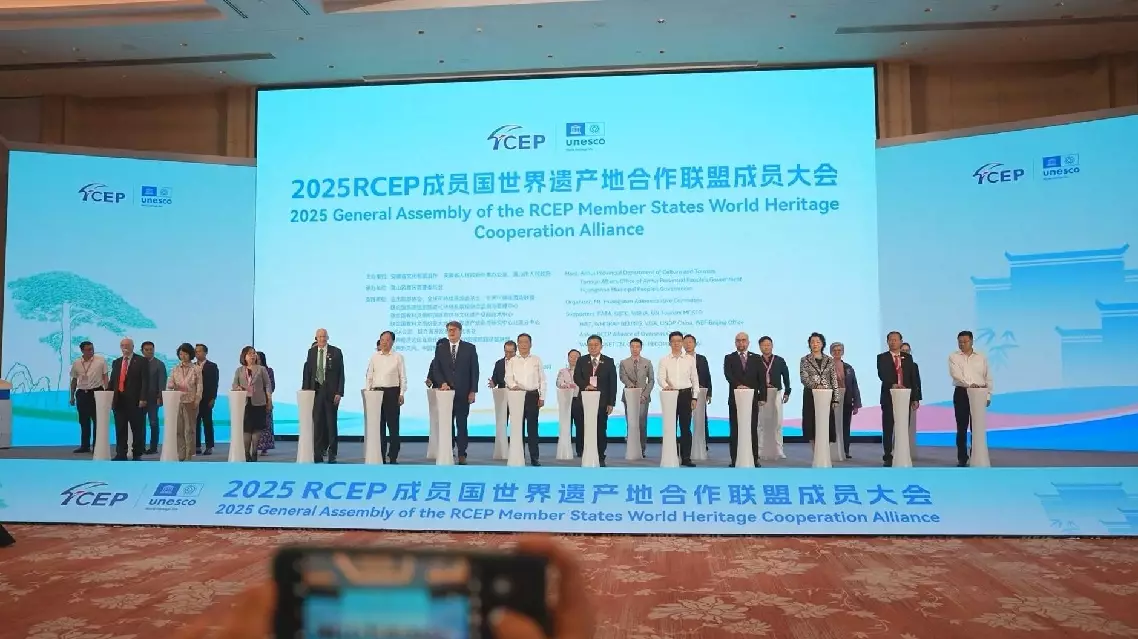
RCEP world heritage assembly opens in China's Hungshan