Skip to Content Facebook Feature Image

China unveils results of "vehicle-road-cloud" integration for intelligent connected vehicle

China

China

China

China unveils results of "vehicle-road-cloud" integration for intelligent connected vehicle

2025-10-18 16:46 Last Updated At:19:57

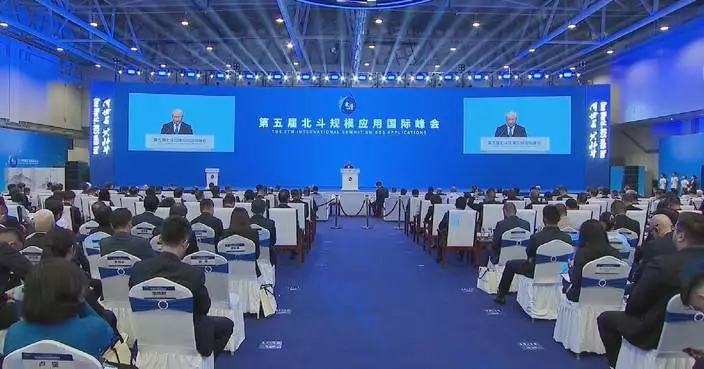
China has announced the phase results of the application of "vehicle-road-cloud integration for intelligent connected vehicles (ICVs) in the country during the three-day 2025 World Intelligent Connected Vehicles Conference, which was concluded in Beijing Saturday.

The new results provide crucial insights for the future large-scale application of the ICV industry, according to the announcement made public at the event held from Thursday to Saturday.

The "vehicle-road-cloud" integration represents a systematic technological framework for the ICV sector. By deeply integrating vehicles with roadside infrastructure and the cloud, this approach enables collaborative perception and intelligent decision-making in the transportation system, serving as a vital means to ensure the safe operation of autonomous driving systems.

As the first country globally to propose and implement this technical strategy, China has involved 20 cities (or consortiums) in related pilot projects. Currently, the country has successfully developed 10 key functional scenarios for "vehicle-road-cloud" integration, covering traffic signal information services, traffic event warning, collaborative collision avoidance for vulnerable road users, collaborative automatic emergency collision avoidance, and vehicle perception information sharing services.

Additionally, China has successfully implemented "vehicle-road-cloud integration" in various fields, including smart public transportation, unmanned delivery, intelligent passenger mobility, urban logistics, highway logistics, smart sanitation, intelligent charging and discharging, and data closed-loop and value-added services.

China unveils results of "vehicle-road-cloud" integration for intelligent connected vehicle
China unveils results of "vehicle-road-cloud" integration for intelligent connected vehicle

China has no need or intention to seek competitive edges in foreign trade through the depreciation of its currency, China's central bank governor said Friday.

Pan Gongsheng, governor of the People's Bank of China (PBOC), made the remarks at a press conference on the sidelines of the fourth session of the 14th National People's Congress.

"Since the beginning of this year, the Chinese yuan has appreciated against the U.S. dollar, due to China's continuously improving economy, the weaker dollar index and seasonal foreign exchange settlements by enterprises. At present, the bilateral yuan-dollar exchange rate is around the midpoint of its range in recent years," said Pan.

"China has no need or intention to obtain trade competitiveness through currency depreciation. The stance of the PBOC has always been clear. It adheres to the decisive role of the market in exchange rate formation, maintain exchange rate flexibility, strengthen expectation management, and keep the yuan generally stable at a reasonable and balanced level," he continued.

The influencing factors of exchange rates are very complex, such as geopolitics, unexpected events, monetary policies, and financial markets, Pan highlighted. Currently, there are significant changes in these factors globally, and the uncertainty is also very high. For example, he explained, the United States and Israel recently launched military strikes against Iran, which led to a substantial increase in the risk-aversion sentiment in the international financial market, as well as violent fluctuations of the U.S. dollar index and the exchange rates of the currencies of major economies.

More than 60 percent of China's import and export trade is now either settled in Chinese yuan or hedged with foreign exchange risk management tools, reducing the impact of exchange rate fluctuations on businesses, Pan noted, adding that this proportion is likely to increase this year.

During the 15th Five-Year Plan period (2026-2030), the PBOC will build a scientific and sound monetary policy system, strike a balance between short-term and long-term perspectives, between stabilizing economic growth and preventing risks, and between internal and external equilibrium, and advancing these efforts by coordinating the goals, tools, and transmission channels of monetary policies, Pan stated.

China has no need or intention to seek trade advantages via currency devaluation: central bank governor

China has no need or intention to seek trade advantages via currency devaluation: central bank governor

Recommended Articles