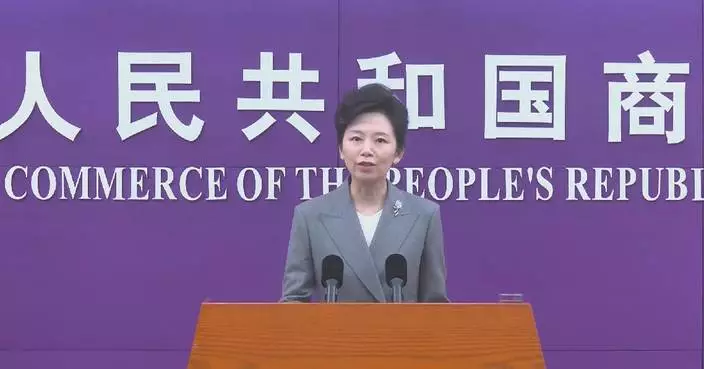
China's economic development has withstood pressure and showed strong resilience in the face of a complex international environment this year, Fu Linghui, spokesman for the National Bureau of Statistics (NBS), said Monday.
According to preliminary estimates, China's gross domestic product (GDP) in the first three quarters was up by 5.2 percent year on year, reaching 101,503.6 billion yuan (about 14,210.5 billion U.S. dollars), according to the NBS.
GDP grew by 5.4 percent year on year in the first quarter, 5.2 percent in the second quarter, and 4.8 percent in the third quarter.
The tertiary industry expanded 5.4 percent year on year in the first three quarters, outpacing a 3.8 percent increase of the primary industry and a 4.9 percent increase of the second industry.
In the first nine months, the total value added of industrial enterprise above designated size (those with an annual main business turnover of at least 20 million yuan) increased by 6.2 percent compared to the same period last year.
The value added of the equipment manufacturing and the high-tech manufacturing sectors grew by 9.7 percent and 9.6 percent, respectively. The value added of enterprises above designated size in these two sectors accounted for 35.9 percent and 16.7 percent of all such enterprises, respectively.
The output of 3D printing equipment, industrial robots and new energy vehicles registered year-on-year increases of 40.5 percent, 29.8 percent and 29.7 percent, respectively.
In the first three quarters, China's retail sales of consumer goods totaled nearly 36.59 trillion yuan, up by 4.5 percent year on year. In September, the retail sales of consumer goods rose three percent year on year to 4.2 trillion yuan.
Sales of basic living items and some upgraded products showed strong growth, while the trade-in programs for consumer goods continued to boost consumption, with the retail sales of household appliances and audio-visual equipment, furniture, communication equipment and cultural and office supplies by enterprises above the designated size up by 25.3 percent, 21.3 percent, 20.5 percent and 19.9 percent, respectively.
The investment in manufacturing grew fast in the first nine months, registering a 4.0 percent growth year on year.
Among the high-tech industries, the investment in information services, aerospace vehicle and equipment manufacturing, and computer and office device manufacturing grew by 33.1 percent, 20.6 percent and 7.4 percent year on year, respectively.
In the first three quarters, China made new progress in the green and low-carbon transition, with the proportion of non-fossil energy consumption in total energy consumption increasing by approximately 1.7 percentage points year on year.
"From a global perspective, a 5.2-percent growth rate ranks among the top in the world's major economies, meaning that China remains a key driving force for global economic growth. It fully demonstrates that although our economic development is facing lots of pressure amid a complex and evolving external environment, the stable fundamentals, upward trajectory, and resilient nature of the economy remain unchanged, laying a solid foundation for steady expansion," Fu, the NBS spokesman, said in an interview in Beijing.
The country's per capita disposable income reached 32,509 yuan during the January-September period, marking a 5.2 percent year-on-year increase after deducting price factors.
The surveyed urban unemployment rate on average in China stood at 5.2 percent in the first three quarters. The rate went down 0.1 percentage point from August to 5.2 percent in September.
China's core consumer price index (CIP) achieved growth for five consecutive months, demonstrating the continued effectiveness of policies to expand domestic demand and boost consumption.
Foreign trade demonstrated strong resilience in the first nine months, with imports and exports reaching all-time highs for the same period, and growth rates recovering gradually. Meanwhile, the RMB exchange rate remained stable with some appreciation.
"Sustaining such growth does not come easy for an economy as large as China's, and it is even more so given the all the interwoven risks and challenges," said Fu.

China's economy sustains resilience with 5.2-pct GDP growth in Jan-Sept: official

China's economy sustains resilience with 5.2-pct GDP growth in Jan-Sept: official