Over the 14th Five-Year Plan period (2021-2025), China has woven a more integrated expressway network with the main routes of 33 major national-level expressways largely interconnected to enhance connectivity and underpin economic growth.
By the end of 2024, China's highway mileage reached 5.49 million kilometers, up 290,000 kilometers from five years earlier. Expressways stretched for 191,000 kilometers, covering 99 percent of cities with a population of over 200,000.
Rural roads are a vital component of China's vast highway system. By the end of 2024, the overall length of rural roads was 4.64 million kilometers, accounting for nearly 85 percent of the national total.
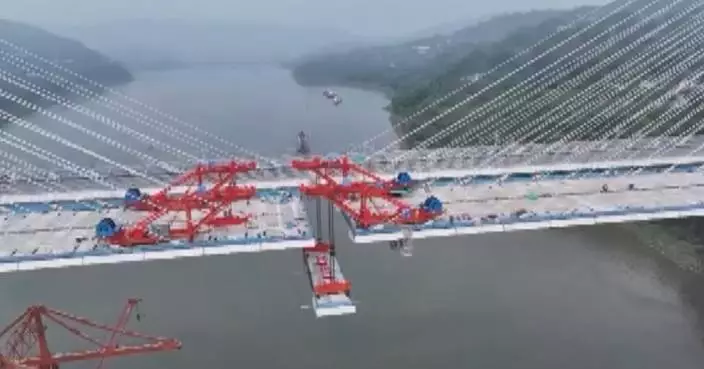
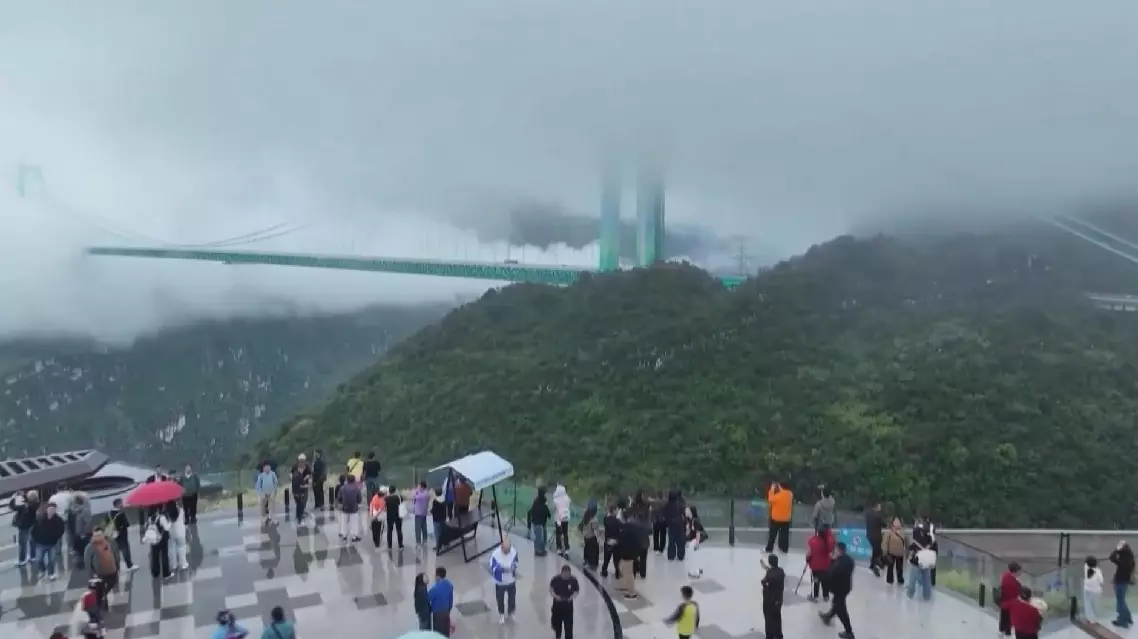
One of the iconic road projects completed during the 14th Five-Year Plan is the world's tallest bridge, which opened to traffic last month in southwest China's Guizhou Province, slashing travel time across a deep canyon from two hours to just two minutes after three years of construction.
The Huajiang Grand Canyon Bridge, soaring 625 meters above the Beipan River in Guizhou's mountainous terrain, is nearly nine times as tall as San Francisco's Golden Gate Bridge.
With a main span of 1,420 meters, the project has become the world's longest-span steel truss girder suspension bridge in mountainous terrain, according to Guizhou provincial authorities.
Spanning the Huajiang Grand Canyon dubbed "the Earth's crack", the 2,890-meter-long structure is the latest addition to the rapidly expanding infrastructure network of the world's second-largest economy.
To harness the economic benefits of the bridge, villagers living near the bridge upgraded their farmhouses into hotels as local authorities developed the travel sector and hosted international skydive events.
As the transportation network becomes increasingly accessible, the main artery is also growing stronger in China.
The Shenzhen-Zhongshan Link, a 24-kilometer cross-sea passage in south China, has greatly enhanced connectivity in the Greater Bay Area, making travel more convenient between cities.
The mega-project, opened in June 2024, has seen over 42 million vehicles in total traffic as of Monday. The link drastically reduces the time for traveling between the city of Zhongshan and the technology hub of Shenzhen -- situated on opposite sides of the Pearl River Estuary in Guangdong Province -- from two hours to approximately 30 minutes.
The new speed has made cross-city living nothing out of the ordinary -- more than 3.7 million passenger trips on the inter-city buses now let people work in Shenzhen and sleep in Zhongshan or Guangzhou.
China weaves stronger expressway network in 14th Five-Year Plan period
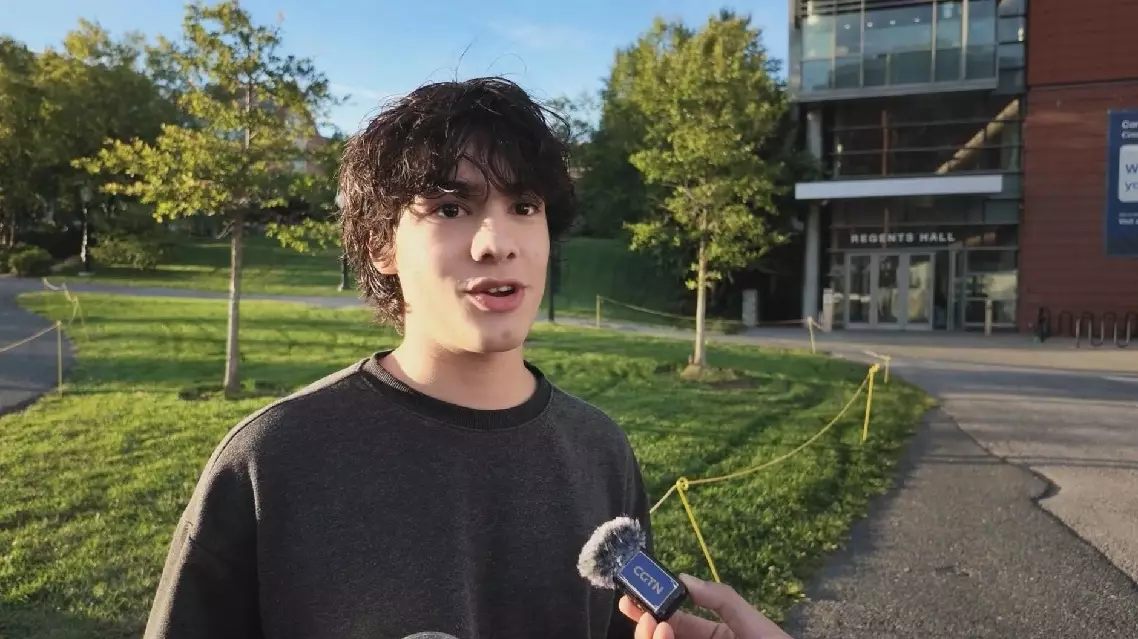
A number of university students in the U.S. capital have shared their views on China's initiative to invite 100,000 young Americans to visit the country for exchanges and study over the next five years.
The program was announced by Chinese President Xi Jinping when addressing a welcome ceremony at the White House during his visit to the United States from Wednesday to Friday.
Many of the students interviewed expressed their hope to visit some well-known places in China like Beijing, Shanghai and Guangdong.
"My dad's been to China for work, and he really loves it, so I'd love to go sometime. Maybe Shanghai. That's where my dad went, and he really liked it there," said a student.
"I've heard of Guangdong. I've heard of the basketball team," another student said.
Many of the students agreed that allowing more young Americans to experience Chinese culture in person would be beneficial for both countries.
"I think that's really cool to have the opportunity to connect with those cultures. And I really do like that idea. I think it's a great idea to invite us to China. It's great," said a student.
"I feel like the culture. I feel like getting the opportunity to immerse yourself in different cultures is really important," said another student.
"There's definitely value in traveling to other places and learning other cultures. So I think that it can be beneficial," said another one.
Even beyond cultural exchange, the students expressed their beliefs that American youth could learn a lot from Chinese society.
"I think, for me personally, it's the scale, with how many people live in China. I would definitely be interested in seeing how that functions, especially in those larger cities," said a student.
"I think I would like to know what their people are like. What are their thoughts on the world? On what the world should be like?" one student said.
"I think China's amazing. They're so far ahead. We're supposed to be the Western world, but I feel like they're so much more advanced than us in so many ways. I know AI and medicine are big things right now, and I think China has made huge advancements in that. So probably that," said a student.
The students also hope that the program will help strengthen China-U.S. relationship, promote educational exchanges, and broaden the horizons of those who take part.
"It's better for both countries to be connected and to build a better relationship over the coming years. And I think that's important to global peace and prosperity," said a student.
"I think it's really a great thing. I think different cultures, combining different cultures, and education is such a global thing, and having different students come all over the place and take classes here and there," said another student.
"There's a lot more to this world than what's right in front of us. And there's a lot to learn from different ways of seeing things around the world. So I think it could be valuable from that standpoint," a student said.
US students share views on China's plan to invite 100,000 young people for study, exchange