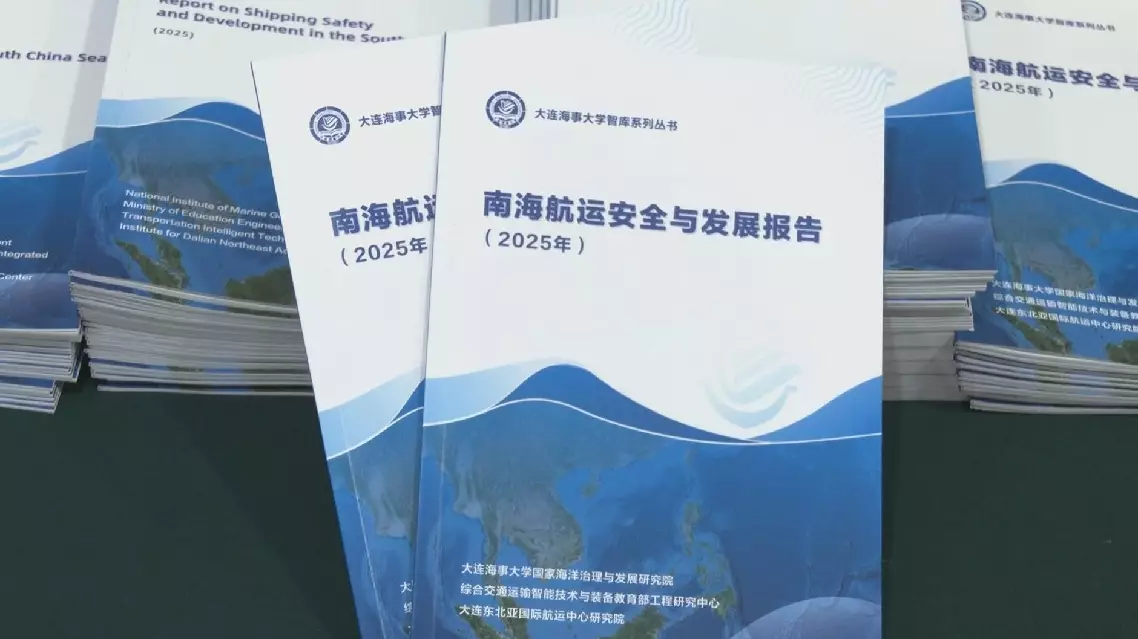
A report on shipping safety and development in the South China Sea was released on Friday, underscoring the region's critical role as a key hub in the global maritime shipping system, supported by objective and comprehensive data.
Compiled by experts from Dalian Maritime University, the report is the world's first comprehensive study that uses big data methodologies to systematically analyze the three key elements of shipping in the South China Sea -- ports, shipping routes, and cargo.
According to the report, the South China Sea is home to 29 major ports and 14 marine routes that connect with all major global trade regions.
It handles 40 percent of the world's port calls and 30 percent of the container transportation volume, linking economic circles of China-Japan-South Korea, ASEAN, Australia, and Africa, as shown in the report.
"The vessel traffic density in the South China Sea is 7.5 times that of the Caribbean Sea, three times that of the Baltic Sea, and 1.5 times that of the Mediterranean Sea. In the era of globalization, countries around the world have formed an industrial supply chain network. And in this network, the South China Sea serves as a 'super seam,' ensuring the stable and efficient operation of global supply chains," said Jia Peng, executive director of the Institute for Dalian Northeast Asia International Shipping Center.
The South China Sea also plays a vital role in the marine transportation of key bulk commodities, with 40 percent of global seaborne crude oil, 34 percent of liquefied natural gas, and 21 percent of soybeans passing through its waters.
"Using big data, the report objectively illustrates the bustling maritime traffic in the South China Sea, providing evidence that navigation in the region is free, safe, and fully guaranteed. It plays a critical role in facilitating global trade, and maintaining and promoting sustainable economic and social development of various countries," said Zhang Haiwen, executive vice president of the Chinese Society for the Law of the Sea.
Report on South China Sea shipping safety, development released
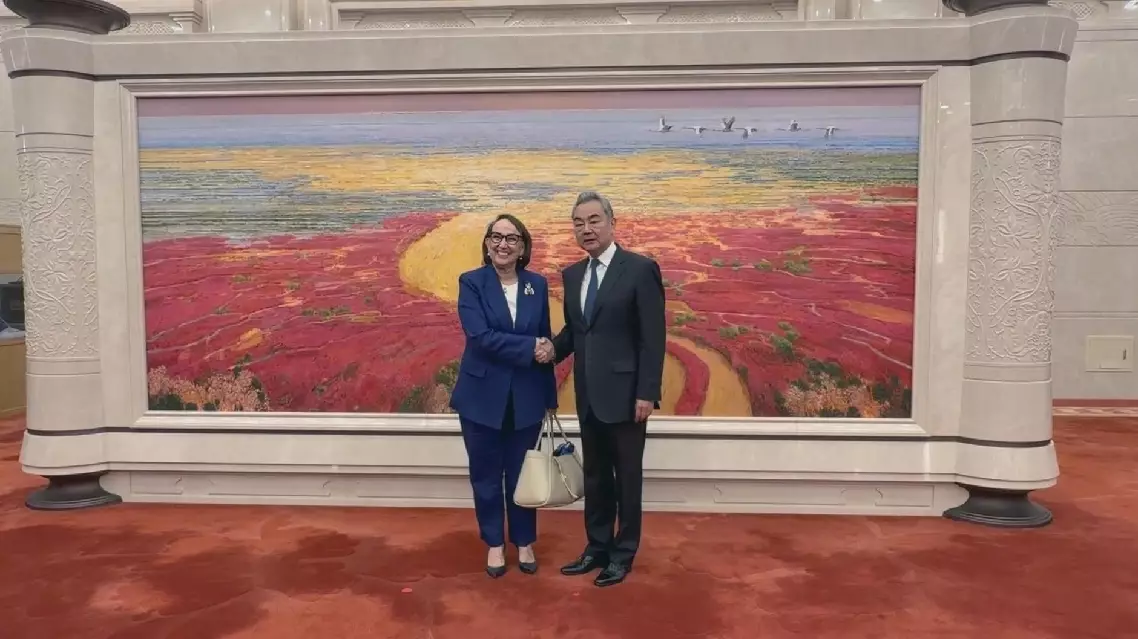
Chinese Foreign Minister Wang Yi met with Rebeca Grynspan, candidate for the next United Nations (UN) secretary-general, in Beijing on Tuesday.
Grynspan, secretary-general of the United Nations Conference on Trade and Development (UNCTAD) and former vice president of Costa Rica, outlined her vision for the future of the United Nations, saying the organization remains irreplaceable but must advance reforms to keep pace with the times.
She said the UN should place greater emphasis on peace, development and the future while fully playing its role as the center of the international system.
Reaffirming her commitment to the one-China principle, Grynspan praised China for consistently supporting multilateralism and the UN Charter. Grynspan said she looks forward to working with China and the international community to strengthen the authority of the United Nations and help build a shared future for humanity.
Wang, also a member of the Political Bureau of the Communist Party of China Central Committee, said Grynspan's remarks reflected a firm commitment to the UN cause, an unwavering pursuit of world peace, and a deep understanding of the concerns and aspirations of Global South countries.
The United Nations is a century-defining undertaking built through the tremendous efforts of the international community, Wang pointed out.
Since the restoration of the lawful seat of the People's Republic of China in the United Nations 55 years ago, China has consistently been a supporter and builder of the UN cause, he noted.
Wang recalled that China assumed the rotating presidency of the UN Security Council last month, during which he traveled to New York to chair a high-level Security Council meeting. The meeting delivered a unified message in support of multilateralism, adherence to the UN Charter, and efforts to revitalize the authority of the United Nations, he said.
The post of UN secretary-general carries significant responsibilities and global influence, Wang said, adding that the next secretary-general should uphold the UN Charter, demonstrate outstanding competence, act with fairness and integrity, and shoulder responsibilities with commitment and resolve.
As a responsible major country and a permanent member of the UN Security Council, China will participate in the selection of the next UN secretary-general in a constructive manner, Wang noted.
He added that China stands ready to work with all parties to safeguard, revitalize and strengthen the United Nations.
Chinese FM meets UN secretary-general candidate Rebeca Grynspan in Beijing