Skip to Content Facebook Feature Image

The 2025 Future Science Prize Week - Laureates' Dialogue with the Youth Inspires 200 local students to explore science

HK

The 2025 Future Science Prize Week - Laureates' Dialogue with the Youth Inspires 200 local students to explore science
HK

HK

The 2025 Future Science Prize Week - Laureates' Dialogue with the Youth Inspires 200 local students to explore science

2025-10-26 15:28 Last Updated At:16:20

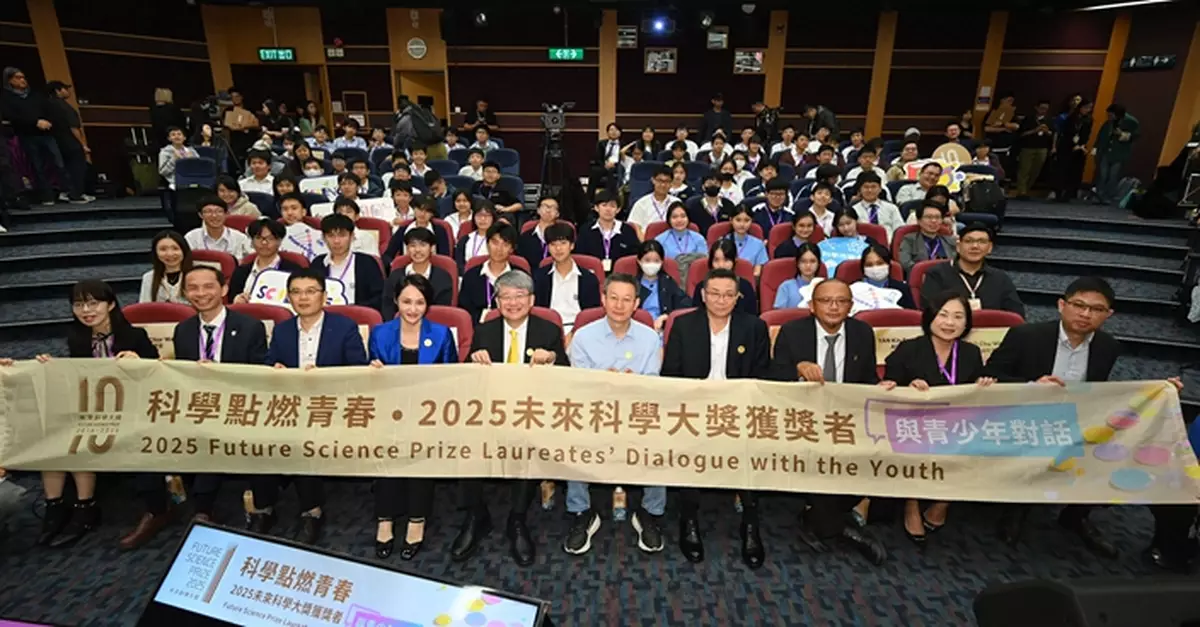
Inspiring the younger generation’s passion for science and nurturing future technological innovatorsstands as one of the key missions of the Future Science Prize. The 2025 Future Science Prize Week(“Prize Week”), co-organised by the Future Science Awards Foundation and the Hong Kong Academyof Sciences, once again hosted the "Laureates' Dialogue with the Youth". The event was successfullyheld this morning (26 October) at the Hong Kong Space Museum, where laureates of the 2025 FutureScience Prize, including Xing XU and Zhonghe ZHOU (Life Science Prize), Xi DAI and Hong DING(Physical Science Prize), engaged in face-to-face exchanges with nearly 200 students from local secondary schools.
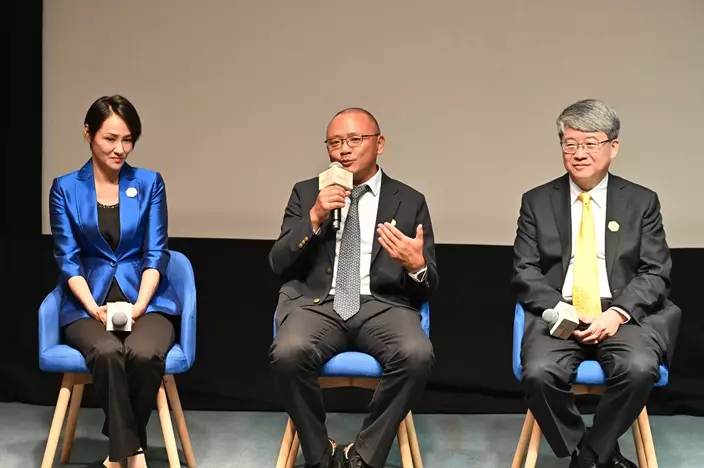
Xi DAI(Middle) and Hong DING(Right), Laureates of the "Physical Science Prize", shared their contributions to the computational prediction and experimental realisation of topological electronic materials. They engaged in face-to-face exchanges with local secondary school students to share their personal experiences with China's first Olympic gold medalist inSpringboard Diving, GAO Min(Left). Image source: the Future Science Prize
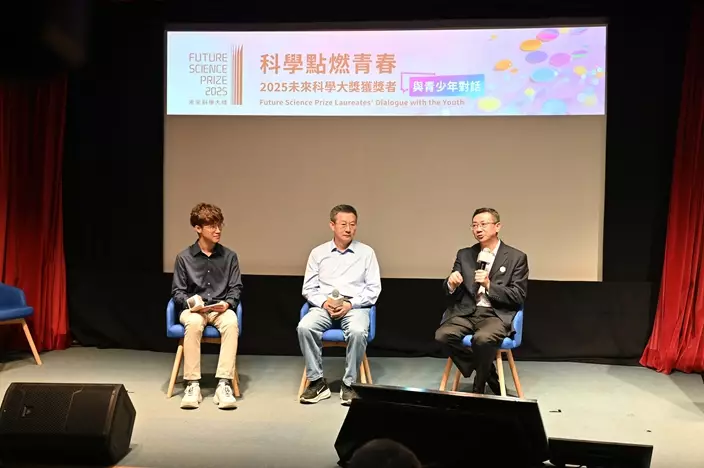
Xi DAI(Middle) and Hong DING(Right), Laureates of the "Physical Science Prize", shared their contributions to the computational prediction and experimental realisation of topological electronic materials. They engaged in face-to-face exchanges with local secondary school students to share their personal experiences with China's first Olympic gold medalist inSpringboard Diving, GAO Min(Left). Image source: the Future Science Prize

Xing XU(Middle) and Zhonghe ZHOU(Right), Laureates of the “Life Science Prize", presented their pioneering work on the discovery of fossil evidence demonstrating the origin of birds from dinosaurs. Andrew Lau(Left), a student at the Faculty of Medicine, Chineses University of Hong Kong hosted the sharing session. Image source: the Future Science Prize
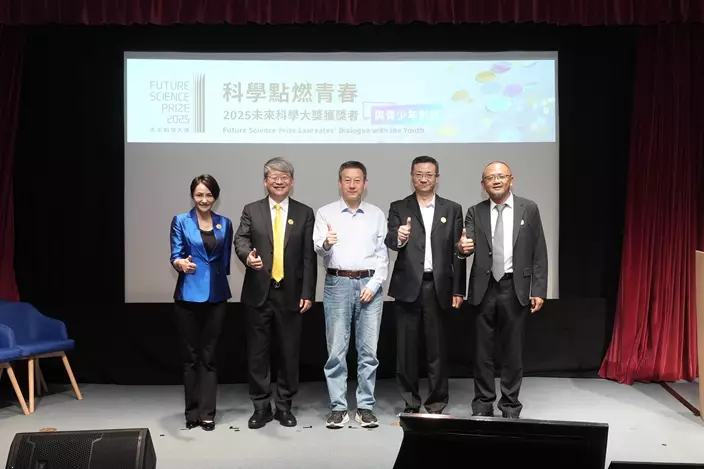
Xing XU(Middle) and Zhonghe ZHOU(Right), Laureates of the “Life Science Prize", presented their pioneering work on the discovery of fossil evidence demonstrating the origin of birds from dinosaurs. Andrew Lau(Left), a student at the Faculty of Medicine, Chineses University of Hong Kong hosted the sharing session. Image source: the Future Science Prize

China's first Olympic gold medalist in Springboard Diving, GAO Min, also participated in the event. She joined this year’s award winners in interacting with the youth, sharing her experiences of perseverance throughout her athletic journey, and in the spirit that closely aligns with the dedication of scientists. Students participating in the event seized this rare opportunity to ask renowned scientists questions, demonstrating their strong interest in and exploratory attitude toward science, marking the first step in their journey into scientific research.

More Images
Xi DAI(Middle) and Hong DING(Right), Laureates of the "Physical Science Prize", shared their contributions to the computational prediction and experimental realisation of topological electronic materials. They engaged in face-to-face exchanges with local secondary school students to share their personal experiences with China's first Olympic gold medalist inSpringboard Diving, GAO Min(Left). Image source: the Future Science Prize

Xi DAI(Middle) and Hong DING(Right), Laureates of the "Physical Science Prize", shared their contributions to the computational prediction and experimental realisation of topological electronic materials. They engaged in face-to-face exchanges with local secondary school students to share their personal experiences with China's first Olympic gold medalist inSpringboard Diving, GAO Min(Left). Image source: the Future Science Prize

Xing XU(Middle) and Zhonghe ZHOU(Right), Laureates of the “Life Science Prize", presented their pioneering work on the discovery of fossil evidence demonstrating the origin of birds from dinosaurs. Andrew Lau(Left), a student at the Faculty of Medicine, Chineses University of Hong Kong hosted the sharing session. Image source: the Future Science Prize

Xing XU(Middle) and Zhonghe ZHOU(Right), Laureates of the “Life Science Prize", presented their pioneering work on the discovery of fossil evidence demonstrating the origin of birds from dinosaurs. Andrew Lau(Left), a student at the Faculty of Medicine, Chineses University of Hong Kong hosted the sharing session. Image source: the Future Science Prize

The 2025 Future Science Prize Week held the “Laureates' Dialogue with the Youth" today, aiming to inspire the younger generation’s passion for science and nurture future technological innovators through face-to-face exchanges between award-winning scientists and Hong Kong students, sharing their research experiences. Image source: the Future Science Prize
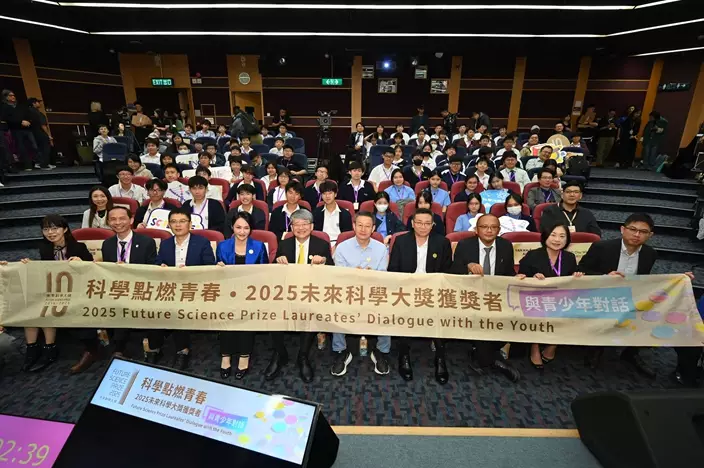
The 2025 Future Science Prize Week held the “Laureates' Dialogue with the Youth" today, aiming to inspire the younger generation’s passion for science and nurture future technological innovators through face-to-face exchanges between award-winning scientists and Hong Kong students, sharing their research experiences. Image source: the Future Science Prize

The 2025 Future Science Prize Week held the “Laureates' Dialogue with the Youth" today, aiming to inspire the younger generation’s passion for science and nurture future technological innovators through face-to-face exchanges between award-winning scientists and Hong Kong students, sharing their research experiences. Image source: the Future Science Prize

The 2025 Future Science Prize Week held the “Laureates' Dialogue with the Youth" today, aiming to inspire the younger generation’s passion for science and nurture future technological innovators through face-to-face exchanges between award-winning scientists and Hong Kong students, sharing their research experiences. Image source: the Future Science Prize

The 2025 Future Science Prize Week held the “Laureates' Dialogue with the Youth" today, aiming to inspire the younger generation’s passion for science and nurture future technological innovators through face-to-face exchanges between award-winning scientists and Hong Kong students, sharing their research experiences. Image source: the Future Science Prize
The 2025 Future Science Prize Week held the “Laureates' Dialogue with the Youth" today, aiming to inspire the younger generation’s passion for science and nurture future technological innovators through face-to-face exchanges between award-winning scientists and Hong Kong students, sharing their research experiences. Image source: the Future Science Prize
The 2025 Future Science Prize Week held the “Laureates' Dialogue with the Youth" today, aiming to inspire the younger generation’s passion for science and nurture future technological innovators through face-to-face exchanges between award-winning scientists and Hong Kong students, sharing their research experiences. Image source: the Future Science Prize
The 2025 Future Science Prize Week held the “Laureates' Dialogue with the Youth" today, aiming to inspire the younger generation’s passion for science and nurture future technological innovators through face-to-face exchanges between award-winning scientists and Hong Kong students, sharing their research experiences. Image source: the Future Science Prize
With no background in coding, Faith Maeba, a psychology major, was reluctant when her mother first suggested she enroll in classes on artificial intelligence.

But the senior at Virginia Commonwealth University began to see it differently as she looked into graduate psychology programs that explore human behavior in the workplace, which is quickly being upended by machine learning. Maeba, 21, is now pursuing a minor in AI.

“It’s giving me an edge and standing out,” she said.

Hiring has cooled for entry-level software developers — work increasingly done by AI agents — and college enrollment in computer and information science programs has been declining. Yet at campuses across the country, many professors are finding themselves busier than ever teaching students from a range of majors about artificial intelligence.

Colleges are responding to changes in student demand, but they also recognize that new graduates — regardless of their field — are facing questions about their AI skills from potential employers.

“We have to democratize it,” said Peter Stone, the chair of computer science at the University of Texas at Austin, who recently developed an introductory course on AI essentials for noncomputer science majors.

“In the same way that everybody needs some degree of math, reading and writing, I think everybody needs a degree of AI literacy,” he said.

Schools like VCU are standing up AI minors targeting students outside computer science. There’s a new AI graduation requirement at Purdue University. In freshman writing classes, Harvard University is teaching students how large language models work, plus exploring AI topics such as copyright and disinformation. And Ohio State University has an AI fluency requirement that includes hands-on workshops. Meanwhile, AI-focused undergraduate and even graduate degrees are proliferating.

At Northwestern University, noncomputer science majors had interest in taking classes in the department even before ChatGPT launched in 2022, but sometimes there wasn’t enough room, said Samir Khuller, the chair for computer science. That’s because computer science, then seen as a golden ticket to a high-paying job, was exploding in popularity.

But recently, the number of incoming computer science majors has started to shrink. Now Northwestern’s computer science staff, which had doubled in size to meet the demand, is teaching more students from other majors. The school, which already has a popular AI minor, is adding an AI major. It's also streamlining prerequisites to make it easier for nonmajors to take an AI or machine learning class.

“Overall, classes are going to be a lot more accessible moving forward,” Khuller said. The department is so busy, he's trying to hire three more computer science professors.

Among other changes across the university, Northwestern’s Bienen School of Music is offering a certificate in music and artificial intelligence.

Nationwide, enrollment in computer and information sciences continued falling this spring, down more than 8% at four-year institutions from the spring of 2025, according to the latest data from the National Student Clearinghouse Research Center, a dip that came as job postings for software developers dropped.

Interest in attaining at least a bare-bones understanding in computer science — and particularly AI-enhanced coding — has exploded across different majors. Music students, for instance, are discovering tools that can easily do tasks such as editing or generating drum tracks.

At Eastern Mennonite University in Harrisonburg, Virginia, assistant music professor Benjamin Guerrero is co-teaching a class next year with a computer scientist. Musicians, artists, theater and digital media majors will learn alongside math, computer science and electrical engineering students. The goal, he said, is to create people who can work at the intersection of art and technology.

“In my mind, AI is no more disruptive than the record player, the radio, the metronome, the synthesizer or the computer,” said Guerrero, who has helped organizations including the National Association for Music Education develop plans to incorporate AI.

Even before this latest surge in interest, STEM majors — like physicists and biologists — often took computer science classes to learn how to code for data-heavy research. But the learning curve was steep until new AI tools came along, said Murtaza Ali, a doctoral candidate at the University of Washington whose research focuses on computer science education.

Yet, he said, AI also is stirring anxiety. The concern, he said, is that even if the AI is just being used to write code, it’s going to encroach so much that eventually some college graduates won’t understand the basic concepts in their field.

“When you ask the AI to do it for you, on the surface it might just seem it is writing the code,” he said. “But under the hood, it’s actually also doing the understanding of the task for you.”

Despite those concerns, the pace of change is remarkable for a sector infamous for moving slowly, said Paul LeBlanc, a visiting scholar at Harvard’s Graduate School of Education, who studies AI’s impact on higher education.

“It’s impossible to keep up with the technology, but that’s true for every organization in the world right now,” said LeBlanc, formerly president of Southern New Hampshire University, a prominent player in online degrees.

Community colleges that want to offer non-credit classes are able to move especially fast, because the approval process is less cumbersome. One in suburban Kansas City recently offered a non-credit “vibe-coding” class to teach nontechies to create working software.

“What AI does is shrink that distance between a complete novice and an expert,” said Grant Carlson, program coordinator for workforce development and continuing education at Johnson County Community College. The Kansas City-area college also offers an AI certificate and is making plans to tailor AI classes to specific occupations, such as human resources and medical careers.

At VCU, it used to take a year and a half to design a course and get it approved for students to take, said Andrew Arroyo, senior vice provost of academic affairs.

“Now we’re doing things really in a matter of months and in some cases weeks,” Arroyo said. An online graduate certificate program in applied AI is being added this year, he said.

More than simply creating programs, professors must try to prepare students for widely differing goals for using AI in their careers. In courses for VCU’s AI minor, Althea Pappas said she’s exploring AI not to use in her career, but to help her answer philosophical questions.

“What happens when we create actual life, or how do we even make that distinction?” asked Pappas, a music composition major entering her sophomore year.

Meanwhile, what fascinates aspiring neurologist Makenzie Stovall is the idea that AI is trying to emulate the brain — an organ whose inner workings continue to leave researchers dumbfounded.

“If I am going to try to make people’s brain the best it can be, well, then,” the 20-year-old VCU biology major asked, “why not study AI?”

The Associated Press’ education coverage receives financial support from multiple private foundations. AP is solely responsible for all content. Find AP’s standards for working with philanthropies, a list of supporters and funded coverage areas at AP.org.

Faith Maeba, a student at Virginia Commonwealth University, poses for a portrait with her tablet at home Monday, July 20, 2026, in Stafford, Va. (AP Photo/Moriah Ratner)

Faith Maeba, a student at Virginia Commonwealth University, poses for a portrait with her tablet at home Monday, July 20, 2026, in Stafford, Va. (AP Photo/Moriah Ratner)

Faith Maeba, a student at Virginia Commonwealth University, shares an assignment she completed assignment for her Practical AI Synthesis course at her home, Monday, July 20, 2026, in Stafford, Va. (AP Photo/Moriah Ratner)

Faith Maeba, a student at Virginia Commonwealth University, shares an assignment she completed assignment for her Practical AI Synthesis course at her home, Monday, July 20, 2026, in Stafford, Va. (AP Photo/Moriah Ratner)

Faith Maeba, a student at Virginia Commonwealth University, poses for a portrait with her tablet at her home Monday, July 20, 2026, in Stafford, Va. (AP Photo/Moriah Ratner)

Faith Maeba, a student at Virginia Commonwealth University, poses for a portrait with her tablet at her home Monday, July 20, 2026, in Stafford, Va. (AP Photo/Moriah Ratner)

Recommended Articles