Skip to Content Facebook Feature Image

Bird flu hits migrating cranes hard in Germany as the virus flares up

News

Bird flu hits migrating cranes hard in Germany as the virus flares up
News

News

Bird flu hits migrating cranes hard in Germany as the virus flares up

2025-10-29 15:02 Last Updated At:15:10

LINUM, Germany (AP) — In a spot outside Berlin that's usually a paradise for birdwatchers, volunteers have recovered nearly 2,000 dead cranes in recent days as bird flu has hit the migrating birds hard.

Linum, a small village about an hour's travel from the German capital, is known in summer for its many nesting storks. In the fall and spring, it's a popular resting spot for thousands of cranes as they migrate between the Baltic and Nordic regions and southern Europe. But this month, many of the birds' journeys have ended in the ponds and fields that surround it, as well as at other spots in Germany.

More Images
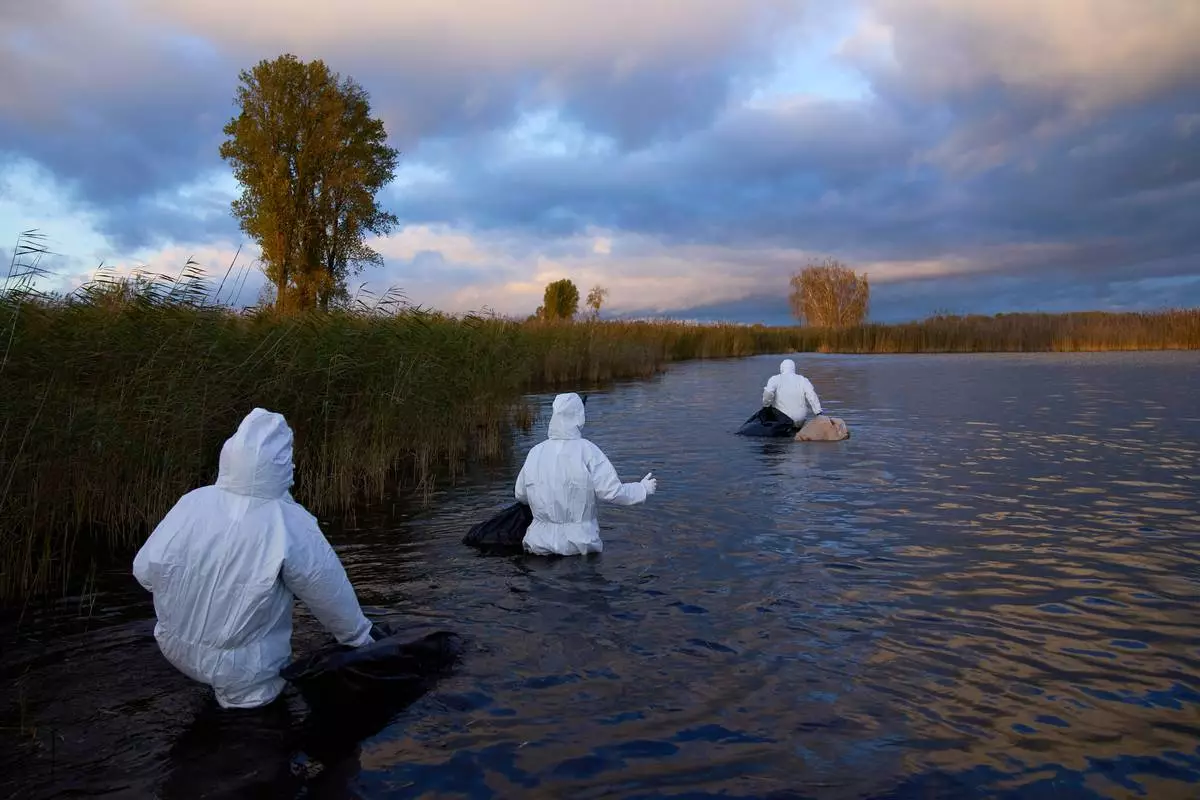
Environmental workers collect the bodies of birds that have died from bird flu in a lake in Linum, Brandenburg, Germany, Monday, Oct. 27, 2025. (AP Photo/Ebrahim Noroozi)

Environmental workers collect the bodies of birds that have died from bird flu in a lake in Linum, Brandenburg, Germany, Monday, Oct. 27, 2025. (AP Photo/Ebrahim Noroozi)

A bird dead from bird flu lays in a lake in Linum, Brandenburg, Germany, Monday, Oct. 27, 2025. (AP Photo/Ebrahim Noroozi)

A bird dead from bird flu lays in a lake in Linum, Brandenburg, Germany, Monday, Oct. 27, 2025. (AP Photo/Ebrahim Noroozi)

Environmental workers collect the bodies of the birds have died from bird flu in a lake in Linum, Brandenburg, Germany, Monday, Oct. 27, 2025. (AP Photo/Ebrahim Noroozi)

Environmental workers collect the bodies of the birds have died from bird flu in a lake in Linum, Brandenburg, Germany, Monday, Oct. 27, 2025. (AP Photo/Ebrahim Noroozi)

Environmental workers collect the bodies of the birds have died from bird flu in a lake in Linum, Brandenburg, Germany, Monday, Oct. 27, 2025. (AP Photo/Ebrahim Noroozi)

Environmental workers collect the bodies of the birds have died from bird flu in a lake in Linum, Brandenburg, Germany, Monday, Oct. 27, 2025. (AP Photo/Ebrahim Noroozi)

Environmental workers collect the bodies of the birds have died from bird flu in a lake in Linum, Brandenburg, Germany, Monday, Oct. 27, 2025. (AP Photo/Ebrahim Noroozi)

Environmental workers collect the bodies of the birds have died from bird flu in a lake in Linum, Brandenburg, Germany, Monday, Oct. 27, 2025. (AP Photo/Ebrahim Noroozi)

Bird flu has flared up early and quickly in the country this year. Since early September, the Friedrich Loeffler Institute, Germany's national animal health authority, has recorded 30 outbreaks at poultry farms as well as cases among wild birds in various parts of the country, and more than 500,000 chickens, ducks, geese and turkeys so far have been slaughtered as a precaution.

Over the past week the majestic gray-and-white cranes, unusually, have been at the center of attention. It's not clear where they were infected. Norbert Schneeweiss, an expert with Brandenburg state's environment office, said that such a severe impact from bird flu hasn't previously been seen in cranes on this migration route, though there was an outbreak among cranes in Hungary two years ago.

This week, volunteers in full-body protective overalls waded through the water and reeds outside Linum and stuffed the limp, floating bodies of the large birds into sacks.

A sick bird stood listlessly by a path nearby, failing to fly away as people approached. Others have been seen staggering and then collapsing. Still-healthy birds flew overhead and pecked for food in the fields.

By Monday evening, volunteers had picked up 1,875 dead cranes and expected the total to top 2,000 in the coming days.

“There's not a lot more we can do here other than gather up the birds,” Schneeweiss said. He added that experts have made an effort to make the area less attractive for migrating birds, for example by limiting the water flow to reduce the size of the resting area — but noted that “resting places are rare in Central Europe.”

In earlier years, “we were glad of every crane — it was a natural spectacle every evening when thousands of cranes fly in; a lot of visitors came,” he said. Now, however, the usual guided tours for bird fans have been cancelled.

Schneeweiss said the situation appears to be under control locally for now, with the number of dead cranes slowing and no other wild birds yet showing symptoms.

Collecting the birds is hard and depressing work. “We try to convince ourselves that we’re doing something good for conservation and that it’s important,” volunteer Lara Weinmann said. “But of course, it does affect you.”

Bird flu infections in humans are relatively rare. But as it hits other species, including some mammals, scientists fear the virus could evolve to spread more easily among people.

Ebrahim Noroozi in Linum and Geir Moulson in Berlin contributed to this report.
Environmental workers collect the bodies of birds that have died from bird flu in a lake in Linum, Brandenburg, Germany, Monday, Oct. 27, 2025. (AP Photo/Ebrahim Noroozi)

Environmental workers collect the bodies of birds that have died from bird flu in a lake in Linum, Brandenburg, Germany, Monday, Oct. 27, 2025. (AP Photo/Ebrahim Noroozi)

A bird dead from bird flu lays in a lake in Linum, Brandenburg, Germany, Monday, Oct. 27, 2025. (AP Photo/Ebrahim Noroozi)

A bird dead from bird flu lays in a lake in Linum, Brandenburg, Germany, Monday, Oct. 27, 2025. (AP Photo/Ebrahim Noroozi)

Environmental workers collect the bodies of the birds have died from bird flu in a lake in Linum, Brandenburg, Germany, Monday, Oct. 27, 2025. (AP Photo/Ebrahim Noroozi)

Environmental workers collect the bodies of the birds have died from bird flu in a lake in Linum, Brandenburg, Germany, Monday, Oct. 27, 2025. (AP Photo/Ebrahim Noroozi)

Environmental workers collect the bodies of the birds have died from bird flu in a lake in Linum, Brandenburg, Germany, Monday, Oct. 27, 2025. (AP Photo/Ebrahim Noroozi)

Environmental workers collect the bodies of the birds have died from bird flu in a lake in Linum, Brandenburg, Germany, Monday, Oct. 27, 2025. (AP Photo/Ebrahim Noroozi)

Environmental workers collect the bodies of the birds have died from bird flu in a lake in Linum, Brandenburg, Germany, Monday, Oct. 27, 2025. (AP Photo/Ebrahim Noroozi)

Environmental workers collect the bodies of the birds have died from bird flu in a lake in Linum, Brandenburg, Germany, Monday, Oct. 27, 2025. (AP Photo/Ebrahim Noroozi)

SAN FRANCISCO--(BUSINESS WIRE)--Jan 12, 2026--

Multiply Labs, a leader in robotic biomanufacturing, today announced a landmark milestone in its mission to scale production of cell and gene therapies; The company is now leveraging NVIDIA’s open Isaac and GR00T technologies including advanced robotics simulation and perception, marking a turning point for an industry that has historically relied on manual, "artisanal" processes.

This press release features multimedia. View the full release here: https://www.businesswire.com/news/home/20260112559472/en/

Cell and gene therapies are life-changing treatments that hold the potential to address cancer and autoimmune diseases, but manufacturing remains difficult to scale with time-intensive processes and variability that can impact throughput and cost. Multiply Labs is developing robotics-first biomanufacturing systems intended to bring greater consistency, traceability, and operational efficiency to advanced therapy production—so personalized treatments can be more broadly accessible.

Multiply Labs’ systems use four robotic arms operating in parallel to maximize output in existing facilities, targeting up to 100x more patient doses per square foot of cleanroom space compared to traditional manual processes.

To accelerate development, Multiply Labs’ integration of NVIDIA robotics and AI infrastructure covers three core areas:

“Advanced biomanufacturing is one of the highest value applications for robots. That puts us in a fortunate position to be able to invest in the most cutting-edge robotic technologies that exist,” said Fred Parietti, co-founder and CEO at Multiply Labs. “By combining our robotic approach to biomanufacturing with NVIDIA’s state-of-the-art simulation, perception, and foundation model technologies, we accelerate development and unlock the next level of scalability for hardware and software systems, driving our robots towards broader patient impact.”

“Advanced biomanufacturing is a powerful frontier for physical AI, where robotics and AI can help scale the manufacturing of therapies that can help patients across the world,” said Stacie Calad-Thomson, North America Business Development Lead, Healthcare and Life Sciences, NVIDIA. “Multiply Labs, leveraging NVIDIA AI infrastructure, is helping accelerate biomanufacturing automation designed to increase reliability and scalability for advanced therapies—and translate advances in physical AI into meaningful patient impact.”

NVIDIA AI infrastructure used by Multiply Labs:

Video demonstrations:

Download images and video:Here

About Multiply Labs
Multiply Labs is a robotics company with a mission to make the world’s best robots and use them to make the world’s best personalized treatments widely available. The company develops advanced, cloud-controlled robotic systems that enable the production of advanced therapies at scale. Its customers include some of the largest global organizations in the advanced pharmaceutical manufacturing space. Multiply Labs’ expertise is at the intersection of robotics and biopharma – its team includes mechanical engineers, electrical engineers, computer scientists, software engineers and pharmaceutical scientists. The founding team got in touch because of their shared love of robots at MIT, and is now based in San Francisco, California.
www.multiplylabs.com

Multiply Labs' leverage of NVIDIA’s tech stack marks a turning point for a biomanufacturing industry that has historically relied on manual, "artisanal" processes.

Multiply Labs' leverage of NVIDIA’s tech stack marks a turning point for a biomanufacturing industry that has historically relied on manual, "artisanal" processes.

Recommended Articles