The new Terminal 3 (T3) of Guangzhou Baiyun International Airport in Guangzhou City, south China's Guangdong Province, officially began operation on Thursday, along with its supporting transportation center complex.
As a major integrated "air-road-rail" hub enabling seamless zero-distance transfers, the center connects multiple expressways, a high-speed rail, and intercity railway lines via a "cross-shaped" highway network, forming a dense transportation system radiating across the Guangdong-Hong Kong-Macao Greater Bay Area.
The newly inaugurated transportation center complex includes an integrated transport hub, a multi-story parking facility, and a supporting hotel.
Upon entering the center, travelers are greeted by a 5,000-square-meter skylight dome inspired by the imagery of "kapok blossoms and the Milky Way". The design combines aesthetics with functionality.
"It's not merely a beautiful roof--it's an intelligent 'light filter' that retains heat in winter and it in summer while admitting natural light. This design not only saves energy and protects the environment but enhances passenger comfort," said hen Ruiyang, Chief Engineer of Guangzhou Baiyun Airport Transportation Center Complex Project, China Railway Construction Engineering Group.
The transportation center consists of five stories. The first three floors and the first basement floor are interconnected with the terminal and the parking building. The parking facility is planned to accommodate approximately 2,800 spaces in total, with an initial 1,800 spaces open to the public. It also includes a dedicated drop-off area for ride-hailing services to facilitate swift passenger pickups and drop-offs.
Surrounding Guangzhou Baiyun Airport, a "well-shaped" expressway framework has been formed, consisting of the Pearl River Delta Ring Expressway to the north, the Guangzhou-Lechang Expressway and Airport Expressway to the west, the Huadu-Dongguan Expressway and its western extension to the south, and the Guangzhou-Lianzhou Expressway and the Second Airport Expressway to the east.
The underground level of the transportation hub centrally locates entrances for intercity trains, high-speed rail, and the subway. According to reports, two major high-speed rail lines—the Guangzhou-Heyuan High-Speed Railway and the Guangzhou-Zhongshan-Zhuhai-Macao High-Speed Railway—will extend directly into the airport.
Additionally, the Fangcun-Baiyun International Airport Intercity Railway and the Guangzhou-Dongguan-Shenzhen Intercity Railway will also connect simultaneously. To minimize walking distances for passengers with luggage, rail entry and exit points, airport check-in counters, and baggage drop-off services are all positioned on the same level, facilitating efficient transfers.
At present, the underground level is equipped with 14 self-service check-in counters and eight self-service check-in machines. It is expected to provide on-site services for up to 43 percent of rail passengers, seamlessly integrated with the terminal's luggage system to significantly enhance transfer efficiency.
"The transportation center is an integrated hub combining aviation, road and railway services. From here, travelers can reach downtown Guangzhou in 30 minutes, Pearl River Delta cities in one hour, and neighboring provincial capitals in three hours. This advancement speeds up the formation of a 'Greater Bay Area on tracks', enhances the synergistic efficiency of the Guangdong-Hong Kong-Macao Greater Bay Area's world-class airport cluster, and provides key support for improving regional transport efficiency," said Chen.
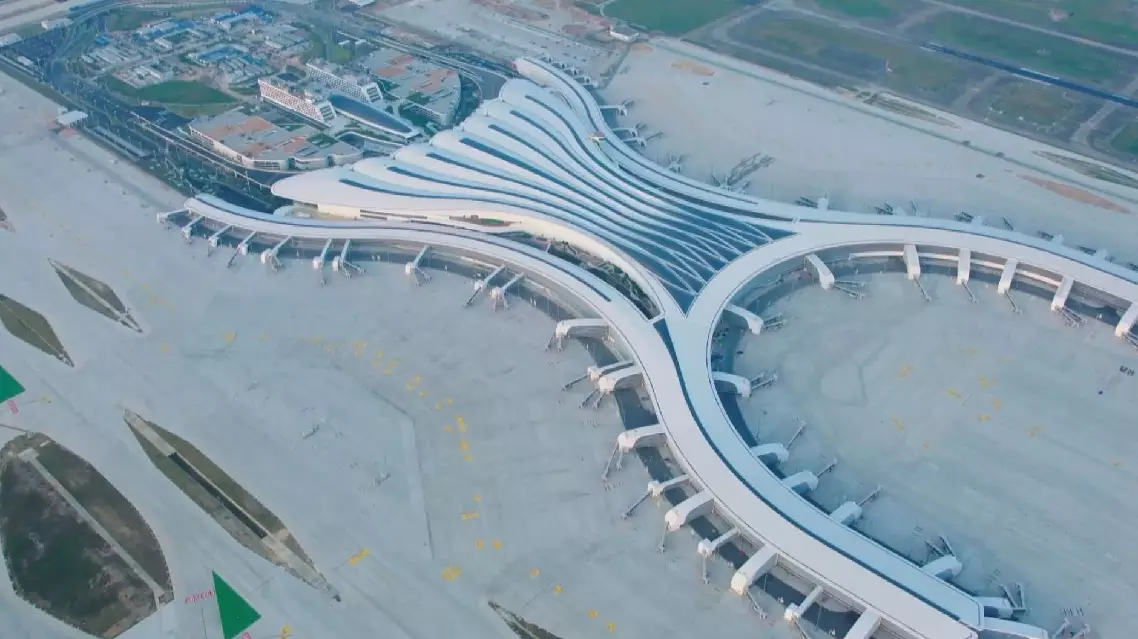
New terminal put into operation in Guangzhou's key airport in south China