China's Thorium Molten Salt Reactor (TMSR), the world's first project of its kind, is able to maintain safe operations due to innovative designs and concepts adopted by Chinese engineers.
In an operational milestone, China achieved the first-ever thorium-to-uranium fuel conversion in the molten-salt reactor, said the Chinese Academy of Sciences' Shanghai Institute of Applied Physics (SINAP) on Saturday.
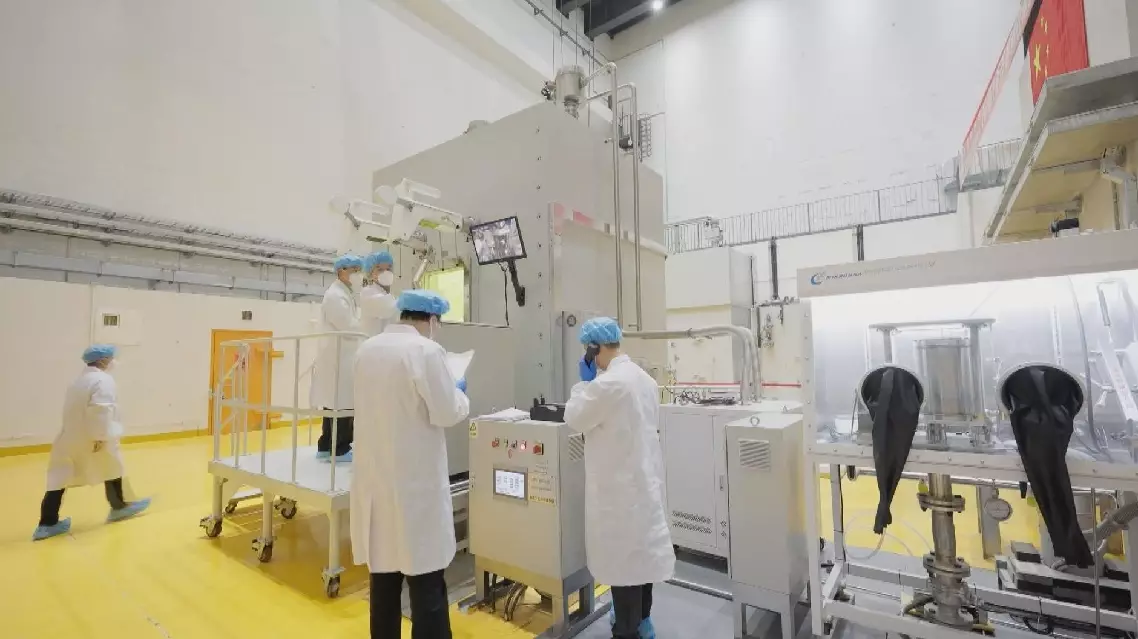
To prevent possible leakage of radioactive substances, the scientists innovatively designed the integrated structure of the reactor, integrating core equipment such as the reactor core, fuel salt pump, and heat exchanger within the main reactor vessel. Such a design can significantly enhance safety.
"With heat exchangers inside the reactor, the molten salt coolant never comes out of the reactor body. We also have a safe container outside the reactor body, so there's a multi-layer protection to make sure radioactive materials don't leak," said Dai Zhimin, director of SINAP.
Molten-salt reactors are fourth-generation advanced nuclear energy systems that use high-temperature molten salt as a coolant. They boast inherent safety features, cool without water, run at atmospheric pressure, and deliver a high-temperature output. These features mean the reactors are widely recognized as the most suitable type for thorium resource utilization in nuclear energy production.
The atmospheric pressure erases rupture risks that are common in high-pressure systems, and the molten salt coolant can prevent the reactor core from melting at high temperatures, according to the scientists.
"Even if there occurs an accident involving the entire reactor, only a very small amount of fission products may be discharged. As the byproducts have already gone through our treatment systems during normal operations, there won't be much leakage of radioactive materials in extreme accidental situations," said Li Qingnuan, deputy director of SINAP.
The TMSR program was launched in 2011, achieving major progress from laboratory research to the engineering verification of core materials, equipment and technologies. With domestically developed core equipment and an independent supply chain, China has established complete TMSR technology and industrial chains in basic terms.
Innovative designs behind enhanced safety of China's thorium molten salt reactor project