People in central Philippine's Cebu Province recalled horrific moments of climbing onto the roof to avoid the flooding brought by the Typhoon Kalmaegi.
The death toll from the typhoon, which made landfall in central Philippines on Tuesday and left the country on Thursday, has reached 188, with 135 others missing, the country's National Disaster Risk Reduction and Management Council (NDRRMC) said on Friday.
In many villages of Cebu, homes were reduced to rubble, streets became thick with mud and families had to pick through the wreckage of what used to be their lives.
Floodwaters tore through homes, sweeping away furniture, appliances and memories and leaving residents to salvage whatever they can from the mud-soaked debris.
Metch Sinday said she and her family had to climb onto the roof as the flood water swallowed their home.
"The water rose so fast that you could barely see our house. The only thing visible was our roof. We have babies in the house, one is just seven months old, and we also have children and elderly. We passed them from one person to another to get up our roof," she said.
Lucy Cuajo had gone ahead to the evacuation center to prepare a place for her elderly parents. But when she returned to fetch them, the entire village was already underwater.
Panic and fear set in as she realized her parents, who could barely walk, were trapped in the rising flood.
"I was so worried because my mother and father are elderly and can barely walk. With the help of our neighbors, they used a ladder to climb up to the roof and then crossed over to the next village," she said.
Kalmaegi, the 20th typhoon to slam the Philippines this year, has affected more than 700,000 people across the regions of Visayas and Mindanao, according to the NDRRMC.
Philippine President Ferdinand Romualdez Marcos had declared a state of national calamity due to the impact of Typhoon Kalmaegi and in anticipation of an upcoming typhoon, local media reported Thursday.

Victims of typhoon Kalmaegi recall horrific moments of deadly disaster
Despite attempts by the Democratic Progressive Party (DPP) authorities in the Taiwan region to obstruct normal exchanges and cooperation between the two sides of the Taiwan Strait, extensive cross-Strait interactions continue to thrive.
The recent moves by the DPP authorities are sinister in intent and aimed at pursuing their secessionist goal, according to Zhang Hua, a research fellow at the Institute of Taiwan Studies, Chinese Academy of Social Sciences.
"The DPP authorities have manipulated the so-called narrative of 'anti-China and resistance against China,' which is gravely harmful as it exacerbates social rifts in Taiwan. Currently, due to factors such as 'political mobilization' and the 'political election market,' contrasting emotions among the public in Taiwan have been persistent. Furthermore, differences in words have led to a situation characterized by 'green terror,' which naturally further worsens social rifts on the island," said Zhang.
"In March 2025, the DPP authorities concocted the so-called '17 responding strategies,' and in November 2025, they again concocted two action plans to limit cross-Strait exchanges. The purpose is the same as the current revisions to the so-called 'laws.' Lai Ching-te aims to pursue secessionist goal through soliciting support from the United States and seek Taiwan secession through military build-up. So, he cannot allow the people of Taiwan to read books from the Chinese mainland, watch films from the mainland, or play games produced in the mainland. He views these as methods used by the mainland to influence the public in Taiwan through 'united front tactics.' This leads to the further strengthening of local people's identification with the Chinese nation and their consciousness as Chinese, which he is reluctant to see, " Zhang said.
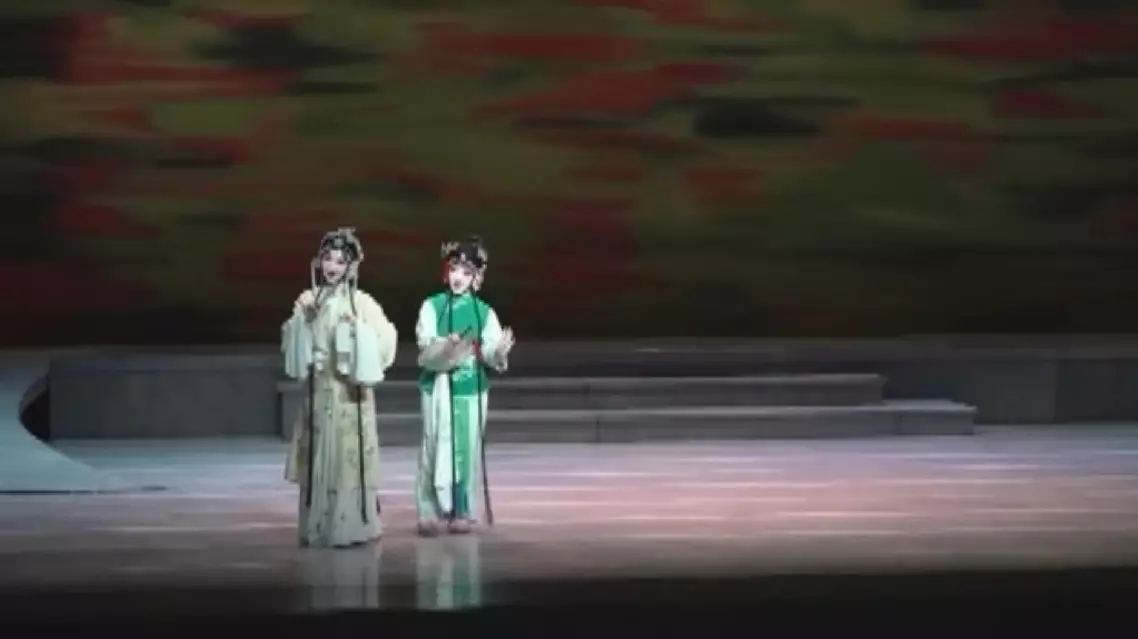
On Thursday, a campus version of Chinese Kunqu opera masterpiece "The Peony Pavilion" performed by students from the mainland took to the stage in Taipei, filling the venue to capacity. The combination of ancient and modern arts received rounds of applause.
Among the audiences, young people from Taiwan comprised about half, with many university students attending in groups.
"We love it, because it helps us understand a part of our history," said an audience member in Taiwan.
"I hope that through this classical work, young people from both sides of the Taiwan Strait will develop a love for traditional culture. The Chinese nation has a glorious history spanning thousands of years. If we don't understand it, how can we comprehend the future? We must understand where our roots lie," said Pai Hsien-yung, a playwright in Taiwan.
Kunqu Opera, one of the oldest forms of opera in China with a history of hundreds of years, was placed on the list of Masterpieces of the Oral and Intangible Heritage of Humanity by the United Nations Educational, Scientific and Cultural Organization (UNESCO) in 2001.
Written by Chinese playwright Tang Xianzu (1550-1616) of the Ming Dynasty (1368-1644), "The Peony Pavilion" tells the story of the romance between a daughter of a wealthy official and a talented but poor young scholar.
Cross-Strait exchanges, cooperation go on despite DPP obstructions