Skip to Content Facebook Feature Image

Mavericks fire GM Nico Harrison 9 months after widely panned Luka Doncic trade

Sport

Mavericks fire GM Nico Harrison 9 months after widely panned Luka Doncic trade
Sport

Sport

Mavericks fire GM Nico Harrison 9 months after widely panned Luka Doncic trade

2025-11-12 05:54 Last Updated At:06:00

DALLAS (AP) — The Dallas Mavericks fired general manager Nico Harrison on Tuesday, an admission nine months later that the widely criticized trade of Luka Doncic backfired on the franchise.

The move came a day after Mavericks governor Patrick Dumont attended a 116-114 loss to the Bucks in which fans again chanted “fire Nico,” a familiar refrain since the blockbuster deal in February that brought Anthony Davis from the Los Angeles Lakers and angered the Dallas fan base.

The Mavericks appointed Michael Finley and Matt Riccardi as co-interim general managers to oversee basketball operations.

Dumont’s hope for goodwill with the fans never came even after Dallas landed No. 1 overall pick Cooper Flagg with just a 1.8% chance to win the draft lottery.

There have been plenty of empty seats in the upper deck of American Airlines Center this season, something not seen consistently since 2018, when the Mavericks traded up to get Doncic with the third overall pick.

Doncic was a 25-year-old generational point guard in his prime when Harrison unloaded him for the oft-injured Davis, who has missed 30 of 44 regular-season games since his arrival in February.

Harrison was in his fourth season and had engineered three trades that helped the Mavs go on a run to the Western Conference finals in 2022 and the NBA Finals two years later.

The Doncic trade and a slow start to the first full season without the young superstar led to a stunning downfall for Harrison, who declined to comment to The Associated Press. Dallas is 3-8, and Davis has missed six of the 11 games with a calf injury.

“No one associated with the Mavericks organization is happy with the start of what we all believed would be a promising season,” Dumont wrote in a letter to fans. “You have high expectations for the Mavericks, and I share them with you. When the results don’t meet expectations, it’s my responsibility to act.”

While Dumont didn't directly mention the Doncic trade in the letter, he acknowledged the vitriolic reaction of fans, who protested after the shocking deal. The Las Vegas-based Dumont and Adelson families, who bought the Mavericks from Mark Cuban in late 2023, were targets of the criticism as well.

“I understand the profound impact these difficult last several months have had,” Dumont wrote. “Please know that I’m fully committed to the success of the Mavericks.”

Dumont approved Harrison’s decision to trade Doncic, which kept the Mavericks from having to commit to a $346 million, five-year supermax extension for the Slovenian star.

Harrison tried to defend the deal by repeating a “defense wins championships” line. But with Davis sidelined by a calf injury and star guard Kyrie Irving still out after tearing the ACL in his left knee last March, defense hasn’t mattered much because Dallas has one of the worst offenses in the NBA.

With Davis and Irving playing together for just part of one game last season, the Mavericks missed the playoffs a year after Doncic led them to the NBA Finals.

The slow, injury-plagued start to this season for the Mavericks coincided with Doncic joining Wilt Chamberlain as the only NBA players to open a season with three consecutive games of at least 40 points.

Doncic’s historic run was interrupted by a three-game injury absence, but the Lakers won twice without him and are 8-3.

Harrison had spent 20 years with Nike and had close relationships with several NBA stars, including the late Kobe Bryant, when Cuban hired him in 2021.

The hiring of Harrison was the first step in trying to restore stability after former general manager Donnie Nelson was fired, then Rick Carlisle resigned as coach a day later. Nelson and Carlisle had been together for 13 years.

Harrison hired Jason Kidd as coach, and the Mavericks reached the Western Conference finals their first season together after Harrison’s first blockbuster trade.

He broke up the European pairing of Doncic and Kristaps Porzingis and got Spencer Dinwiddie, who played a key supporting role with Doncic as the Mavericks stunned Phoenix with a Game 7 blowout in the second round before losing to Golden State in five games.

A year later, Dinwiddie was part of the next blockbuster trade, which brought Irving from Brooklyn. The Mavericks faltered the rest of that season largely because of injuries, but they reached their first NBA Finals in 13 years in 2023-24, led by the pair of star guards. Dallas lost to Boston in five games.

That deep playoff run came in the first six months after Cuban sold the team. He said then that he would maintain control of basketball operations, but that didn’t happen.

Dumont quickly put full control of the basketball side in the hands of Harrison, who saw Davis as a championship-caliber player in the mold of Bryant. Davis won a title with LeBron James and the Lakers in 2020.

Cuban criticized the trade of Doncic, saying he never would have approved it and adding that he didn’t think Dallas got enough in return. Months later, though, Cuban credited Harrison for his salary cap management.

Finley, who was Harrison's top assistant and has been in the Dallas front office for a decade, was a two-time All-Star for the Mavericks in the early 2000s when Hall of Famer Dirk Nowitzki was coming of age.

Finley had moved on to San Antonio when Nowitzki led the Mavericks to the NBA Finals in 2006. Dallas lost to Miami that year but beat the Heat five years later for the franchise's only championship.

AP NBA: https://www.apnews.com/hub/NBA
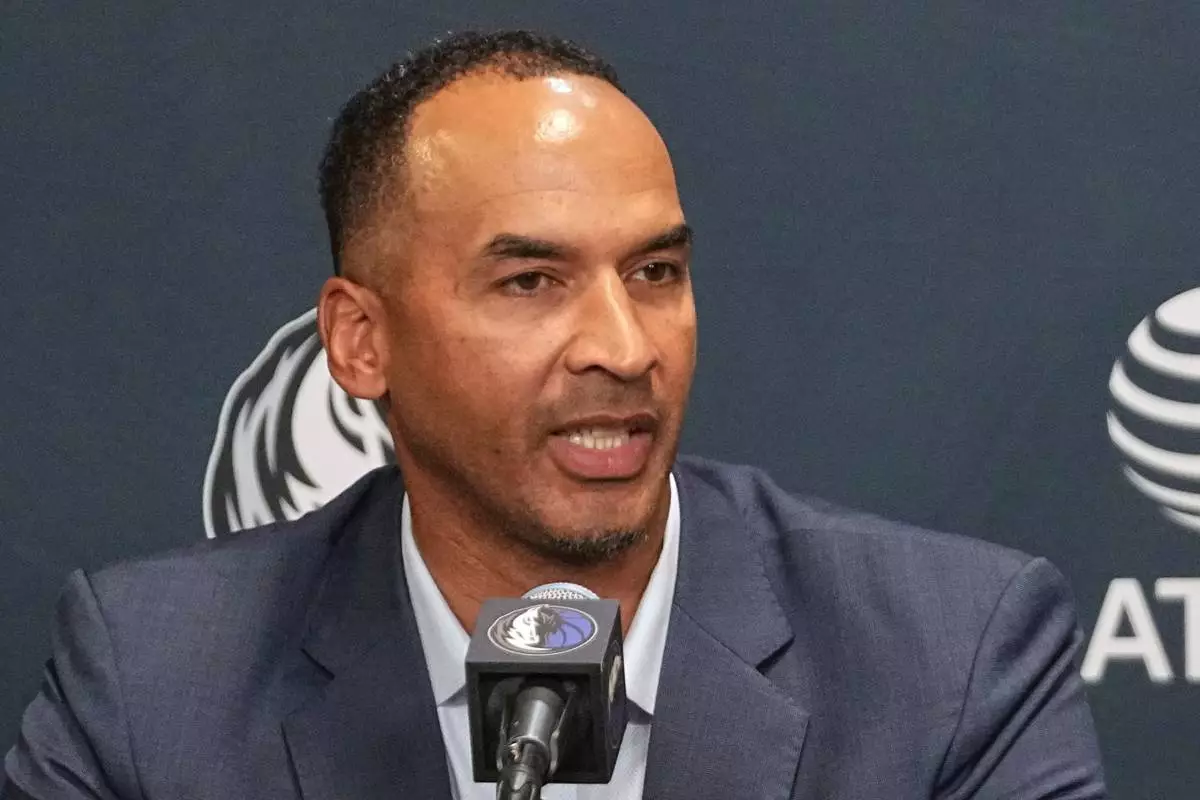
Dallas Mavericks general manager Nico Harrison speaks during a press conference at the NBA basketball team's basketball practice facility, Friday, June 27, 2025, in Dallas. (AP Photo/Tony Gutierrez, File)
Dallas Mavericks general manager Nico Harrison speaks during a press conference at the NBA basketball team's basketball practice facility, Friday, June 27, 2025, in Dallas. (AP Photo/Tony Gutierrez, File)

NEW YORK (AP) — Oil prices climbed back toward $100 per barrel on Thursday, while stock markets worldwide slowed following their big gains from the day before.

The S&P 500 flipped from a small loss to a gain of 0.3%. The Dow Jones Industrial Average was up 77 points, or 0.2%, as of 11:45 a.m. Eastern time, and the Nasdaq composite was 0.3% higher. Earlier in the day, stocks fell across much of Europe and Asia as the United States, Iran and Israel disagreed on the details of their two-week ceasefire, whose announcement had sent markets flying in optimism on Wednesday.

The oil market was jumpier, and the price for a barrel of benchmark U.S. crude oil climbed 5.6% to $99.70. It rose after semiofficial news agencies in Iran suggested forces have mined the Strait of Hormuz, the narrow waterway that has been at the center of President Donald Trump’s demands of Iran. Blockages there have kept oil and natural gas stuck in the Persian Gulf, away from customers worldwide.

Brent crude, the international standard, rose 2.3% to $96.95 per barrel. It’s still below the $119 level that it briefly reached when worries about the war reached their height, but it remains above its roughly $70 level from before the war.

Given how far apart the United States and Iran seem to be in their demands, upward pressure on oil prices may be “here to stay for a while” according to strategists at Macquarie led by Thierry Wizman. Risks remain for renewed fighting, which could cause customers worldwide to hoard whatever oil supplies they do get. That could itself keep oil off the market, much like actual fighting targeting pipelines or oil tankers.

On Wall Street, Constellation Brands climbed 6.3% for one of the market's bigger gains after reporting stronger results for the latest quarter than analysts expected. The company, which sells Modelo beer and Robert Mondavi wines, said it saw encouraging trends heading into its new fiscal year. But it pulled its financial forecasts for the following fiscal year because of “limited near-term visibility” and other factors.

CoreWeave rallied 3.7% after announcing an expanded, $21 billion deal with Meta Platforms to provide AI cloud capacity through December 2032. Meta rose 3.1%.

On the losing end of Wall Street was Simply Good Foods, which dropped 18.2% after reporting a worse drop in revenue than analysts expected. CEO Joe Scalzo called the results unsatisfactory and said the company behind the Quest and Atkins brands is making immediate changes to turn around its performance.

A suite of mixed reports on the U.S. economy also helped to keep Wall Street in check. One said an underlying measure of inflation that the Federal Reserve considers important was slightly hotter in February than economists expected. It decelerated before the war with Iran began, but not by as much as economists expected.

A separate report said that more U.S. workers applied for unemployment benefits last week than economists expected. The number was not very high compared with history, but it could indicate an acceleration in layoffs.

Treasury yields swiveled up and down in the bond market following the reports.

The yield on the 10-year Treasury edged down to 4.27% from 4.29% late Wednesday.

It, though, remains well above its 3.97% level from before the war, which has sent rates up for mortgages and other kinds of loans going to U.S. households and businesses.

If oil prices stay high and keep upward pressure on inflation, the Federal Reserve would have difficulty resuming its cuts to interest rates to help the slowing economy, even if the job market weakens. A growing number of Fed officials seem to be considering the possibility of a hike in rates, according to minutes of their latest meeting released on Wednesday.

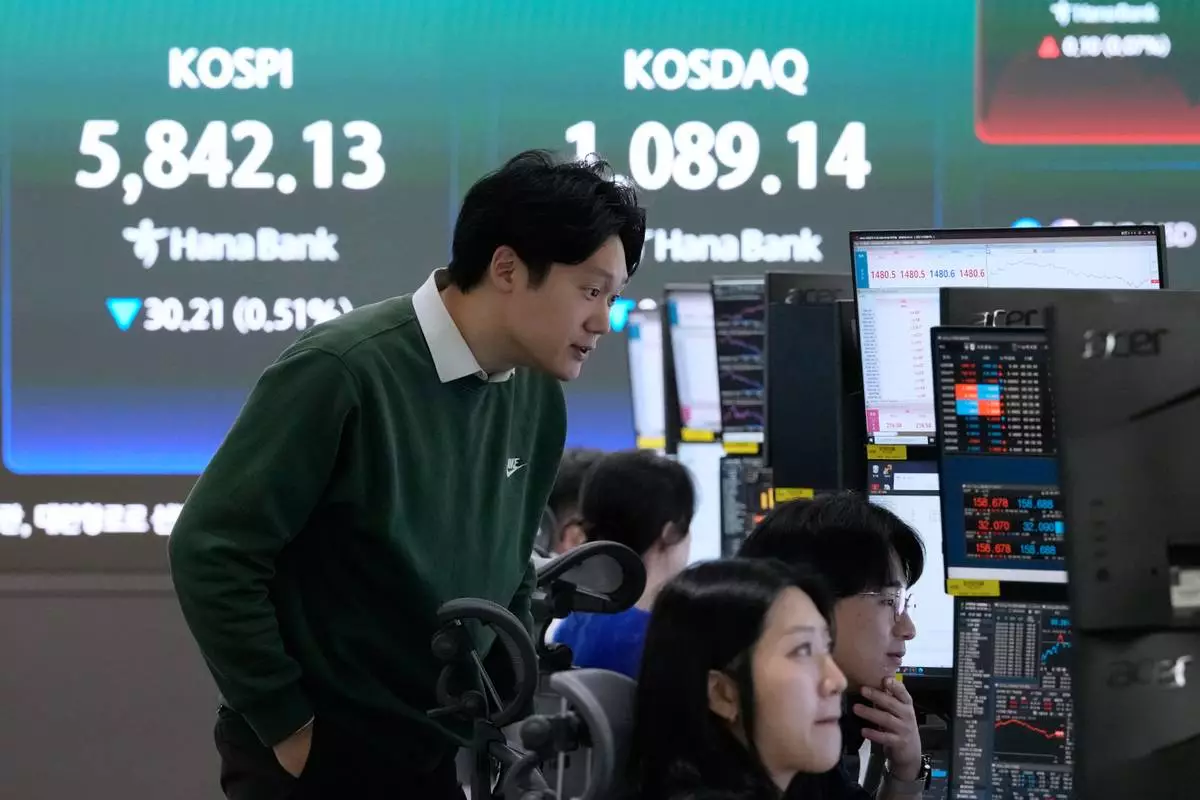
In stock markets abroad, South Korea’s Kospi fell 1.6%, and Germany’s DAX lost 1.1% for two of the world’s biggest moves.

AP Writers Chan Ho-him, Matt Ott and Aniruddha Ghosal contributed to this report.

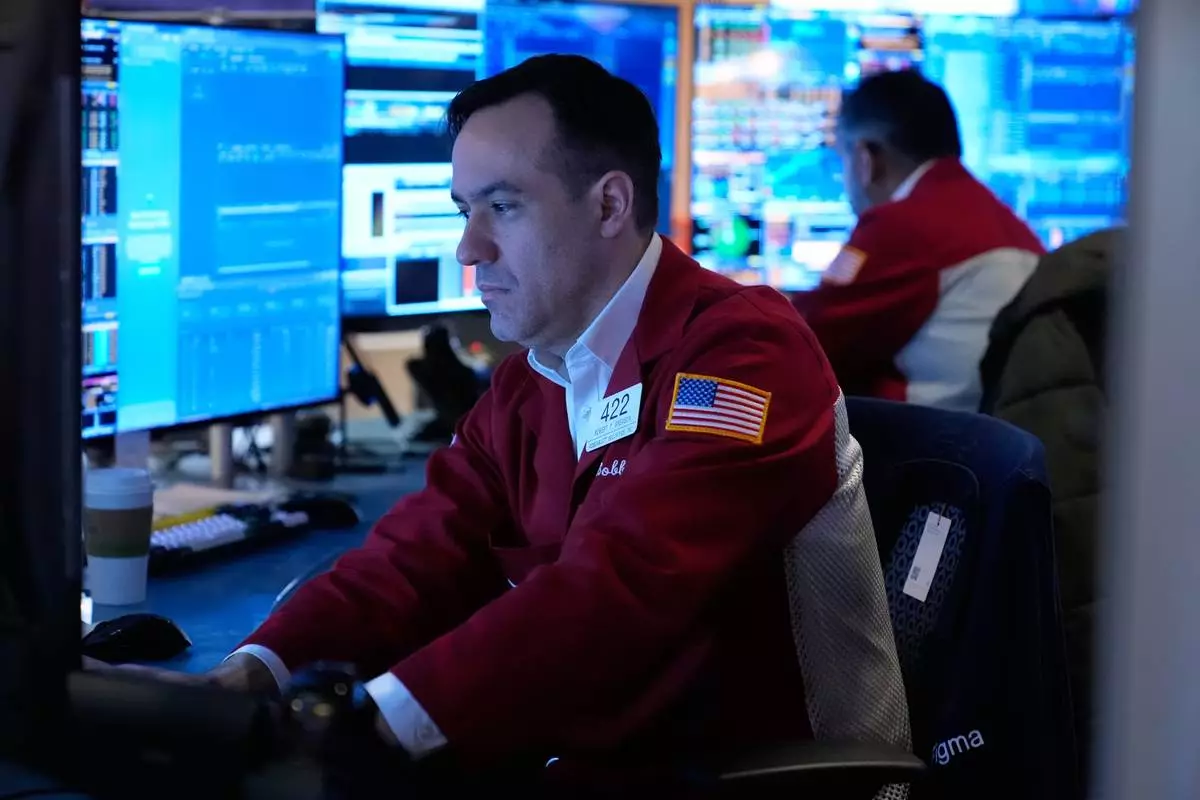
Robert Greason works on the floor at the New York Stock Exchange in New York, Tuesday, April 7, 2026. (AP Photo/Seth Wenig)

Robert Greason works on the floor at the New York Stock Exchange in New York, Tuesday, April 7, 2026. (AP Photo/Seth Wenig)

Currency traders watch monitors near a screen showing the Korea Composite Stock Price Index (KOSPI), top left, at the foreign exchange dealing room of the Hana Bank headquarters in Seoul, South Korea, Thursday, April 9, 2026. (AP Photo/Ahn Young-joon)

Currency traders watch monitors near a screen showing the Korea Composite Stock Price Index (KOSPI), top left, at the foreign exchange dealing room of the Hana Bank headquarters in Seoul, South Korea, Thursday, April 9, 2026. (AP Photo/Ahn Young-joon)

Currency traders work near a screen showing the Korea Composite Stock Price Index (KOSPI), top center, and the foreign exchange rate between U.S. dollar and South Korean won, top center left, at the foreign exchange dealing room of the Hana Bank headquarters in Seoul, South Korea, Thursday, April 9, 2026. (AP Photo/Ahn Young-joon)

Currency traders work near a screen showing the Korea Composite Stock Price Index (KOSPI), top center, and the foreign exchange rate between U.S. dollar and South Korean won, top center left, at the foreign exchange dealing room of the Hana Bank headquarters in Seoul, South Korea, Thursday, April 9, 2026. (AP Photo/Ahn Young-joon)

A currency trader works near a screen showing international oil prices at the foreign exchange dealing room of the Hana Bank headquarters in Seoul, South Korea, Thursday, April 9, 2026. (AP Photo/Ahn Young-joon)

A currency trader works near a screen showing international oil prices at the foreign exchange dealing room of the Hana Bank headquarters in Seoul, South Korea, Thursday, April 9, 2026. (AP Photo/Ahn Young-joon)

Recommended Articles