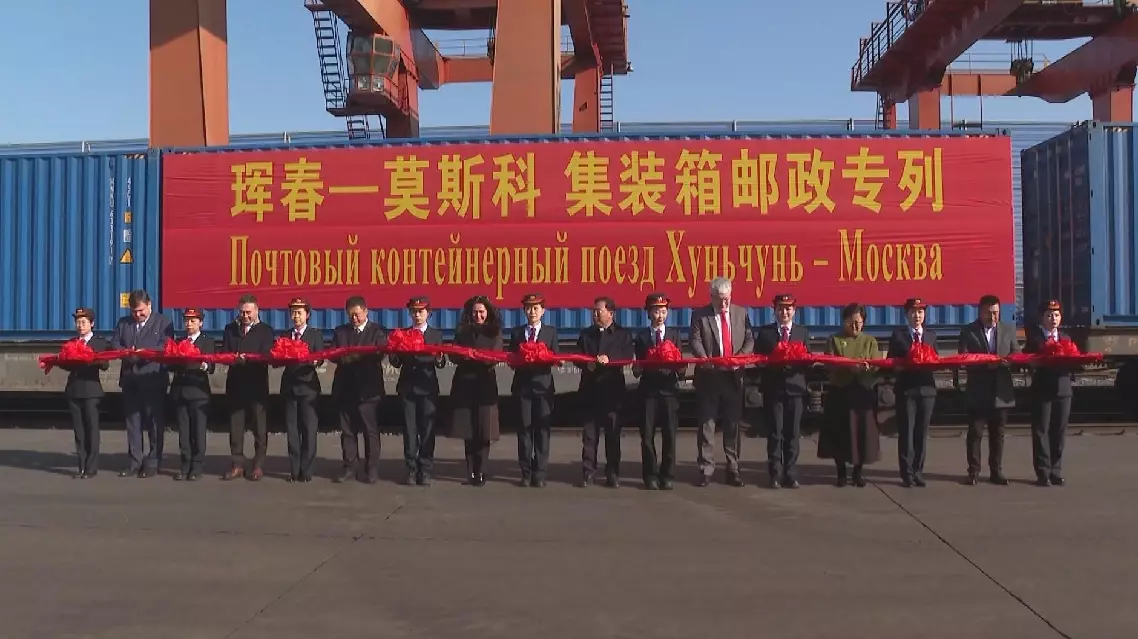
A freight train loaded with 46 containers of goods departed the border city of Hunchun in northeast China's Jilin Province on Tuesday for the Russian capital Moscow, marking the launch of a new cross-border postal service.
The train was packed with dozens of product categories, including auto parts, mechanical equipment, daily necessities, household appliances, and electronic goods.
The new route will operate two to four trains a month, with each trip taking 12 days.
Hemmed in by Russia's frozen coastline and the secluded mountains of the Democratic People's Republic of Korea (DPRK), the small city of Hunchun has become an important hub connecting China with both Russia and the hinterland of Europe.
Since the launch of the first Hunchun-Makhalino Railway postal special train service in November 2023, 164 train trips have been carried out, transporting over 380,000 items of goods.
Tuesday’s launch marks another stride in strengthening cross-border logistics and trade connectivity in the region.
New freight train service links China border city with Moscow
Global food commodity prices climbed for a second consecutive month in March, driven mainly by higher energy costs linked to escalating conflict in the Middle East, the Food and Agriculture Organization of the United Nations (FAO) said in report released on Friday.
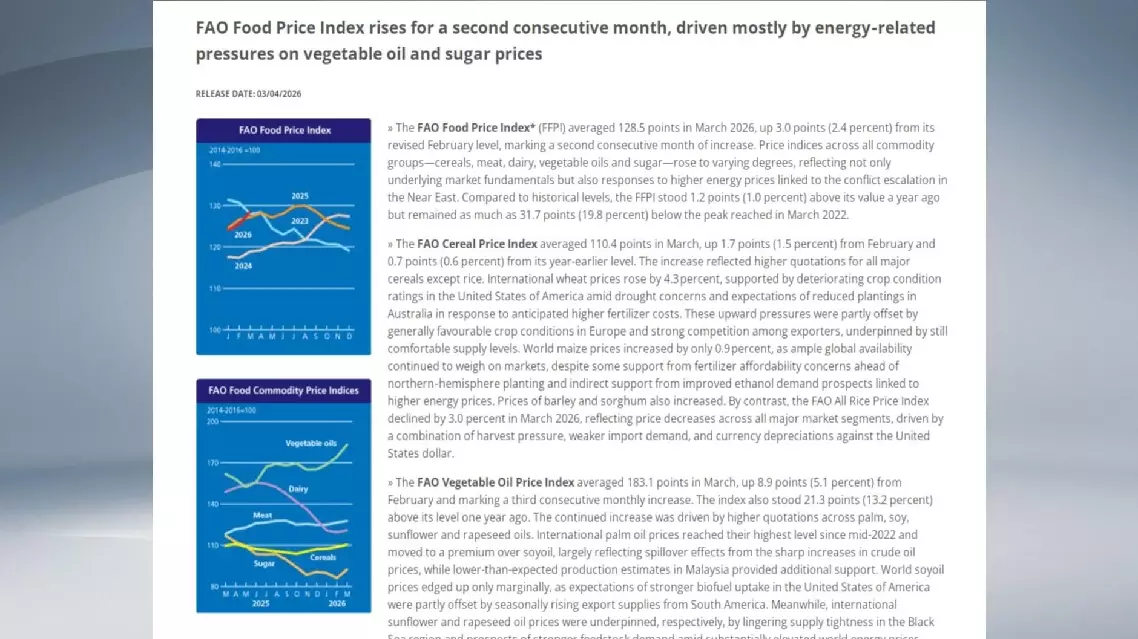
The FAO Food Price Index, which tracks monthly changes in the international prices of a basket of globally traded food commodities, averaged 128.5 points in March, up 2.4 percent from February and 1.0 percent above its level a year ago.
According to the report, the FAO Vegetable Oil Index and Sugar Price Index showed the largest increases, up 5.1 percent and 7.2 percent, respectively.
The FAO Cereal Price Index increased by 1.5 percent from the previous month, driven primarily by higher world wheat prices, which rose 4.3 percent.
The FAO Meat Price Index rose by 1.0 percent from the previous month, and the FAO All-Rice Price Index declined by 3.0 percent in March, according to the report.
FAO stated that rising energy and fertilizer prices have been driving up agricultural input costs.
If the conflict stretches beyond 40 days, farmers will have to choose to farm the same with fewer inputs, plant less, or switch to less intensive fertilizer crops, according to FAO Chief Economist Maximo Torero.
These choices will hit future yields and shape food supply and commodity prices for the rest of this year and beyond, Torero said.
Global food prices rise for 2nd consecutive month in March amid Middle East conflict: FAO