China has completed the first phase of 6G technology trials, resulting in the development of over 300 key technologies, according to the Ministry of Industry and Information Technology (MIIT) on Thursday.
The country has organized and conducted 6G technology trials for four consecutive years, with progress including systematic research on 6G system design and network architecture, Vice Minister of Industry and Information Technology Zhang Yunming said at the 2025 6G Development Conference in Beijing.
6G refers to the next-generation comprehensive digital information network infrastructure globally over the next decade.
According to a recent MIIT report, 6G is expected to achieve integrated innovation in communications, sensing, computing, intelligence and other technologies, while its service scope will expand from people, machines, and goods to intelligent agents. Operational space will extend beyond ground-based to integrated space-air-ground coverage, realizing the vision of intelligent interconnection of everything and the rapid development of digital twins.
"China will make continuous efforts to strengthen research on core technology and integrated technical solutions, and advance technical research and development, standard development, test verification, and application cultivation in an integrated manner, laying a solid foundation for 6G standardization and industrialization," said Zhang.
China's 6G technology trials are carried out in three phases: the first phase is the key technology trial stage, which defines the main technical directions of 6G; the second phase is the technical solution trial stage, which will develop 6G prototypes targeting typical scenarios and performance metrics; and the third phase is system networking trial stage, which will involve developing pre-commercial 6G equipment and conducting tests on key 6G products.
The MIIT established a 6G promotion group in June 2019, aiming to gather China's industry-university-research forces, promote China's sixth-generation mobile communication technology research, and develop international exchanges and cooperation. The members include major Chinese operators, vendors, universities and research institutions.
Since the beginning of this year, the group, in alignment with the International Telecommunication Union's definition of 6G use cases, has conducted 57 tests across five major technical areas, namely immersive communication, wireless intelligence, integrated sensing and communication, air-ground integrated network, and network architecture.
Currently, 6G technology has entered the international standard research phase, according to the group.
The International Organization for Standardization has determined the timetable and research priorities for 6G standardization: research on 6G standards was initiated in 2025, and the formulation of 6G standards will start in the first half of 2027, forming the overall architecture of the 6G system and specific technical specifications to guide equipment research and development; the 6G international standard is expected to be completed in the first half of 2029, and commercial deployment is anticipated to commence around 2030.
"We entered the research and development and testing phase for equipment in 2025. This year, we have also progressed from isolated key technologies to tests for scenario-oriented, systematic technical solutions," said Wang Zhiqin, deputy head of China Academy of Information and Communications Technology, who also serves as the leader of the 6G promotion group.
So far, the 6G promotion group has released over 80 6G-related white papers and research reports, promoting the inclusion of China's advantageous technologies into the overall framework of 6G. All five typical 6G scenarios and 14 key capability indicators proposed by China have been adopted by the International Telecommunication Union, indicating that China's 6G development is among the global frontrunners.
"We have advanced the comprehensive verification of multiple key 6G technologies. Going forward, we will continue to promote the construction of the 6G open public innovation experimental device, and conduct tests and verifications in larger scale, including more scenarios and more technical directions at multiple nodes across the country," said Jin Jing, deputy director of the Future Research Laboratory of China Mobile Research Institute.
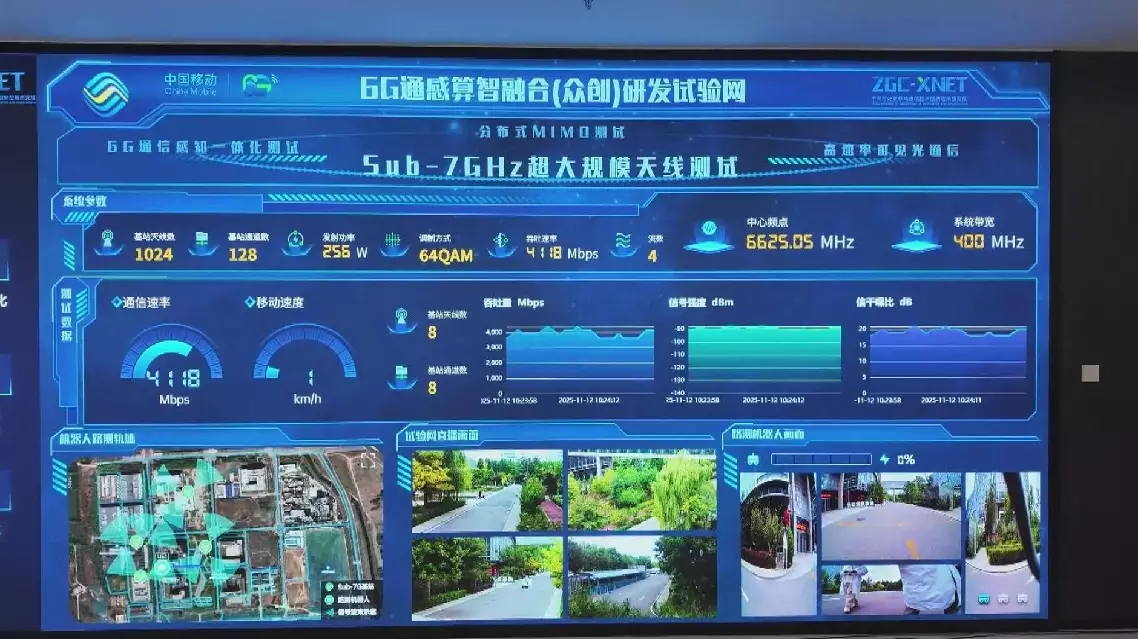
China completes 1st phase of 6G technology trials