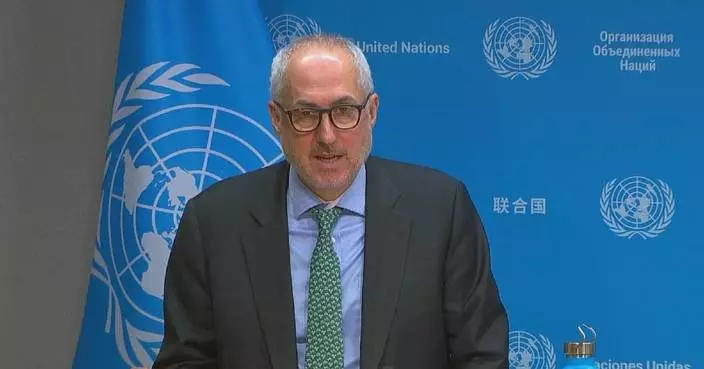
Takakage Fujita, secretary-general of the Association for Inheriting and Propagating Murayama Statement said Japanese Prime Minister Sanae Takaichi's recent comments on Taiwan have violated international law and severely damaged Japan-China relations.
"The Taiwan question is an internal affair of China. In 1972, the governments of Japan and China signed the Japan-China Joint Communiqué, which confirmed the fact that Taiwan belongs to China. Takaichi's remarks this time trampled on the historical process to date and ignore the fundamental principles of international law. They can only be described as extremely problematic and foolish remarks," said Fujita.
Fujita said the 1995 Murayama Statement expressed deep remorse for Japan's colonial rule and aggression to countries including China, while Takaichi's recent remarks run counter to the statement's spirit.
"[I believe] the Murayama Statement expressed deep reflection on the enormous harm Japan's war of aggression caused to the Chinese people and offered a solemn apology, pledging never to repeat such mistakes. Takaichi's remarks on Taiwan obviously deny the spirit of the Murayama Statement and are foolish comments tantamount to trampling on the Murayama Statement," he said.
Fujita added that Takaichi's actions have severely harmed the bilateral relations and undermined the interests of the Japanese public.
"Today, China and Japan have extremely close economic relations. Japan imports a large amount of daily necessities from China. Once relations deteriorate, it is the Japanese people who will suffer. For this reason, the consequences of Takaichi's words and actions are extremely serious. Any attempt to lead the country toward war, or any remarks with the intention of war, must never be allowed," Fujita said.

Takaichi's comments severely damage Japan-China relations: scholar

Takaichi's comments severely damage Japan-China relations: scholar
China's box office revenue has exceeded 11 billion yuan (about 1.6 billion U.S. dollars) so far this year, maintaining its position as the world's largest single film market.
The total, including pre-sales, surpassed the mark on Thursday, according to data from Maoyan, one of the country's major online movie ticket platforms.
When the National People's Congress (NPC), China's top legislature, and the National Committee of the Chinese People's Political Consultative Conference, the country's top political advisory body, was in session earlier in March, the strong performance of China's film industry became a widely discussed topic among NPC deputies and national political advisers.
Many said China's leading position in the global box office marks not only a breakthrough but also a new starting point.
Driven by the "Film Economy Promotion Year" initiative, relevant authorities have been promoting cross-sector programs linking films with tourism, gastronomy and intangible cultural heritage, with the emerging "film-plus" consumption model turning box office momentum into broader growth for the real economy.
With support from the China Film Administration, local governments have rolled out a variety of movie ticket subsidy programs since the start of the year, helping reduce average ticket prices by about 6 percent and encouraging more people to go to theaters. Screenings during the nine-day Spring Festival holiday reached a record 4.35 million sessions nationwide.
A single movie ticket can spur spending in sectors ranging from dining and shopping to transportation and cultural merchandise, providing a boost to the offline economy.
Estimates show the total value generated by the film industry has exceeded 150 billion yuan (about 22 billion U.S. dollars) in 2026.
Beyond theaters, the trend of traveling with films is fueling a new wave of consumption. Regions across China are combining local cultural and tourism resources with film-related promotions, creating "film-plus-tourism" experiences that turn cinematic popularity into consumer demand.
Since the start of the year, Chinese films have not only driven the domestic box office but have also continued gaining popularity overseas.
During the Spring Festival holiday, films including "Scare Out" and "Blades of the Guardians" were released simultaneously on the first day of the Chinese New Year in more than a dozen countries and regions, including North America, Europe, Australia, New Zealand and Southeast Asia.
At the same time, overseas promotions for initiatives such as "China Travel with Chinese Films" are attracting more international audiences to visit China so as to experience the country's culture, natural scenery and modern development.
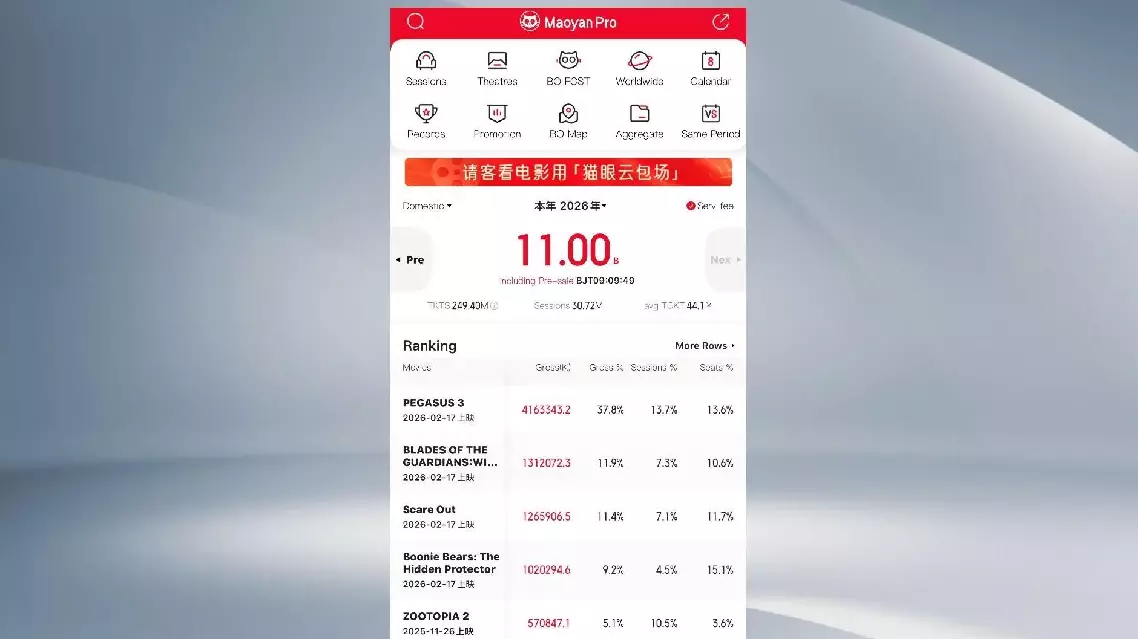
China's box office surpasses 11 bln yuan in 2026