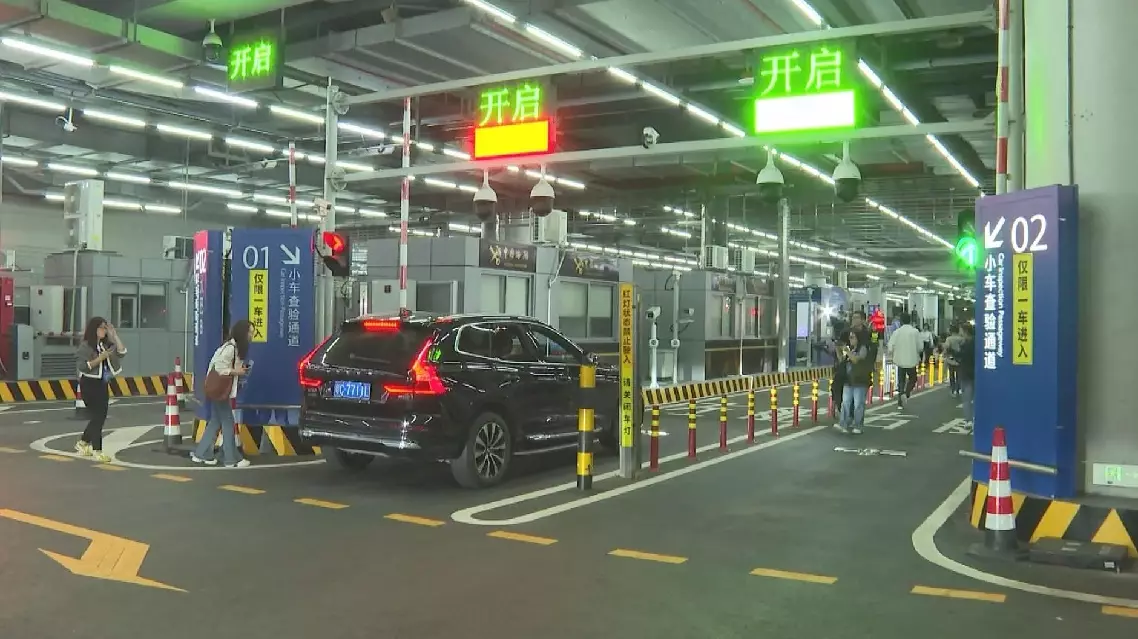
The first batch of eligible private cars from Guangdong Province cleared customs via the Zhuhai Port on the Hong Kong-Zhuhai-Macao Bridge and drove to an automated carpark near the Hong Kong Port, as China's newly introduced "Southbound Travel for Guangdong-Licensed Vehicles" scheme officially took effect at 0:00 on Saturday, marking a significant step in the integration of the Greater Bay Area city cluster in south China.
The scheme, rolled out by the Hong Kong Special Administrative Region government, allows eligible and approved private cars from Guangdong to park at the automated carparks on the artificial island at the Hong Kong Port (port carparks) via the Zhuhai Port of the Hong Kong-Zhuhai-Macao Bridge, after which the drivers and passengers may transfer to a flight via the Hong Kong International Airport or enter and visit Hong Kong by taking Hong Kong local transportation.
The "Park and Fly" carpark of the port carparks had been opened for application starting from Nov 1.
To further streamline customs clearance, the governments of Guangdong Province and the Hong Kong Special Administrative Region, in coordination with customs and border inspection authorities, have upgraded the "one-stop" clearance system at the Zhuhai Port, allowing southbound travel procedures for people and vehicles to be completed online.
"After completing the required filing and appointment booking, drivers from the mainland can use electronic travel documents including the exit-entry permits for traveling to and from Hong Kong, Macao and Taiwan, and the permit for traveling to and from Hong Kong and Macao for official purpose to clear customs. Their vehicles can directly pass through the port via one-stop automated inspection lanes merely with the optical license plate on their vehicles," said Zhang Lei, deputy director of the bridge's border inspection station.
"We have established five dedicated inspection lanes in each direction. Once a vehicle enters a lane, the system will automatically verify and compare its filed information and provide clearance instructions, achieving an 'one-stop services for vehicles, one-time release by the system' model," said Wang Peiyang, deputy director of the Hong Kong-Zhuhai-Macao Bridge Customs Office.
The access to parking facilities at Hong Kong's border checkpoints for private cars from Guangdong is just the first phase of the scheme.
In the second phase of the scheme, which is scheduled to take effect on Dec 23, eligible Guangdong-licensed vehicles can enter the urban area in Hong Kong without obtaining a regular quota.
This policy marks a significant move in further integrating Hong Kong into the Guangdong-Hong Kong-Macao Greater Bay Area. It builds upon the existing "Northbound Travel for Hong Kong-Licensed Vehicles" scheme, which has allowed Hong Kong and Macao residents to drive into Guangdong without holding a mainland license plate since July 1, 2023.
With the implementation of the policies, the growing northbound and southbound vehicle flows are weaving a strong bond that connects the people of Guangdong, Hong Kong, and Macao, driving regional economic development.
The Greater Bay Area consists of the Hong Kong Special Administrative Region, the Macao Special Administrative Region, as well as nine cities in Guangdong Province -- Guangzhou, Shenzhen, Zhuhai, Foshan, Huizhou, Dongguan, Zhongshan, Jiangmen and Zhaoqing. China plans to vigorously develop the Greater Bay Area into a world-class bay area and a top international city cluster as an important driver for national economic growth.
Southbound Travel scheme for Guangdong vehicles takes effect