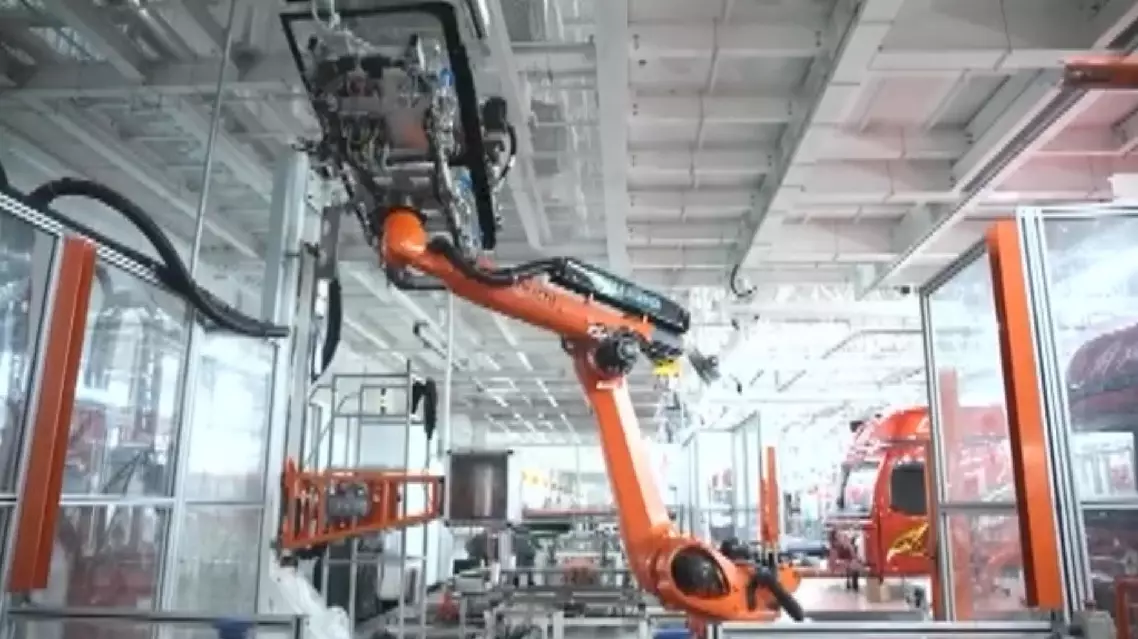
Chinese Ministry of Industry and Information Technology on Wednesday unveiled the 2025 5G Factory Typical Application Practices, featuring 100 exemplary 5G factory projects selected from thousands nationwide to accelerate the country's manufacturing modernization.
These selected applications span key sectors including equipment manufacturing, consumer goods, raw materials, electronics and information technology, energy, and transportation.
These factories have effectively increased production capacity, reduced operating costs and improved product quality, thanks to their coverage of 5G network exceeding 99 percent.
"These 100 projects fully showcase the construction needs, solutions, and value of 5G factories. They offer replicable and scalable models for industries to build high-quality 5G factories, providing a Chinese solution for digital and intelligent transformation of the industrial sector," said Tang Libo, deputy director of the Technology and Standards Institute at the China Academy of Information and Communications Technology.
The development follows the ministry's vigorous promotion of the large-scale application of "5G + Industrial Internet" in 2022. Since then, the program has driven the construction of more than 23,000 dedicated 5G networks.
"5G enables the collection of massive real-time data from production sites, laying the foundation for rapid AI development. It has turned '5G + Industrial Internet' into a core capability for enterprises' digital and intelligent transformation, becoming vital infrastructure for advancing new industrialization and developing new quality productive forces," said Tang.
China unveils 100 exemplary 5G factory projects to drive industrial digital transformation

The Polish government has recently rolled out a series of emergency measures to cushion the impact of energy costs on households in light of rising oil prices and increasing inflation risks.
Amid escalating tensions in the Middle East, international crude oil prices have jumped, pushing fuel prices in Poland up by more than 30 percent over the past month. Starting Tuesday, the Polish government began implementing a package of measures aimed at reducing fuel costs. These include lowering the value-added tax on fuel, cutting excise duties to the minimum level permitted under the European Union (EU) regulations, and cracking down on price gouging to maintain market stability.
Notably, gas stations in Poland have seen an increase in customers following the price cuts. Still, many residents believed the reduction is only temporary and that prices will likely rise again in the future.
"Even though the government has lowered prices, they are still high. I think the price cut might last for a while, but it's hard to say how long. I think this is just the beginning and the prices will rise in the future," said Arkadiusz, a local resident.
Polish economist Tomasz Bieliński said that it remains unclear how long the government can sustain these policies, and that rising energy prices are now transmitting pressure to core areas of the macroeconomy. In his view, if oil prices continue to climb, the European Central Bank and other central banks across the EU may be forced to adjust their monetary policies.
"Interest rates were actually reduced in most of the central banks in Europe. But, this reduction will probably stop, because we have rising prices of pretty much everything on the horizon," he said.
Poland unveils measures to ease pain of soaring oil prices