China has seen a soaring demand for new-type energy storage as it accelerates its transition to clean energy, with some companies reporting full production schedules extending into next year.
Data from the National Energy Administration showed that by the end of September 2025, China's installed capacity of new-type energy storage exceeded 100 million kilowatts. This figure marks a more than thirty-fold increase compared to the end of the 13th Five-Year Plan period (2016-2020), and accounts for over 40 percent of the global total, securing the country the top position worldwide.
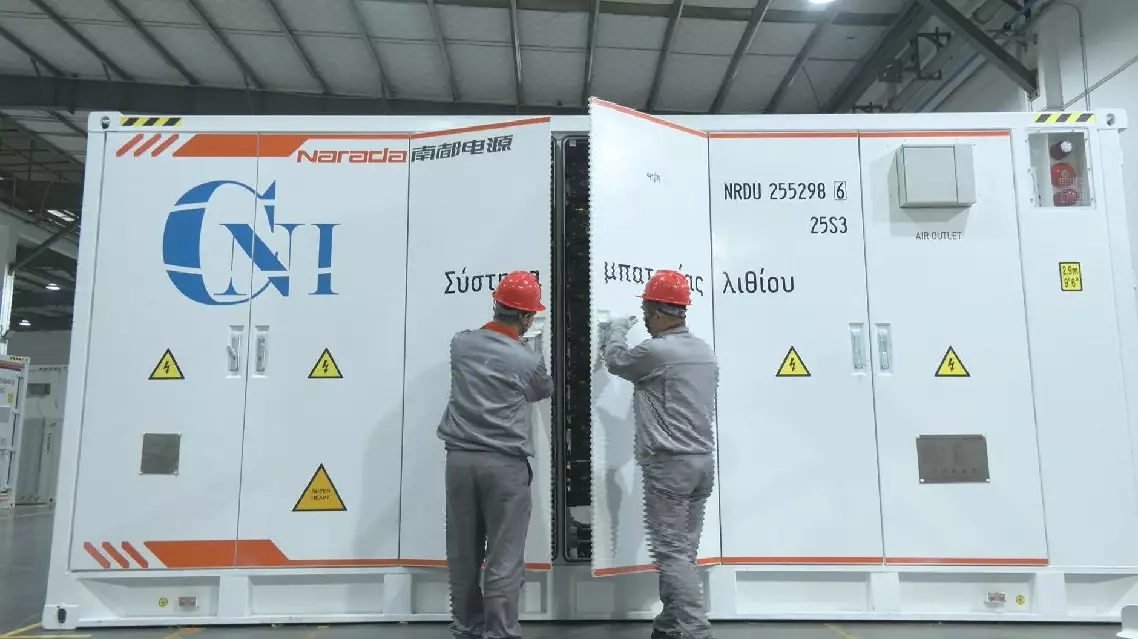
So far this year, the energy storage market has continued to heat up. At the bustling Lin'an production center of Narada Power, a Zhejiang-based energy storage equipment manufacturer, rows of large, silver-white cabinets stand ready. They are massive "power banks" designed to store electricity generated from wind and solar sources for use during peak demand.
Tan Jianguo, general manager of the center, said production here has barely stopped this year, and units are often shipped out immediately after they roll off the line.
"Our daily output can reach 20 megawatt-hours, which is about four storage container units, each capable of supplying electricity for nearly 50 households [for a day]. Since the beginning of this year, our production lines have run at full capacity, and we expect to remain at maximum output in the first and second quarters of next year," Tan said.
Tan said that the domestic market has seen rapid expansion since China introduced mandatory energy storage requirements for new energy projects in 2022. This year, growth in orders has become even more pronounced, with shipments up more than 80 percent year on year. Large-scale storage systems for power generation and grid applications are now the primary drivers.
"Our shipments of large-scale storage systems have more than tripled compared to last year. We work with grid operators, new energy power generation companies and large energy groups to provide services like peak and frequency regulation, and energy transfer," Tan said.
Industry analysts link this boom to China's "dual carbon" goals, which refer to peaking carbon emissions by 2030 and achieving carbon neutrality by 2060. The rapid rise in renewable energy generation has created an urgent need for storage solutions.
Despite rapid growth, storage projects were mostly driven by government policy and research pilots in the past, with limited marketization. Things changed in February, when the central government issued Official Document No. 136, ending mandatory storage requirements and unleashing market demand.
"Since the issuance of Official Document No. 136 by the state to advance market orientation, it has helped to push the commercial models for energy storage to better integrate with market mechanisms, leading to a rapid acceleration in growth, particularly since June," said Yu Jianhua, vice president of the Domestic Marketing Center of Narada Power.
"The government scrapped mandatory storage requirements, but companies actually increased investment in storage facilities. In addition, with the development of new energy business in recent years, the existing grid's reserve capacity can no longer keep up with rising electricity demand. To hit China's 2030 carbon peak target, we need much more clean energy," said Dong Yunfan, an analyst with Sublime China Information (SCI)'s Fubao lithium battery division.
New-type energy storage market surges as China pushes for green transition