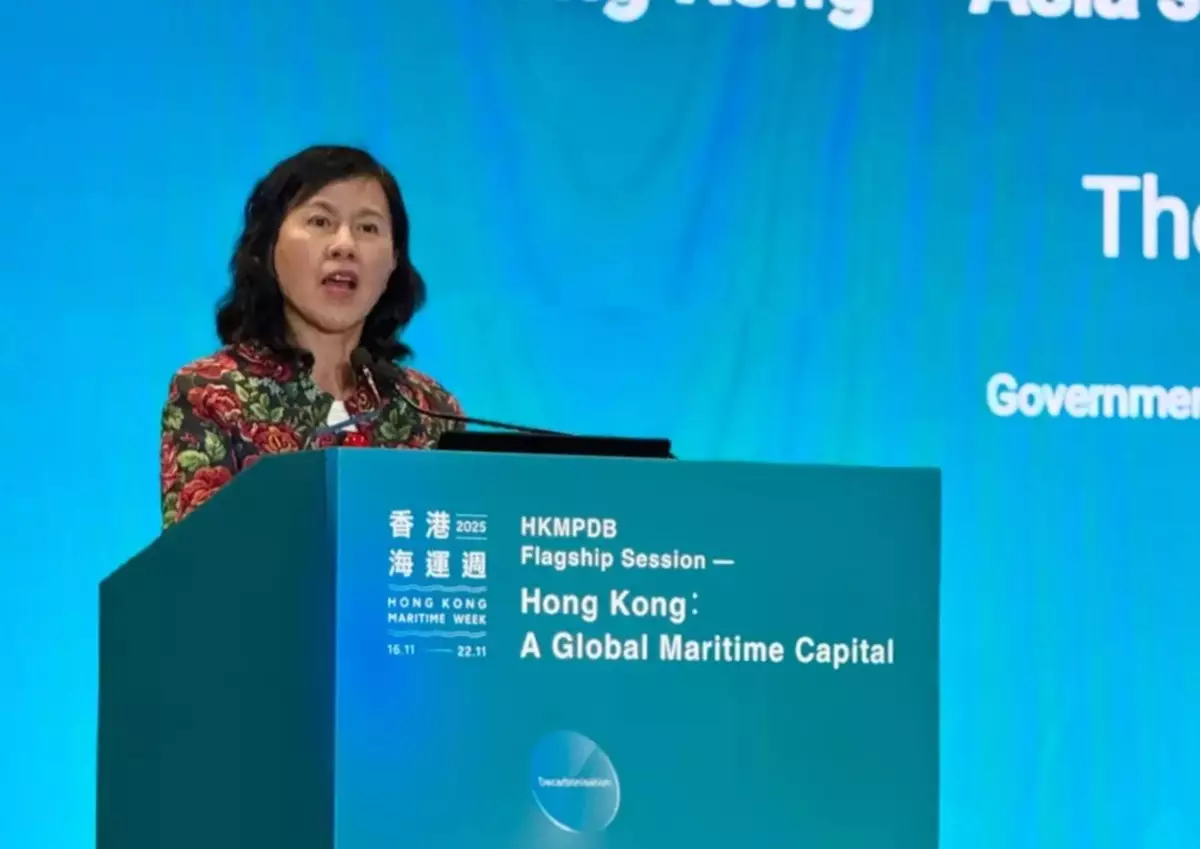
Following is the speech by the Secretary for Transport and Logistics, Ms Mable Chan, at the Hong Kong Maritime and Port Development Board Flagship Session - Hong Kong: A Global Maritime Capital today (November 18):
Dr Moses Cheng (Chairman of the Hong Kong Maritime and Port Development Board), distinguished industry leaders, partners, friends,
Good afternoon. It is my privilege to join you and open this flagship session hosted by the newly established Hong Kong Maritime and Port Development Board. The conversations these days have confirmed a powerful consensus: The global maritime industry now stands at a tipping point, and the capital for the great maritime decarbonisation is ready to flow. The critical question is, where will it find its gateway?
In today's ever-changing global maritime landscape, I stand before you with immense confidence that Hong Kong is positioning itself as Asia's Green Maritime Finance Capital Gateway. What a lengthy word but it inherits a lot of wisdom, ambitions and visions in this long phrase. We are building the bridge that connects the vast global pools of green capital with the multi-trillion-dollar investment opportunities in sustainable shipping. I think sustainability is the keyword.
This is not an aspiration; it is a strategic evolution of our core strengths. Under the "one country, two systems" framework, Hong Kong offers a unique advantage and convergence: a unique bilingual common law system that keeps pace with international maritime regulatory practices, the world's freest economy with seamless flow of capital, as well as a top-notch maritime cluster comprised of over 1 200 companies, many of which actually benefit from the series of tax concessionary measures that Hong Kong has provided by legal mandate over the years. This is the stable, trusted platform to de-risk and deploy capital into one of the world's most critical energy transitions. Our strategic positioning is propelled by three main drivers.
First, we have the proven financial firepower and a complete maritime ecosystem necessary to power this transition. Hong Kong's position as Asia's leading green finance hub is undisputable. Last year, our green and sustainable debt market surpassed US$84 billion, with bonds alone capturing 45 per cent of the regional market. We are also pioneering the green finance technology itself, from launching the world's first government-issued tokenised green bond to the first multi-currency digital bond. I do not know whether you have the opportunity to listen to the Financial Secretary's speech at the ICS (International Chamber of Shipping) open summit yesterday. He made three important key observations about the growth areas in China, Asia and this part of the region including Hong Kong where we are propelling. The figures that I mentioned just now provide clear evidence for the global shipping community with the sophisticated, diverse capital required for the heavy upfront investments in green vessels, fuel infrastructure and clean energy ports. Yet, financial depth alone is not enough. What truly sets Hong Kong apart is our complete, integrated maritime ecosystem - a one-stop shop for the entire industry. This comprehensive ecosystem provides unparalleled support, where you will find, for example, 11 of the 12 International Group P&I (protection and indemnity) clubs and eight of the world's top 10 ship finance bookrunners for your insurance and capital needs. For resolving maritime disputes, we are recognised by the Baltic International Maritime Council as one of the world's four designated arbitration venues. We did not get such recognition yesterday, but we achieved that a few years ago. I would also like to emphasise, for operational support, five of the top 10 global ship managers are here, with three headquartered in our city. All this evidence and data imply that your entire network of partners, financiers, and peers is concentrated here, providing the collaborative muscle to power through the complex challenges of the green transition. I cannot agree more; the peer, the companion, the enjoyment of food and wine, and the companionship of Hong Kong all make doing business so friendly and enjoyable in Hong Kong.
Second, we are establishing Hong Kong into a green fuel bunkering and trading hub to create the bankable assets that capital seeks. Pioneering investments carry higher costs, and the full benefit of green investments may not be realised due to, for example, the low availability of green fuels. Our Action Plan on Green Maritime Fuel Bunkering, with its five core strengths and strategies and 10 concrete actions, provides exactly a definitive roadmap to propel the green fuel bunkering and trading development in Hong Kong. Leveraging our unparalleled access to the Chinese Mainland's green fuel production, we are already delivering tangible, quick results from setting the national record for the largest single delivery of biodiesel at a Chinese port, to successfully transition into regularised LNG (liquefied natural gas) bunkering in Hong Kong waters. In a way, we are starting late but catching up fast. Our focus now is on the next generation of fuels. We are pioneering the future with methanol, ammonia, and hydrogen. To accelerate this, we secured a duty exemption for methanol through legislation and will commence feasibility studies for ammonia and hydrogen bunkering soon this year. We recognise the first-mover disadvantage of high initial costs, and that is precisely why we launched the Green Maritime Fuel Bunkering Incentive Scheme in order to help our partners to de-risk and reward pioneering companies. Like different industries, our shipping partners also like recognition and rewards. Though it may be small to the big businesses, it really serves as a symbolism and demonstration of how much care and attention we show to the industry. Next year, we will introduce legislation for a half-rate profits tax concession for the eligible commodity traders including those who trade in green maritime fuels. Coupled with our ongoing matchmaking events that connect Chinese Mainland enterprises with global end-users, we are not just building a fuel hub; we are creating the entire landscape and liquid marketplace required to finance and sustain the global fleet's transition. And here my keyword will be marketplace. When we talk about food and wine, companion and peer, we need to have a marketplace. We should not say platform, working group or task force; we need to use marketplace in order to be more lively and enjoyable.
Third, we are de-risking the industry's green capital investment by providing unwavering regulatory certainty and forging strategic global partnerships. Over the past few days, there have been closed door and open-door discussions about the disruption and delay of the IMO (International Maritime Organization) schedule. But I think rule-based aside, this will not hinder Hong Kong's determination to create a buoyant and dynamic ecosystem to help forge our journey towards green transformation. While international timelines may shift, Hong Kong offers decisive clarity. At home, we are proactively building comprehensive regulatory frameworks - governing everything from green fuel bunkering, with our Codes of Practice for LNG and Methanol and a mandate for the use of mass flow meters for methanol bunkering by 2026. I found it amazing that this tool and standard are just so important for ensuring fairness and transparency in green fuel bunkering. We will be introducing this mandate for mass flow metres for methanol bunkering by 2026 to the sustainable end-of-life recycling of vessels via the recent enactment of the Hong Kong International Convention for the Safe and Environmentally Sound Recycling of Ships into the local legislation, and we will do this well before the market peaks, with a view to providing investors the necessary confidence and certainty to commit for tomorrow. While the international timeline seems to delay a little bit, we have to act fast and act now for the preparation tomorrow. Concurrently, we are building the infrastructure of international collaboration. As the Chief Executive announced yesterday, we have announced the first batch of partner ports and established partner ports relationships with Guangxi port and Dalian port on the Chinese Mainland, as well as San Antonio Port of Chile. We will continue to identify partner ports for developing green shipping corridors - dedicated routes where vessels can achieve low or zero-carbon operations through co-ordinated green port services and fuel availability. For investors, these corridors could be strategic de-risking instruments that concentrate green capital, create scalable access and testbeds for zero-carbon operations, and, most importantly, drive down first-mover costs through knowledge and technological exchanges, ensuring today's pioneering investments become tomorrow's commercial success.
Ladies and gentlemen, the course is charted, the consensus is clear, and the capital is ready. In Hong Kong, if not other places. In Hong Kong, you can find more than just a port or a financial centre; you can find your strategic gateway for your green maritime finance capital, with our financial firepower to fund your ambitions, physical bunkering and trading hubs to power your vessels, and the regulatory certainty and global partnerships and a marketplace to de-risk your investments. The tides of change are not a threat to be weathered, but a powerful current we can harness together. We have the strategy, the ecosystem, and the unwavering commitment to succeed. So let me conclude with a clear invitation: Do not just navigate this transition - lead it from Hong Kong. Anchor your sustainable future here, and let us work in partnership to steer the global maritime industry towards a more prosperous and resilient zero-carbon future. Thank you very much.
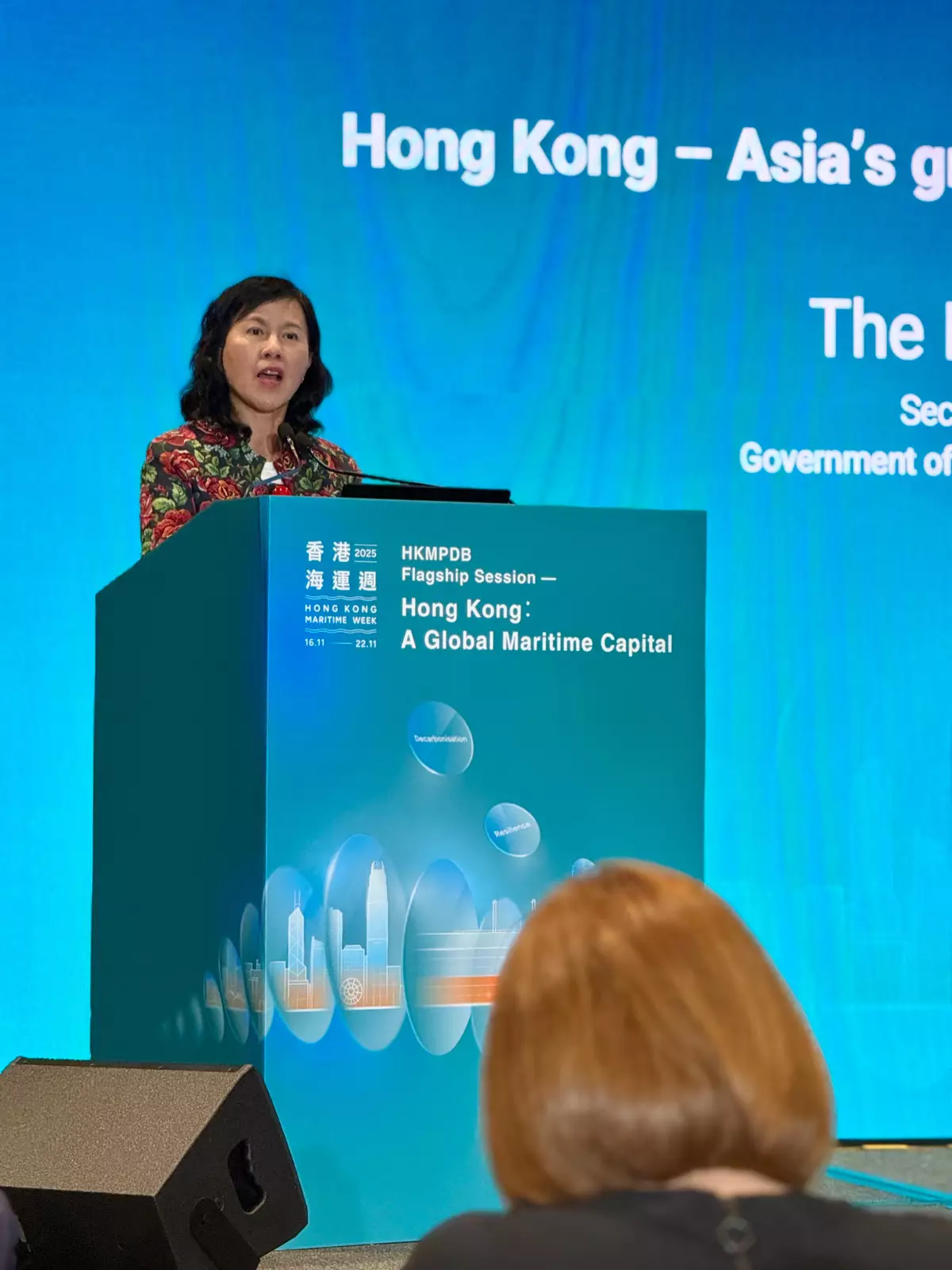
Speech by STL at Hong Kong Maritime and Port Development Board Flagship Session Source: HKSAR Government Press Releases